
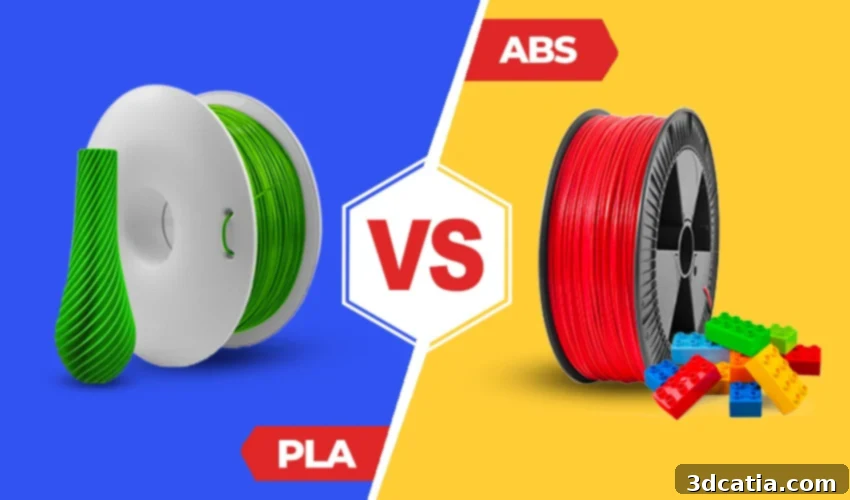
PLA vs ABS for 3D Printing: A Comprehensive Guide to Choosing Your Filament
Choosing the right polymer for 3D printing can be a challenging task, especially for newcomers or hobbyists exploring the vast possibilities of FDM/FFF 3D printing. The market is saturated with various filament types, each boasting unique characteristics and ideal use cases. While we’ve previously delved into the differences between PLA and PETG, today we turn our attention to two of the most popular and widely used filaments in the additive manufacturing world: Polylactic Acid (PLA) and Acrylonitrile Butadiene Styrene (ABS). Both materials have carved out significant niches, but understanding their fundamental similarities and differences is crucial for selecting the best filament for your specific needs. This in-depth comparison will cover everything from their inherent properties and printing requirements to post-processing techniques and suitable applications, empowering you to make an informed decision for your next 3D printing project.
Understanding PLA and ABS: Core Characteristics and Properties
At their most basic level, both PLA and ABS are thermoplastics. This means they are polymers that can be repeatedly softened by heating and then solidified by cooling, making them ideal for fused deposition modeling (FDM) where material is extruded in a molten state. However, beyond this fundamental similarity, their compositions, origins, and resulting properties diverge significantly, influencing their performance and environmental impact.
Material Composition and Origins
The primary distinction between PLA and ABS lies in their source materials. PLA, or Polylactic Acid, is renowned for its organic origins. It is typically derived from renewable resources such as fermented plant starch, commonly sourced from corn, cassava, maize, sugarcane, or sugar beet pulp. The sugars extracted from these plants undergo a fermentation process to produce lactic acid, which is then polymerized into the polylactic acid granules used to create filament. This plant-based origin is a significant selling point, contributing to PLA’s reputation as a more environmentally conscious material.
In stark contrast, ABS, or Acrylonitrile Butadiene Styrene, is a synthetic polymer derived from petroleum, similar to many standard plastics. It is a terpolymer, meaning it’s composed of three distinct monomers: acrylonitrile, butadiene, and styrene. Acrylonitrile is a synthetic monomer produced from propylene and ammonia. Butadiene is a petroleum hydrocarbon known for imparting rubber-like properties, contributing to ABS’s impact resistance and toughness. Styrene is derived from the dehydrogenation of ethylbenzene, providing rigidity and gloss. The petrochemical basis of ABS inherently makes it less sustainable than PLA in terms of its raw material sourcing.
Environmental Impact and Sustainability
The source materials directly influence the perceived environmental footprint of each filament. PLA is frequently praised as an environmentally friendly material due to its biodegradable nature. It is indeed compostable, but it’s crucial to understand the nuances of this claim. PLA typically requires specific conditions for proper biodegradation, often involving industrial composting facilities with controlled temperature, humidity, and microbial activity. Many municipal composting programs lack the necessary infrastructure to effectively break down PLA, meaning that in typical landfill environments, it may persist for extended periods, similar to conventional plastics. While its renewable resource origin certainly makes it a “greener” option than petroleum-based plastics, its disposal presents challenges that are not always widely understood.
ABS, being a petroleum-derived plastic, is generally not considered a sustainable or environmentally friendly material in its production. The energy-intensive processes involved in extracting and refining petroleum, coupled with the non-renewable nature of its source, contribute to a higher carbon footprint compared to PLA. However, ABS does offer a redeeming quality: it is recyclable. While not universally accepted by all recycling centers due to variations in plastic sorting technologies, ABS parts can theoretically be re-processed and repurposed. For individuals aware of the limitations of PLA’s biodegradability, the recyclability of ABS, even if not widely available, might be seen as a more reliable disposal pathway, potentially leading to less waste in landfills if proper recycling channels are utilized.
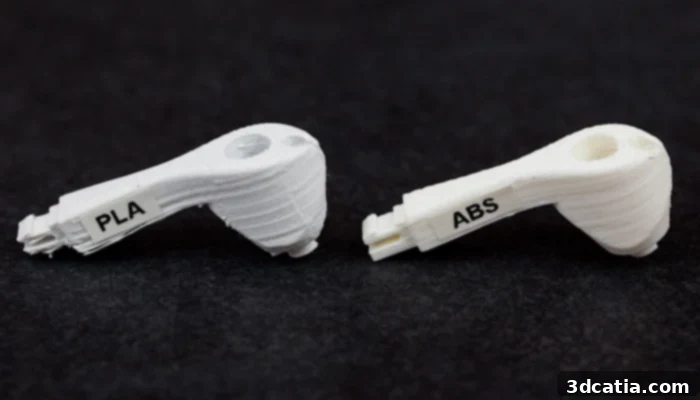
Parts 3D printed with PLA vs ABS have differences in both their appearance and properties, as can be seen above (photo credits: Fictiv).
Thermal and Mechanical Properties Compared
Beyond their origins, PLA and ABS exhibit distinct thermal and mechanical properties that significantly impact their suitability for various applications. One of the most critical differences is their heat resistance. ABS boasts superior heat resistance and a higher glass transition temperature (Tg), the point at which an amorphous polymer transitions from a hard, glassy material to a softer, rubbery material. This property makes ABS ideal for parts that will be exposed to elevated temperatures or require dimensional stability in warmer environments. Conversely, PLA has a much lower melting point and a lower Tg, typically around 60°C. This means PLA parts can deform or soften significantly when exposed to even moderate heat, limiting their use in high-temperature applications.
In terms of mechanical performance, ABS generally surpasses PLA when it comes to toughness, durability, and impact resistance. Its butadiene component contributes to a degree of elasticity, allowing ABS to bend and absorb impact without fracturing. This results in parts that are more resilient, lighter, and better suited for functional components subjected to mechanical stress. While both materials have comparable tensile strength (ABS is often slightly lower but can be reinforced), ABS truly shines in applications demanding improved ductility—the material’s ability to deform plastically under tensile stress without breaking—as well as higher flexural strength and greater elongation before breaking. Essentially, ABS is considerably less brittle and more flexible than PLA, making it a preferred choice for robust, end-use parts. These superior mechanical properties explain why ABS is a staple in industries like injection molding for items such as LEGO bricks, automotive parts, and protective casings.
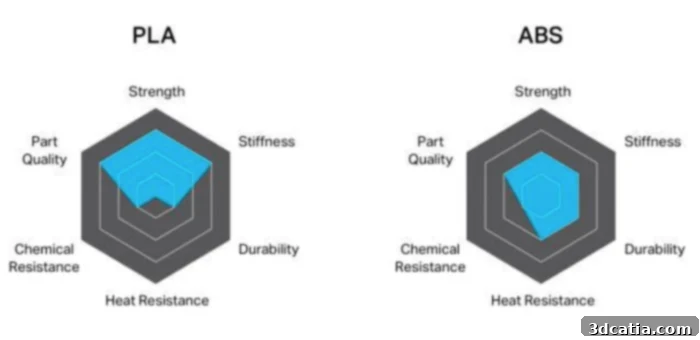
Key characteristics of PLA vs ABS summarized.
However, PLA does hold advantages in other mechanical aspects. It is notably stiffer and often perceived as stronger in terms of initial rigidity compared to ABS. This makes it suitable for parts where high stiffness and minimal flex are desired, provided they are not exposed to heat. The caveat, as mentioned, is its thermal sensitivity; PLA parts will lose these desirable properties rapidly above temperatures exceeding 50-60°C. It’s also worth noting that while ABS offers superior heat resistance, both PLA and ABS, as thermoplastics, will degrade over time when exposed to prolonged UV light and extreme heat. For outdoor applications or parts intended for continuous exposure to sunlight, alternative materials like ASA or PETG, which offer better UV resistance, might be more appropriate choices.
The 3D Printing Process: Ease of Use and Requirements
Understanding the inherent properties of PLA and ABS is only half the battle; successfully printing with them requires adhering to specific processing parameters. The differences in their glass transition temperatures significantly dictate the necessary print environment and settings, making ABS generally more challenging for beginners.
Temperature Settings: Glass Transition and Printing Temperatures
The glass transition temperature (Tg) is a critical factor for 3D printing, as it marks the temperature range at which the polymer shifts from a rigid, glassy state to a softer, rubbery state. For PLA, this range is typically between 60°C and 100°C. For ABS, it is considerably higher, ranging from 105°C to 200°C. These differences directly influence the required printing temperatures for both the print bed and the extruder nozzle.
When printing with ABS, a heated print bed is essential, typically set between 80°C and 110°C. This high bed temperature is crucial for maintaining proper adhesion and preventing premature cooling and warping of the print. In contrast, PLA requires a much lower bed temperature, usually around 60°C, and can even be printed on an unheated bed for smaller parts, though a heated bed is still recommended for optimal adhesion. For the extruder nozzle, PLA prints at a relatively low temperature range of 180°C to 230°C. ABS, due to its higher Tg and melting point, demands higher extrusion temperatures, typically between 210°C and 250°C. These elevated temperatures are necessary to ensure the material flows smoothly and bonds effectively layer by layer.
Overcoming Printing Challenges: Warping and Adhesion
The higher temperature requirements of ABS contribute to its reputation as a more challenging material to print compared to PLA. A primary difficulty arises from thermal shrinkage. Because ABS needs to be heated to a much higher temperature during extrusion, the subsequent cooling process, especially if abrupt, leads to a greater degree of material contraction. This rapid and uneven cooling can cause significant internal stresses within the print, resulting in a common problem known as warping. Warping manifests as the edges or corners of the printed part curling upwards, detaching from the build plate, and deforming the object. This can ruin a print and frustrate users.
To mitigate warping when printing with ABS, several strategies are highly recommended. Firstly, controlling the printing environment is paramount. Using a 3D printer with an enclosed print chamber is often strongly advised. An enclosure helps maintain a consistent, elevated ambient temperature around the print, slowing down the cooling process and reducing thermal gradients. Additionally, build plate adhesives such as ABS slurry (ABS dissolved in acetone), glue sticks, or specialized tapes (like Kapton tape) can significantly improve first-layer adhesion. Other techniques include printing with a brim or raft, which are sacrificial structures that increase the footprint of the first layer, distributing forces and enhancing bed adhesion. PLA, with its lower melting point and less aggressive cooling requirements, is far less prone to warping, making it a more forgiving material for open-frame printers and beginners.
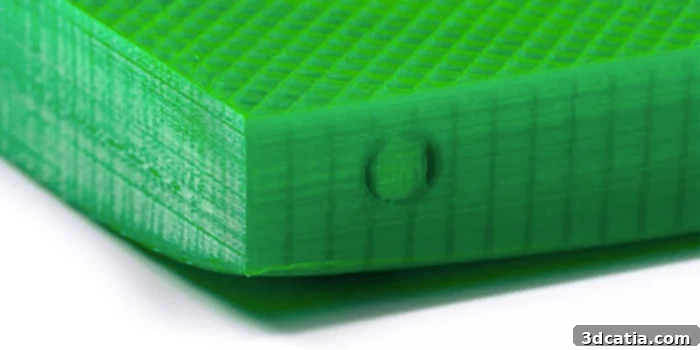
ABS tends to suffer from warping, a problem related to the shrinkage of the material under sudden temperature changes.
Print Speed and Environmental Considerations
Despite their differences in thermal properties, both PLA and ABS generally share similar recommended print speeds, which can be an advantage for users accustomed to a particular workflow. PLA typically prints effectively at around 60 mm/s, and some advanced users can even achieve higher speeds with optimized settings. ABS usually operates within a range of 40-60 mm/s. Pushing ABS to significantly higher speeds can exacerbate warping and layer adhesion issues due to insufficient heating or cooling inconsistencies.
A crucial consideration during the 3D printing process, particularly for home users or those in shared workspaces, is the emission of odors and potentially harmful fumes. Like most thermoplastic filaments, heating the material releases volatile organic compounds (VOCs) and ultrafine particles (UFPs). However, the nature and intensity of these emissions vary significantly between PLA and ABS. PLA, being derived from natural, plant-based sources, emits very little odor during printing, and the fumes are generally considered benign. It’s still advisable to ensure adequate ventilation, but it’s not a primary concern for most users.
ABS, on the other hand, is notorious for emitting strong, unpleasant odors and potentially toxic gases, especially styrene, which is one of its constituent monomers. Styrene is known to be irritating to the respiratory system and eyes, and prolonged exposure is not recommended. This is a major reason why printing ABS in an enclosed chamber with proper ventilation and an air filtration system (ideally with activated carbon filters) is strongly recommended. Continuous room ventilation, even with an enclosure, is advisable to ensure that any residual fumes do not accumulate in the workspace and pose health risks. Prioritizing safety and air quality is paramount when working with ABS.
To gain further insight, we consulted with industry professionals. Luke Taylor, Marketing Manager at Polymaker, aptly summarizes the practical differences: “PLA is a weaker material but the advantage is that it is very easy to work with, it prints very easily. You do not need a heated bed, you do not need high temperatures, it has very low shrinkage rates, whereas ABS has a very high shrinkage rate. And it makes sense, generally speaking we see that the better the mechanical properties, the harder it is to work with. Though we can also add things to PLA to make it stronger without changing the printability.” This expert perspective reinforces the trade-off between printability and mechanical performance.
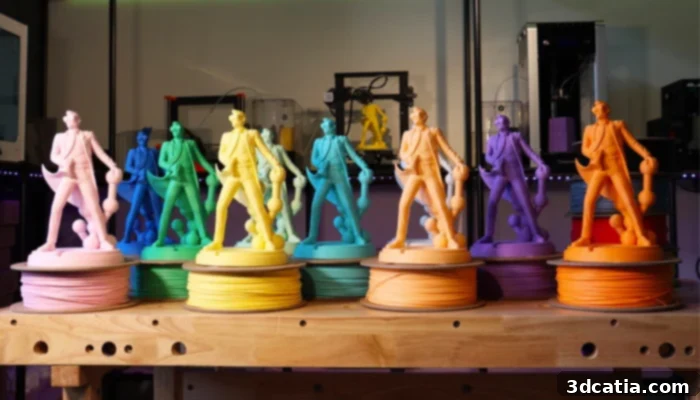
Figures 3D printed with PLA filament from Polymaker (photo credits: Polymaker).
Post-Processing Techniques for PLA and ABS
Once a part is 3D printed, the next step often involves post-processing to achieve the desired finish, dimensional accuracy, or enhanced aesthetics. While many post-processing techniques can be applied to both PLA and ABS, there are key differences dictated by their material properties.
Surface Finish and Basic Treatments
One immediate difference noticed after printing is the typical surface finish. PLA parts often emerge from the printer with a somewhat shinier, sometimes glossy appearance, which many users find aesthetically pleasing for decorative items. ABS, conversely, tends to produce parts with a more matte finish. Both materials are receptive to painting, allowing for customization and adding color to printed objects. Sanding is a common method for smoothing layer lines and refining surfaces, and it is applicable to both filaments. However, the process is generally easier and more forgiving with ABS due to its inherent durability and higher heat resistance. PLA, being softer and having a lower melting point, can be more challenging to sand; excessive friction can generate enough heat to soften or even melt the surface, leading to smearing or uneven finishes. Machining operations, such as drilling or tapping, are also possible with both, but users must exercise greater care and use lower speeds with PLA to prevent heat buildup and material deformation.
Advanced Smoothing and Finishing Methods
Where ABS truly gains an advantage in post-processing is its compatibility with chemical vapor smoothing. For a truly smooth, glossy, and professional finish, ABS parts can be exposed to acetone vapor. Acetone, a colorless liquid commonly used as a solvent, reacts with the surface of ABS, gently melting and redistributing the plastic to eliminate layer lines and create a seamless, injection-molded like appearance. This method is incredibly efficient for achieving high-quality finishes and significantly reduces the time and effort compared to manual sanding. It is important to note that acetone cannot be used with PLA, as PLA is not soluble in acetone.
For those seeking a similar vapor smoothing effect for PLA parts, alternative solvents are available, though they are often less accessible or more challenging to work with. Tetrahydrofuran (THF) is one such solvent that can be used for hand polishing or even vapor smoothing with PLA filament parts. However, THF is a potent chemical and requires careful handling in a well-ventilated area with appropriate personal protective equipment. While chemical smoothing is possible for both, the ease and effectiveness of acetone vapor smoothing for ABS make it a standout feature for producing aesthetically superior and functional parts.
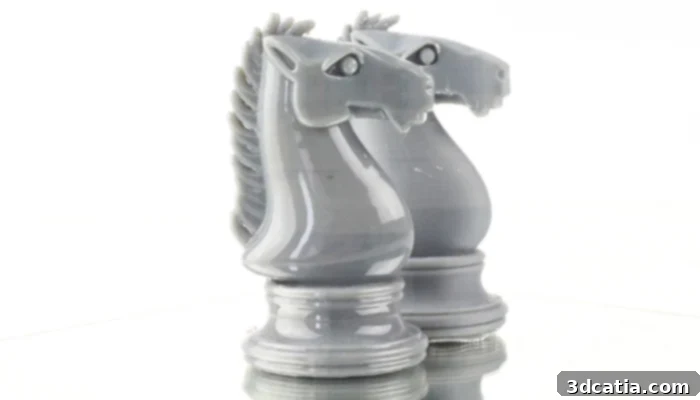
These finished parts have a glossy finish thanks to acetone smoothing (photo credits: Zortrax).
Diverse Applications of PLA and ABS
The distinct characteristics and printing requirements of PLA and ABS naturally lead them to be favored for different types of applications. Understanding these typical use cases is essential for matching the right material to your project’s functional demands.
PLA stands as the most widely used material in FDM 3D printing, particularly popular in the maker community, educational settings, and for novice users. Its ease of printing, low warping tendency, and minimal odor make it incredibly approachable. However, its mechanical properties—being relatively brittle, weaker than ABS, and highly sensitive to sunlight and high temperatures—limit its suitability for demanding functional parts. Consequently, PLA is often chosen for decorative elements, artistic models, toys, educational aids, prototypes for fit-testing, and general proof-of-concept models. It excels in applications where aesthetics, ease of production, and cost-effectiveness are prioritized over extreme durability or performance in harsh environments.
Conversely, ABS is considered a more industrial-grade material, offering advanced mechanical and thermal properties that make it suitable for more demanding applications. Despite its more challenging printing process, the resulting parts boast superior qualities such as high impact resistance, greater ductility, and excellent heat deflection. This makes ABS an ideal choice for developing functional prototypes that will undergo testing, robust gears, jigs, fixtures, and tooling components. It is frequently implemented in situations where parts are likely to be subjected to physical stresses, impacts, or elevated temperatures, requiring high mechanical and thermal resistance. Examples include enclosures for electronic devices, automotive interior components, durable consumer goods, and even structural elements in some non-critical assemblies. Before embarking on an additive manufacturing project, a careful assessment of the intended use and environmental conditions the part will encounter is crucial for selecting between these two fundamentally different materials.
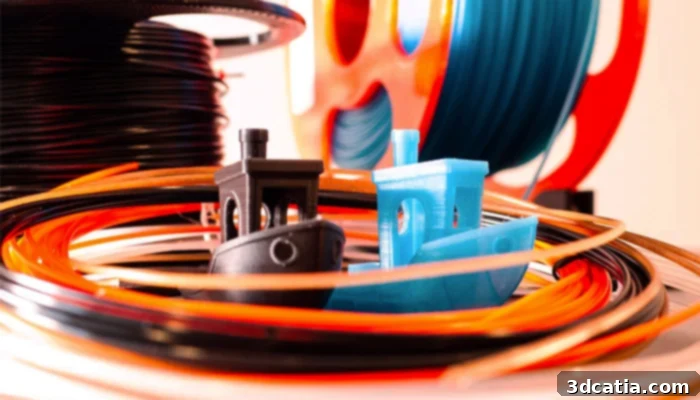
PLA is typically used for more maker applications, decorative elements, and toys. On the other hand, ABS can be used for applications where higher mechanical and thermal resistance is required.
Cost-Effectiveness and Market Pricing
When comparing the cost of PLA and ABS filaments, it’s often surprising to find that there is functionally very little difference in their typical retail prices for a standard 1kg spool. The price tends to vary more significantly based on factors such as the specific manufacturer, brand reputation, filament quality, and any special additives or colors, rather than the base material type itself.
Manufacturers play a significant role, particularly in systems where 3D printers operate with a closed filament ecosystem. In such cases, only filaments made or approved by the printer manufacturer can be used. This strategy is often implemented to ensure quality control and optimize print performance, but it can sometimes lead to higher prices for both ABS and PLA filaments within that specific ecosystem, though their relative prices to each other usually remain similar. Generally, a basic 1kg spool of both PLA and ABS filament typically starts around $18, with the average price for a good quality, standard filament roll often hovering around $20 to $30. Naturally, if you seek higher-performance filaments, specialized colors (e.g., silk, glow-in-the-dark), or professional-grade engineering blends (e.g., carbon fiber-reinforced, temperature-resistant), the price can increase substantially.
While PLA is arguably the most widely used and popular 3D printing filament, leading to a broader array of colors, blends, and options being readily available from almost every material and 3D printer manufacturer, ABS filament still maintains a strong presence. Despite slightly less market variety compared to PLA, ABS is extensively supported. Interestingly, there’s a distinction in pricing when considering the raw material form. As one of the most popular industrial plastics globally, used in massive quantities for products like LEGO bricks, ABS is often less expensive as a raw material (pellets) before it is processed into filament form. While this difference usually doesn’t impact FDM users buying pre-spooled filament, it can be a significant factor for industrial users who process raw polymer pellets, where ABS might offer a cost advantage over PLA.
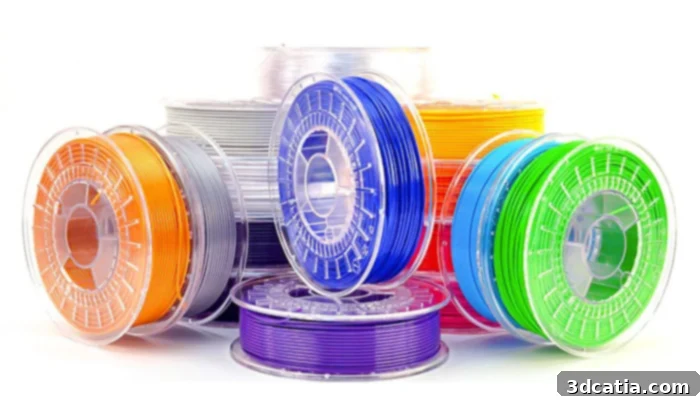
Photo Credits: ColorFabb.
Leading Manufacturers in the 3D Printing Filament Market
The additive manufacturing market thrives on innovation, particularly in materials development. Given FDM 3D printing’s widespread adoption by both enthusiastic beginners and industrial enterprises, the demand for high-quality thermoplastic polymer filaments is substantial, leading to a diverse ecosystem of manufacturers.
Due to its popularity and ease of use, the market for PLA filament is exceptionally vibrant and extensive. Hundreds of different brands, offering a vast spectrum of colors, blends, and specialized formulations (e.g., wood-filled, metal-filled, silk-like), are available. Renowned material manufacturers exclusively dedicated to filament development include companies like Polymaker, ColorFabb, Filamentum, MatterHackers, Prusament (from Prusa Research), and eSUN, among many others. These companies often innovate with unique PLA blends that enhance properties like toughness or heat resistance, effectively bridging some of PLA’s traditional weaknesses while maintaining its printability.
While the supply of ABS filament might be slightly smaller in terms of sheer variety compared to PLA, it is still robustly supported by a significant number of manufacturers. Many companies that produce PLA also offer ABS, recognizing its importance for functional and industrial applications. You will find familiar names such as Polymaker, Hatchbox, Filamentum, and eSUN offering high-quality ABS options. Furthermore, it’s crucial not to overlook the role of 3D printer manufacturers themselves. While their primary business is hardware, many develop and sell their own branded filaments, often optimized for their specific machines to ensure optimal performance and quality. Prominent examples include Ultimaker, Zortrax, and Flashforge, who offer ABS filaments alongside their PLA offerings, often with specific profiles pre-tuned for their printer models.
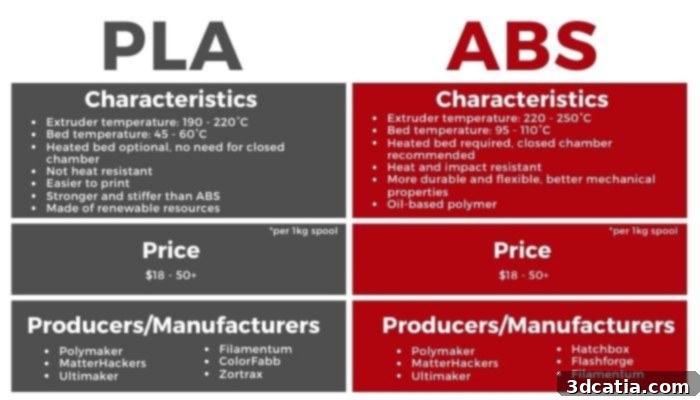
A comprehensive comparison between PLA and ABS (image credits: 3Dnatives).
Choosing Your Filament: A Final Look
The decision between PLA and ABS ultimately hinges on the specific requirements of your 3D printing project. If you are a beginner, prioritizing ease of use, or creating decorative objects, prototypes for fit-testing, or models that won’t experience significant stress or heat, PLA is an excellent choice. Its forgiving nature, minimal odor, and good aesthetic finish right off the print bed make it ideal for learning and casual printing. However, if your project demands durability, high impact resistance, thermal stability, and the ability to withstand mechanical loads, ABS becomes the superior option. While it presents a steeper learning curve due to its printing requirements and fume emissions, the resulting parts offer robust functional performance that is indispensable for industrial applications, durable consumer goods, and components in challenging environments.
Conclusion
Both PLA and ABS have earned their places as foundational filaments in the world of FDM 3D printing, each with a unique set of advantages and limitations. PLA excels in accessibility, user-friendliness, and its renewable origins, making it a favorite for educational, hobbyist, and decorative applications. ABS, conversely, offers unparalleled mechanical strength, ductility, and heat resistance, positioning it as the go-to material for functional prototypes and end-use parts requiring robust performance. By carefully weighing your project’s needs against the detailed comparison of their characteristics, printing processes, post-processing options, and typical applications, you can confidently select the filament that will bring your 3D printing vision to life most effectively.
What are your thoughts on PLA vs ABS? Do you have a preferred material, or perhaps tips and tricks for printing with one over the other? We’d love to hear your experiences in a comment below or on our LinkedIn, Facebook, and Twitter pages! Don’t forget to sign up for our free weekly Newsletter here to receive the latest 3D printing news straight to your inbox! You can also find all our videos on our YouTube channel.