

Beyond the Lens: Exploring Photogrammetry’s Power and Its Transformative Role in 3D Printing
Photogrammetry stands as a fascinating and indispensable technology in our increasingly digital world. At its core, it’s a scientific method for deriving reliable, precise 3D data from real-world objects and environments simply by analyzing a series of photographs. This innovative technique transforms multiple 2D images, taken from various perspectives and with sufficient overlap, into a comprehensive 3D digital model. Unlike traditional scanning methods that might be limited by object size or accessibility, photogrammetry excels at capturing vast landscapes, entire buildings, or intricate objects that would otherwise be impractical or impossible to digitize. Its unparalleled ability to generate detailed topographic maps, intricate point clouds, and robust 3D models has made it a cornerstone for professionals in diverse fields such as surveying, architecture, civil engineering, and archaeology, providing invaluable insights and data for planning, analysis, and preservation.
The impact of photogrammetry is particularly profound in topography and geospatial mapping. When juxtaposed with classical topographical instruments and techniques, photogrammetry offers a myriad of advantages that streamline data collection and enhance accuracy. It dramatically accelerates the data acquisition process, making it significantly faster and more agile, especially for expansive or complex terrains. Furthermore, the advent of drone technology has revolutionized photogrammetry, enabling access to challenging or perilous locations that are inaccessible by traditional means. Drones equipped with high-resolution cameras can effortlessly navigate over mountainous regions, dense forests, or hazardous industrial sites, continuously mapping every nuance of the terrain. This continuous, detailed mapping capability ensures that every feature, from subtle elevation changes to intricate geological formations, is precisely captured and rendered in a digital format, offering a complete and dynamic overview of the environment.
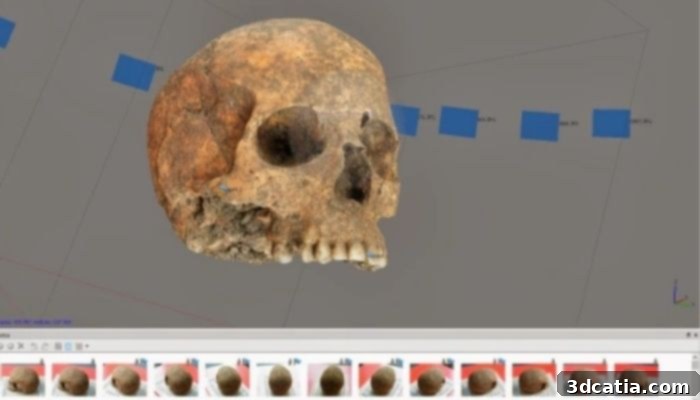
One of the uses of photogrammetry is in the world of archaeology (photo credits: PAR – Archaeology and National Heritage)
Photogrammetry’s Intricate Workflow: From Photos to 3D Models
The process of transforming a collection of photographs into a detailed 3D model is both sophisticated and remarkably accessible. It begins with capturing a series of high-quality images of the target object or scene from multiple angles, ensuring significant overlap between consecutive shots. Consistency in lighting conditions is paramount to achieving optimal results, as variations can introduce unwanted artifacts or inaccuracies into the final model. Once the photographs are acquired, specialized photogrammetry software takes over. This software employs advanced algorithms to meticulously analyze each image, identifying unique “key points” or distinctive features that appear across several photographs. By triangulating the positions of these common points in 2D space from different camera perspectives, the software can accurately determine their corresponding 3D coordinates.
A critical aspect of this process involves leveraging the stereoscopic effect. Just as our brains infer depth from two slightly different views provided by our eyes, photogrammetry software can reconstruct the third dimension by analyzing the parallax shift between corresponding points in a pair of overlapping photographs. This principle is further enhanced by considering factors like shadows cast by objects, allowing the software to infer height and depth with remarkable precision. This meticulous spatial analysis culminates in the creation of a dense “point cloud”—a collection of millions of individual data points, each representing a specific XYZ coordinate in 3D space. This point cloud is the raw, digital blueprint of the captured object or environment, faithfully replicating its geometry and contours.
Following the generation of the point cloud, the next crucial step in the photogrammetry workflow is the conversion of these discrete points into a continuous, solid surface—a process known as meshing. The software intelligently connects adjacent points to form a polygonal mesh, typically composed of triangles, which defines the object’s surface geometry. This mesh can then be textured using the original photographs, applying the visual information (colors and patterns) onto the 3D model, resulting in a highly realistic and visually accurate digital replica. Before being ready for applications like 3D printing, the resulting mesh often undergoes a series of post-processing steps. These may include cleaning up noise, filling small holes, smoothing surfaces, and simplifying the mesh to optimize it for various downstream uses, ensuring a watertight and printable model.
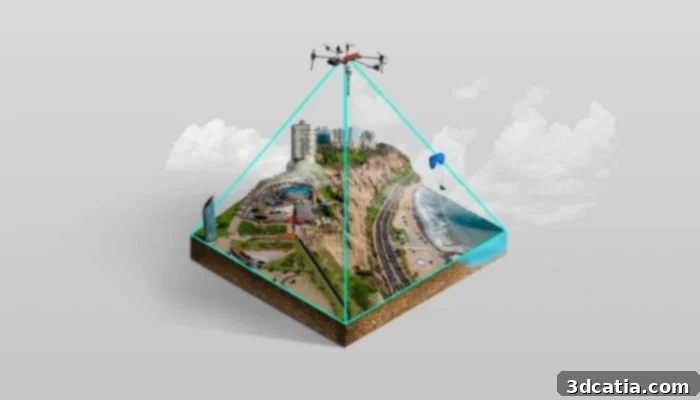
Photogrammetry carried out with drones (photo credits: Geomatic)
The Symbiotic Relationship Between Photogrammetry and 3D Printing
In an era defined by digital fabrication, the synergy between photogrammetry and 3D printing has opened up an expansive realm of possibilities across numerous industries. While many 3D scanning techniques exist, photogrammetry stands out due to its remarkable accessibility and cost-effectiveness. In its most basic form, one can embark on a photogrammetry project with nothing more than a smartphone camera and a personal computer, democratizing 3D scanning for hobbyists, artists, and small businesses alike. However, it’s essential to acknowledge that while image acquisition can be simple, the subsequent processing often demands significant computational power. Professional-grade photogrammetry software typically requires a robust computer equipped with a powerful CPU, ample RAM, and a dedicated GPU to efficiently process hundreds or thousands of high-resolution images and render complex 3D models within a reasonable timeframe.
The applications of photogrammetry in conjunction with 3D printing are incredibly diverse and continually expanding. One common and visually compelling use is the digital preservation and replication of artistic sculptures and historical artifacts. Imagine digitizing an ancient statue with unparalleled detail using photogrammetry, creating a perfect 3D model that can then be scaled down for miniature replicas or reproduced at full scale for museum displays or educational purposes. This not only aids in conservation efforts by creating digital archives but also makes art and history more accessible to the public.
Beyond art, photogrammetry is a game-changer in industrial design and reverse engineering. Consider the scenario of a broken or missing component from a piece of machinery or equipment, for which original parts are scarce or prohibitively expensive. This is a prevalent issue in specialized markets like classic car restoration, where bespoke or limited-run parts command stratospheric prices. Through photogrammetry, an existing original part (or even a similar component) can be meticulously scanned, capturing its exact dimensions and intricate geometry. This digital blueprint then allows for the precise replication of the part using 3D printing technologies. This method offers a cost-effective and timely solution, enabling the creation of exact copies for a fraction of the market price, extending the lifespan of valuable assets, and fostering innovation in manufacturing.
Furthermore, the medical sector is increasingly leveraging photogrammetry for highly personalized applications. For instance, in craniomaxillofacial surgery or orthodontics, detailed 3D models of a patient’s anatomy can be generated from photographs. These models are invaluable for surgical planning, custom implant design, and the creation of highly accurate prosthetics, such as facial or dental prostheses. The ability to capture human anatomy non-invasively and with high fidelity allows for tailor-made solutions that significantly improve patient outcomes and quality of life. This bespoke approach to healthcare exemplifies the transformative power of combining photogrammetry with advanced manufacturing techniques like 3D printing, moving beyond generalized solutions towards truly individualized care.
Choosing the Right Photogrammetry Software
The market for photogrammetry software is vibrant and diverse, catering to a wide spectrum of users, from casual hobbyists to seasoned professionals. The selection often depends on the project’s scale, required accuracy, and budget. On one end, there are robust commercial solutions meticulously engineered for demanding industrial, architectural, and engineering applications. These professional packages typically offer advanced features such as highly precise alignment algorithms, sophisticated meshing and texturing capabilities, robust error correction, and extensive support for various camera types and data inputs. Examples include Agisoft Metashape, RealityCapture, and 3DF Zephyr, which are often favored for their reliability and comprehensive toolsets.
Conversely, the open-source and free software community provides an accessible entry point into the world of photogrammetry. Programs like Blender, combined with add-ons like Meshroom or OpenMVG (which is itself a powerful library for MVS – Multi-View Stereo), allow users to perform sophisticated 3D reconstructions without incurring licensing costs. These tools are excellent for learning the fundamentals, experimenting with personal projects, and even achieving impressive results for non-commercial applications. All that’s typically required is a digital camera (even a modern smartphone camera suffices for many projects) to capture the necessary photographs, and a computer with sufficient processing power to handle the computations. For those with access to a 3D printer, these software solutions provide a seamless pathway to digitize an object and then bring it into the physical world as a printed model.
For those eager to dive deeper, exploring a curated list of photogrammetry programs can be incredibly beneficial. Such lists often provide comparisons of features, pricing (if applicable), ease of use, and typical applications. This allows users to make an informed decision based on their specific needs, whether they’re looking for a simple, intuitive tool for quick scans or a powerful, professional suite for high-precision industrial work. From free tools like Blender that offer incredible versatility to paid professional software like ZBrush (primarily a digital sculpting tool that can integrate with photogrammetry workflows, particularly for refining meshes) or dedicated photogrammetry suites that generate exceptionally accurate 3D models, there’s a solution for every requirement and skill level.
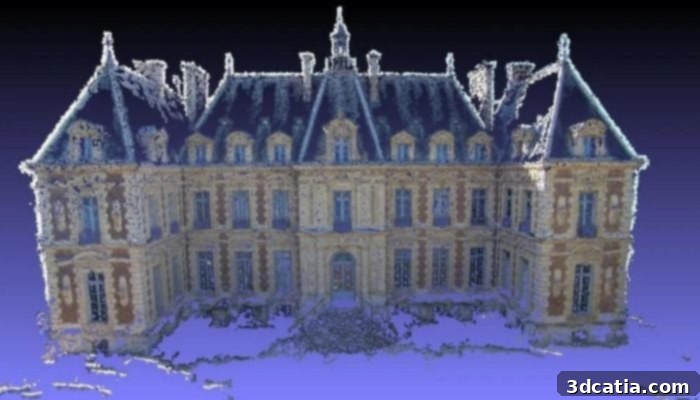
Image of a castle using the OpenMVG photogrammetry program (photo credits: Open MVG)
The Future of 3D Digitization and Fabrication
Photogrammetry continues to evolve, pushing the boundaries of what’s possible in 3D digitization. Its non-invasive nature, combined with the increasing sophistication of cameras and computing power, ensures its pivotal role in various future applications. Imagine real-time photogrammetry for dynamic scene capture, or even more seamless integration with virtual and augmented reality environments. As artificial intelligence and machine learning algorithms become more refined, they will undoubtedly enhance the automation and accuracy of photogrammetry software, making it even more efficient and user-friendly. The ability to quickly and accurately create digital twins of physical objects and environments is not just a technological feat; it’s a foundation for innovation in everything from smart city planning and autonomous vehicle navigation to personalized healthcare and sustainable manufacturing.
So, what are your thoughts on photogrammetry? Have you considered integrating it into your 3D printing projects, perhaps to replicate a cherished item, reverse engineer a mechanical component, or even design a custom prosthetic? We’re eager to hear about your experiences and perspectives! Share your comments below or connect with us on our Linkedin, Facebook, and Twitter pages. Don’t miss out on the latest advancements and news in the additive manufacturing world; be sure to sign up for our free weekly Newsletter here, delivered directly to your inbox. You can also explore a wealth of informative content and demonstrations on our YouTube channel. Join our community and delve into the fascinating intersection of 3D scanning and 3D printing!