

Peter Lang’s “Silent Orchestra”: A Groundbreaking 3D Printed Masterpiece of Acoustic Art and Sustainable Design
In contemporary spaces, the effective management of sound is paramount, transforming mere rooms into environments conducive to productivity, concentration, and enjoyment. Sound absorbers play a crucial role in achieving this, working diligently to mitigate unwanted echoes and reverberations, thereby significantly improving overall room acoustics. While their primary function is often practical, these essential elements, typically mounted on walls or ceilings, also offer an opportunity for aesthetic enhancement. Traditionally, acoustic solutions have sometimes struggled to seamlessly blend functionality with high artistic merit. However, a revolutionary project by artist Peter Lang has redefined these boundaries, giving rise to “Silent Orchestra” – a breathtaking room sculpture that functions as an advanced sound absorber, brought to life through the transformative power of 3D printing technology. This extraordinary creation, characterized by its intricate honeycomb structure composed of tubes of varying sizes, stands as a testament to the innovative potential found at the intersection of art, engineering, and sustainable design.
Peter Lang, an acclaimed painter and graphic designer, found his initial inspiration for this monumental art design in the sophisticated architectural wonders of nature: the intricate nests of wasps and hornets. These natural structures, renowned for their efficiency and organic beauty, provided the foundational concept for the “Silent Orchestra’s” unique form and function. To translate this organic inspiration into a scientifically sound acoustic solution, Lang embarked on a collaborative journey, refining his basic idea with the invaluable expertise of acoustics specialists from the Rosenheim University of Applied Sciences. This partnership ensured that the artistic vision was grounded in robust acoustic principles, guaranteeing both aesthetic appeal and practical effectiveness. For the intricate and challenging task of bringing his vision to physical reality, Lang sought the assistance of additive tectonics, a distinguished subsidiary of the FIT Additive Manufacturing Group. As a global leader and long-standing industry partner in additive manufacturing, FIT Group boasts over 25 years of experience in producing everything from high-precision prototypes and essential production aids to complex 3D-printed spare parts and advanced final components for a diverse international clientele. Their profound expertise in additive manufacturing proved indispensable for a project as ambitious and technically demanding as the “Silent Orchestra.”

Peter Lang poses next to his artwork “Silent Orchestra.” (Photo credit: FIT AG/Martin Hangen)
The Visionary Manufacturing Process: Blending Artistry with Advanced Technology
The journey from an initial concept to the commencement of production for Peter Lang’s “Silent Orchestra” was a meticulously planned and executed process that spanned a full ten months. This extensive period underscores the complexity and innovative spirit behind the project, as Lang deliberately chose a hybrid approach, merging traditional analog artistry with cutting-edge digital fabrication methods. His vision was to create a piece that resonated with both human touch and technological precision.
From Hand-Drawn Layers to Digital Precision
The first phase of this unique manufacturing process began with an intensely analog, hands-on artistic endeavor. Peter Lang meticulously deconstructed his conceptual model into 43 distinct layers. For each of these layers, he then painstakingly drew the object’s outline by hand onto vast 3 x 6 meter fleece sheets. This manual, artistic step was not merely a preliminary sketch but an integral part of the design philosophy, allowing Lang to imbue the artwork with an organic fluidity and human imperfection that would be challenging to achieve through purely digital means from the outset. It was an homage to traditional craftsmanship, laying a bespoke foundation for the subsequent digital transformation.
Following these labor-intensive analog stages, the project transitioned seamlessly into the digital realm. The hand-drawn outlines on the fleece sheets were carefully hung and arranged, then precisely photographed. These high-resolution digital images were subsequently processed and refined online, undergoing extensive digital editing. This crucial digitization process effectively transformed two-dimensional artistic renderings into a comprehensive three-dimensional digital data model. This precise digital model, capturing every nuance of Lang’s hand-drawn details, became the indispensable blueprint for the subsequent 3D printing phase, ensuring that the final physical object would perfectly embody the artist’s original vision.
Additive Manufacturing: Precision, Sustainability, and Innovation
The physical creation of the “Silent Orchestra” was executed using the classic Fused Deposition Modeling (FDM) process, a widely recognized and versatile additive manufacturing technique. This process was carried out with exceptional precision by a robotic arm, which meticulously applied the chosen material layer by layer through a finely controlled extrusion nozzle. FDM was particularly well-suited for this project due to its ability to handle large-scale objects and complex geometries, allowing for the faithful reproduction of the intricate honeycomb pattern with varying tube sizes.
A cornerstone of this project’s innovative approach was the commitment to sustainability. The material selected for the “Silent Orchestra” was Arboblend biopolymer from Tecnaro, a remarkable substance that is 100% bio-based. This choice profoundly underscores the project’s dedication to environmental responsibility, showcasing how advanced manufacturing can integrate eco-conscious material selection without compromising performance or artistic integrity. Furthermore, Peter Lang introduced unique and personal elements into the material mixture: beer, which functioned as a natural adhesive, and carefully hand-selected pigments. The addition of beer is a testament to an artisanal spirit, bringing an unconventional yet effective binder to the bio-polymer, while the pigments allowed for the artistic control over the sculpture’s final aesthetic appearance, harmonizing with its environment.
Achieving a uniform and aesthetically flawless surface on such a large and complex 3D-printed object presented significant engineering challenges. To overcome these, development engineers at additive tectonics devised and programmed a sophisticated algorithm. This intricate algorithm was designed to optimize the extruder’s pathway, ensuring that it could traverse the entire object without any undesirable overlaps or inconsistencies. This technological marvel was critical in guaranteeing the structural integrity, visual continuity, and high-quality finish of the final sculpture. After two intensive months of dedicated production, the project reached its triumphant completion. The outcome is truly exceptional: a unique work of art that masterfully combines a powerful sound absorption effect with an unparalleled aesthetic. It represents a symbiotic fusion of the finest traditional craftsmanship and the most advanced contemporary additive manufacturing technologies. For those interested in delving deeper into the specifics, additional information can be found in the official press release HERE.
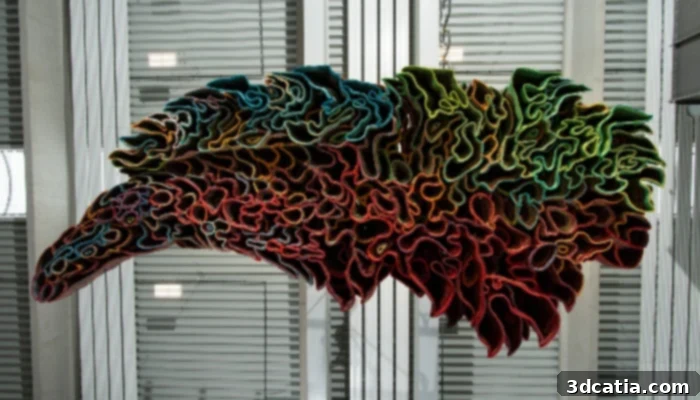
The 3D-printed room sculpture serves as an acoustic element. (Photo credit: FIT AG/Martin Hangen)
The Impact of “Silent Orchestra”: Redefining Functional Art and Sustainable Innovation
Peter Lang’s “Silent Orchestra” is far more than just a sound absorber or a piece of art; it is a profound statement on the future of functional design, where aesthetics and performance are intrinsically linked and mutually enhancing. This project exemplifies how artists, in collaboration with engineers and scientists, can leverage cutting-edge technologies like 3D printing to push the boundaries of creativity and solve real-world problems. The choice of a 100% bio-based biopolymer material not only highlights a commitment to sustainability but also pioneers the use of eco-friendly alternatives in large-scale additive manufacturing, setting a precedent for environmentally conscious production.
The “Silent Orchestra” serves as an inspiring example of biomimicry in action, demonstrating how nature’s ingeniously designed structures can inform and enhance human innovation. The honeycomb pattern, derived from wasp and hornet nests, is not merely visually appealing; it is acoustically efficient, providing an optimal surface area for sound diffusion and absorption. This intelligent design, coupled with the precision of robotic FDM printing and algorithmic control, results in an acoustic element that is both highly effective and visually captivating. Its ability to stylistically beautify a room while simultaneously improving its acoustics makes it a versatile solution for various environments, from concert halls and recording studios to modern offices and public spaces.
Moreover, the collaborative spirit underpinning this project – bringing together an artist, academic acoustics experts, and an industrial additive manufacturing powerhouse – illustrates a powerful model for innovation. Such interdisciplinary partnerships are crucial for tackling complex challenges and realizing ambitious visions that transcend the capabilities of any single discipline. The “Silent Orchestra” thus emerges as a beacon of innovation, showcasing the immense potential when artistic vision meets scientific rigor and technological prowess, all while embracing sustainable practices. It challenges perceptions of what acoustic solutions can look like and how art can serve a practical purpose without compromising its integrity or beauty.
What are your thoughts on Peter Lang’s groundbreaking 3D printed ‘Silent Orchestra?’ Do you believe functional art pieces like this represent the future of interior design and acoustic engineering? We encourage you to share your insights in a comment below or engage with us on our Facebook, Twitter, and LinkedIn pages! Don’t miss out on the latest advancements and inspiring stories from the world of additive manufacturing – sign up for our free weekly Newsletter here, delivering the freshest 3D printing news straight to your inbox every week!
*Cover photo credit: FIT AG/Martin Hangen