
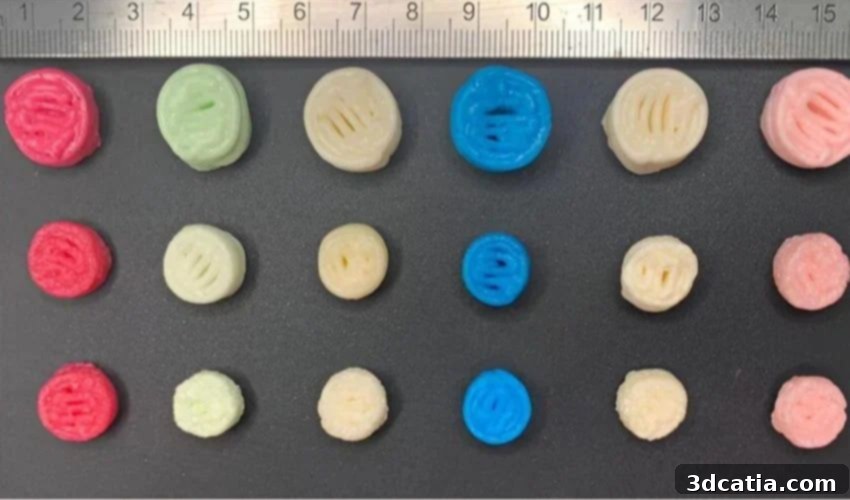
Revolutionizing Pharmaceutical Manufacturing: The Rise of 3D Printed Personalized Medication
The pharmaceutical industry is on the cusp of a major transformation, driven by the innovative capabilities of 3D printing technology. This groundbreaking approach offers customized drug solutions that promise to significantly enhance both the efficacy of treatments and the overall patient experience. Historically, the creation of bespoke medicines relied heavily on magistral preparations—a process that was not only manual and labor-intensive but also inherently prone to human error and lacked the precision desired in modern healthcare. However, 3D printing is rapidly emerging as a powerful, viable alternative, capable of overcoming these traditional limitations by enabling the production of medicines precisely tailored to the unique physiological and psychological needs of each individual patient. This shift marks a pivotal moment in drug development, moving away from a one-size-fits-all model towards a truly patient-centric approach.
A recent, highly impactful study led by Lucía Rodríguez Pombo, a dedicated researcher at the University of Santiago de Compostela (USC), has provided compelling evidence confirming the effectiveness and transformative potential of 3D printed personalized medication, with a particular focus on its application for pediatric patients. This research not only validates the technical feasibility of this technology but also highlights its critical role in addressing unmet needs within specific patient populations, especially children who often struggle with standard dosage forms and flavors. The findings underscore a significant leap forward in pharmaceutical innovation, paving the way for more adaptable and patient-friendly therapeutic solutions.
The comprehensive study, aptly titled “Clinical Implementation of 3D Printing for the Preparation of Personalized Medicines,” delves deeply into the practical application of 3D printing within a clinical context for drug manufacturing. Under the expert guidance and supervision of Professors Carmen Álvarez and Álvaro Goyanes, Lucía Rodríguez Pombo meticulously explores two cutting-edge 3D printing technologies: semi-solid extrusion (SSE) and, remarkably, for the very first time in the pharmaceutical field, volumetric 3D printing. This pioneering work aims to integrate these advanced manufacturing techniques into hospital pharmacies, thereby transforming how personalized drugs are conceived, developed, and administered. The exploration of volumetric 3D printing represents a significant scientific milestone, pushing the boundaries of what is possible in precision drug formulation.
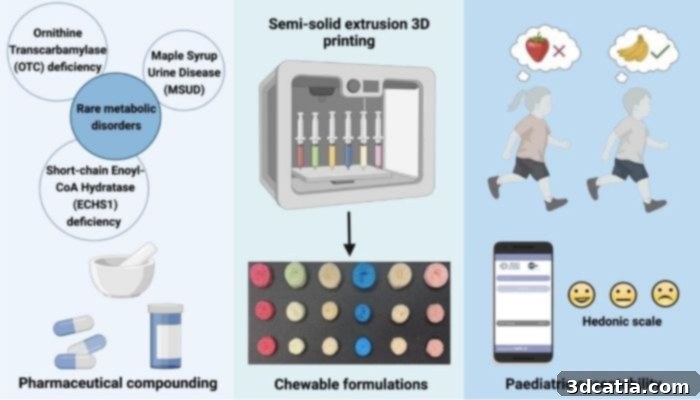
The 3D-printed drugs are designed with the patient’s needs in mind, and of course their taste preferences.
A core component of this groundbreaking study involved a rigorous evaluation of both semi-solid extrusion and volumetric 3D printing techniques for their potential implementation within hospital settings. The research particularly highlighted their exceptional capability to produce highly personalized pediatric drugs. These customized medications can be designed with specific shapes, flavors, and dosages precisely tailored to the unique requirements and preferences of each young patient. This level of customization is crucial for children, who often face challenges with traditional pill forms due to swallowing difficulties, unpleasant tastes, or rigid dosing schedules. Moreover, a significant achievement of the study was the successful integration of two different active pharmaceutical ingredients (formulations) into a single 3D-printed drug for the first time. This innovation is expected to dramatically improve treatment compliance, especially in children aged 6 to 14, by simplifying complex medication regimens and making the experience more palatable and less intimidating.
Semi-Solid Extrusion and Volumetric 3D Printing: Pioneering Pharmaceutical Innovation
The results derived from the application of both semi-solid extrusion and volumetric 3D printing techniques unequivocally demonstrate their immense potential and represent a significant stride forward in the realm of personalized medicine. The study convincingly showed that semi-solid extrusion (SSE) is an effective method for printing tablets designed to treat rare diseases, offering hope for conditions such as Maple Syrup Urine Disease (MSUD), a complex and uncommon hereditary metabolic disorder. For patients with such conditions, precisely tailored dosages and formulations are not just beneficial but often essential for managing their health effectively. SSE’s versatility also allows for the incorporation of different excipients, enabling the creation of drugs in varied forms and flavors, like gelatin or chocolate, making medication intake more appealing, especially for younger patients or those with specific taste sensitivities.
Furthermore, the integration of volumetric 3D printing into pharmaceutical development “was a milestone in the pharmaceutical field, as this technology had never before been tested for printing medicines,” as eloquently explained by Lucía Rodríguez Pombo in her doctoral thesis. This pioneering application underscores the innovative spirit of the research. Volumetric 3D printing distinguishes itself through its remarkable speed and precision, offering the capability to produce high-quality personalized drugs in a matter of seconds. Unlike layer-by-layer deposition methods, volumetric printing cures an entire volume simultaneously, which drastically reduces manufacturing time and opens new avenues for on-demand drug production directly within clinical environments. This speed is particularly critical for emergency situations or for rapidly adapting treatment plans based on real-time patient needs, thus offering an unprecedented level of agility in drug delivery.
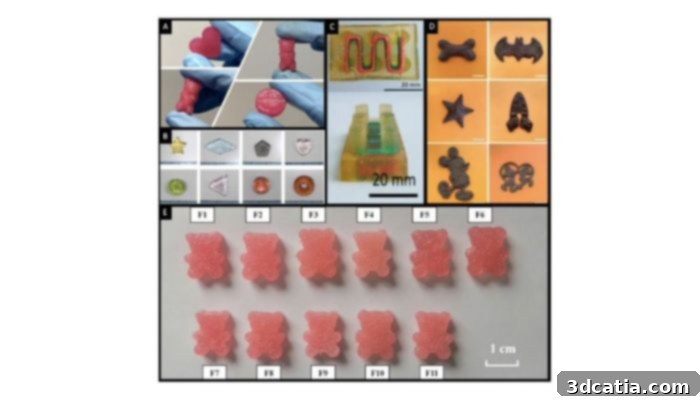
Semi-solid extrusion has been used to print drugs in a variety of forms, including gelatin and chocolate.
Beyond its focus on precise customization, the USC study marks an essential step forward in addressing the regulatory and clinical implementation challenges of 3D printing within the pharmaceutical landscape. By demonstrating the robust capabilities of technologies like semi-solid extrusion and volumetric 3D printing, this research is effectively paving the way for a new era of more efficient, adaptable, and patient-centered drug manufacturing. These innovations do more than just optimize the use of valuable pharmaceutical resources; they also significantly facilitate adherence to treatment protocols. By creating medicines that are inherently more attractive, convenient, and easier to administer—especially for young patients who often face significant hurdles with conventional dosage forms—these technologies are poised to transform the healthcare experience. The ability to tailor drug attributes like taste, shape, and size to individual preferences directly contributes to improved patient outcomes and reduced treatment discontinuation.
The comprehensive doctoral thesis also delves into the critical regulatory implications and explores the extensive opportunities for clinical integration of these advanced 3D printing technologies within hospitals. This forward-looking perspective is crucial for understanding the pathway towards their wider adoption across the global healthcare ecosystem. The research provides a blueprint for how these innovative manufacturing methods can be scaled, standardized, and ultimately brought into mainstream clinical practice, ensuring safety, efficacy, and accessibility. The journey from laboratory validation to widespread clinical use involves navigating complex regulatory frameworks, but studies like this one provide the foundational evidence needed to drive policy changes and inspire investment in future infrastructure. Ultimately, 3D printing has the potential to decentralize drug production, allowing for on-demand manufacturing at the point of care, which could drastically reduce lead times and improve access to essential medicines, particularly in remote or underserved areas.
The transformative power of 3D printing in personalized medicine extends beyond simple customization. It enables the creation of complex drug release profiles, allowing for multi-layered pills that release active ingredients at different rates or at specific times within the body. This precision can optimize therapeutic effects while minimizing side effects. Furthermore, the ability to combine multiple medications into a single polymedical pill can simplify regimens for patients with chronic conditions, reducing pill burden and further enhancing compliance. This technology also offers unprecedented flexibility for clinical trials, allowing researchers to quickly produce novel formulations and test various dosages, accelerating the drug development pipeline. The economic benefits are also substantial; by printing drugs on demand, pharmaceutical waste can be significantly reduced, and inventory management becomes far more efficient. This paradigm shift will not only benefit patients but also enhance the sustainability and responsiveness of healthcare systems worldwide. To learn more about this pioneering research and its broader implications, you can read the official press release from the University of Santiago de Compostela, available in Spanish, HERE.
What are your thoughts on this revolutionary method for 3D printing medication and its potential to reshape personalized healthcare? We invite you to share your insights and comments below, or engage with us on our LinkedIn, Facebook, and Twitter pages! For those interested in exploring more about 3D printing applications in the medical and dental fields, be sure to visit our dedicated page HERE. Don’t miss out on the latest advancements and breaking news in additive manufacturing—sign up for our free weekly Newsletter here to get all the essential 3D printing updates delivered straight to your inbox! You can also discover a wealth of engaging content by checking out all our videos on our YouTube channel.
*All Photo Credits: Lucía Rodríguez Pombo/University of Santiago de Compostela