
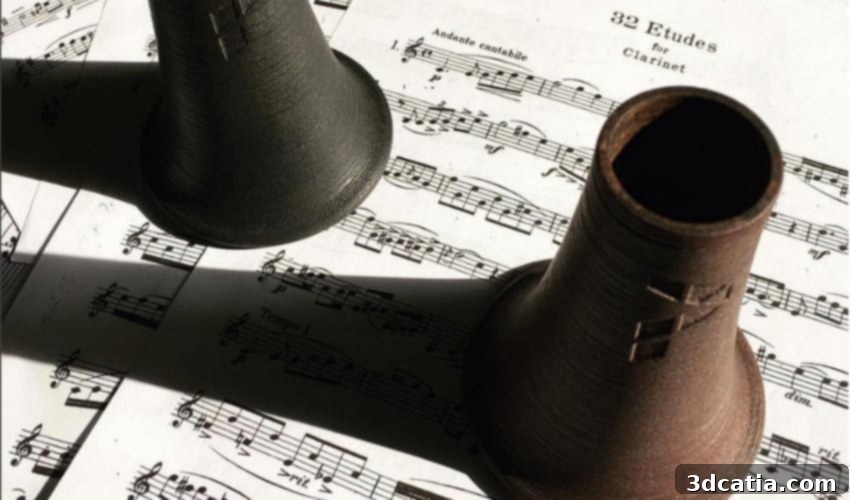
Revolutionizing Clarinet Playing: Pereira 3D’s Affordable and Sustainable 3D Printed Accessories
The allure of music is universal, yet the journey to becoming a musician often faces a significant hurdle: the prohibitive cost of acquiring and maintaining musical instruments. Instruments like the clarinet, with its intricate design and various essential accessories, can present a considerable financial barrier, deterring countless aspiring musicians from pursuing their passion. This challenge inspired Ryan Pereira, a classically-trained clarinetist with a keen eye for technological innovation. In 2014, Pereira harnessed the transformative power of 3D printing, combining it with his profound clarinet expertise, to establish Pereira 3D. His initial breakthrough was the development of an aftermarket clarinet barrel, designed to enhance performance without the hefty price tag associated with traditional components.
The integration of 3D printing technology into clarinet product manufacturing proved to be a game-changer. By leveraging additive manufacturing, Pereira 3D drastically reduced production costs, paving the way for significantly more affordable, high-quality products. A prime example of this commitment to accessibility is Pereira 3D’s acclaimed Balance Barrels. These barrels are meticulously designed with students in mind, offering exceptional performance characteristics at an astonishing price point of just $50. This stands in stark contrast to traditional, comparable clarinet barrels, which typically retail for $200 to $300 or even more, making musical excellence a luxury for many. Pereira 3D effectively democratizes access to professional-grade accessories, allowing a wider demographic to experience the joy and challenge of clarinet playing without financial strain.
The barrel of a clarinet is far more than a simple connector; it is a critical component that profoundly influences the instrument’s acoustic properties and the player’s experience. Different barrel designs and materials can yield a vast spectrum of sounds, each with distinct advantages. A barrel can shape the tone, making it somber and rich, or bright and whimsical. It can affect the focus and projection of the sound, making it more concentrated or expansive. Crucially, the barrel also dictates the blowing resistance of the clarinet, which directly impacts a musician’s comfort and control. This intricate relationship between barrel and sound means that clarinetists often seek multiple barrels to achieve specific tonal qualities or to adapt to different musical pieces and venues.
Beyond their initial performance, clarinet accessories, particularly those made from traditional materials, are subject to wear and tear. Over time, constant use necessitates frequent replacement to maintain optimal sound production and playability. This not only adds to the ongoing cost of playing but also raises concerns about material sourcing and environmental impact. Pereira 3D directly addresses these issues by championing sustainability in the production of clarinet replacement parts and repairs. The company utilizes advanced biocompatible 3D Wood materials, such as innovative blends infused with Blackwood and Mahogany – materials that emulate the acoustic properties of traditional woods but are abundantly available and sustainably produced. This approach minimizes reliance on rare hardwoods, which are often subject to ethical harvesting concerns and diminishing supply.
Pereira 3D’s product range extends well beyond just barrels. Understanding the interconnectedness of clarinet components, the company meticulously engineers and produces other vital accessories through 3D printing, including clarinet bells, mouthpieces, and ligatures. Each of these components plays a crucial role in shaping the instrument’s overall sound, intonation, and response. By offering a comprehensive suite of 3D-printed accessories, Pereira 3D ensures that musicians can outfit their instruments with high-performance, cost-effective, and environmentally conscious parts, delivering a holistic solution for enhanced clarinet playing.
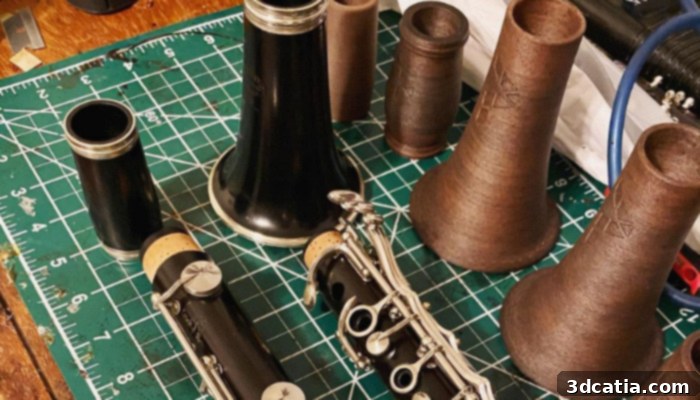
Clarinet repair services by Pereira 3D in Philadelphia, PA USA (Photo Credit: Pereira3D)
The Genesis of Innovation: Ryan Pereira and Pereira 3D Clarinet Accessories
The foundation of Pereira 3D is deeply rooted in the unique background and fervent passion of its founder, Ryan Pereira. Raised in a dynamic household teeming with engineers, Ryan was immersed in a culture of curiosity and technological exploration from a young age. This upbringing fostered an innate understanding and appreciation for cutting-edge technologies, which he would later skillfully merge with his musical calling. His early explorations into clarinet acoustics led him to seek out components capable of producing an exceptionally clear, centered, and smooth sound, a pursuit that ultimately pointed him towards the unparalleled precision and customization offered by 3D printing.
Pereira is not just an engineer by proxy; he is also an accomplished, classically-trained clarinet player. This dual expertise is critical to his success. His understanding of a musician’s needs, combined with his technical acumen, allows him to innovate from an informed perspective. His journey included a four-year apprenticeship as a clarinet repair specialist, an invaluable period that significantly deepened his expertise. During this intensive apprenticeship, he gained hands-on experience with every nuance of clarinet performance and mechanics. He meticulously experimented with various aspects, from testing different clarinet bumper materials to understanding the subtle effects of barrel tapers and the precision required for beveling clarinet cork pads. This comprehensive practical knowledge provided him with an intimate understanding of the instrument’s intricate workings, highlighting areas where traditional manufacturing methods fell short and where 3D printing could offer superior solutions.
Building upon his foundational success, Ryan Pereira systematically expanded Pereira 3D’s product line, driven by an unwavering commitment to innovation and material science. A cornerstone of this expansion has been the pioneering use of advanced 3D printed wood materials. Unlike traditional wood, which is susceptible to cracking due to changes in humidity and temperature, Pereira 3D’s proprietary wood-infused filaments offer remarkable dimensional stability, ensuring that accessories retain their precise shape and acoustic properties over time. Furthermore, these materials eliminate the tedious and often frustrating “break-in” process typically associated with new clarinet components, allowing musicians to achieve optimal performance from day one. This material innovation not only enhances durability and consistency but also significantly simplifies the user experience.
The heart of the Pereira 3D workshop lies in its sophisticated additive manufacturing setup. The facility is equipped with state-of-the-art Fused Deposition Modeling (FDM) machines, specifically the robust Zortrax M200 and the versatile Zortrax M300 Dual 3D printers. FDM technology is particularly well-suited for this application due to its ability to process a wide range of thermoplastic filaments with high precision and reliability. Pereira 3D carefully selects its printing materials to optimize both acoustic performance and structural integrity. They primarily utilize specialized wood/PLA filaments and bronze/PLA filaments. These unique composite materials enable the creation of clarinet repairs and accessories that are not only exceptionally lightweight but also incredibly durable, offering superior resilience compared to many traditional alternatives. The blend of PLA (polylactic acid) with wood or bronze particles allows for components that resonate effectively, provide excellent tactile feedback, and withstand the rigors of consistent musical practice and performance. This careful material selection and technological approach ensure that every Pereira 3D product delivers consistent, high-quality results.
After completing his rigorous academic training and earning an advanced degree in Clarinet Performance, Ryan Pereira chose Philadelphia, Pennsylvania, as the home for his visionary enterprise. In this vibrant cultural hub, he not only runs Pereira 3D but also operates a comprehensive, full-service clarinet repair shop. This establishment serves as a direct interface with musicians, allowing him to understand their evolving needs firsthand and to continuously refine his 3D-printed solutions. It’s a testament to his holistic approach: combining cutting-edge manufacturing with traditional craftsmanship and direct customer engagement to deliver unparalleled service and innovative products.
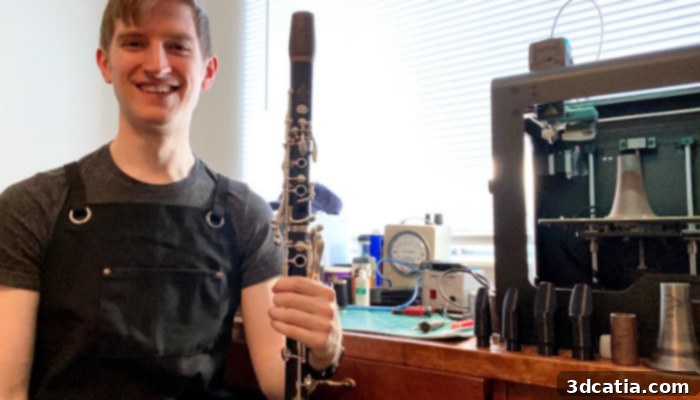
Ryan Pereira, founder of Pereira 3D. (Photo Credits: Pereira3D)
Empowering Future Musicians: The Impact on Music Education and Accessibility
The economic realities of musical instrument acquisition and maintenance extend far beyond individual enthusiasts; they significantly impact music education programs nationwide. According to research funded by the National Association of Music Merchants (NAMM) Foundation’s Sounds of Learning initiative, the average annual cost for music education can be as high as $187 per student in typical U.S. school districts. This figure, though an average, underscores the substantial financial burden placed on schools and families, often leading to cuts in music programs or limited access for students from lower-income backgrounds.
The challenge is further illuminated by organizations dedicated to fostering music education. John Gerdy, the visionary founder and CEO of the nonprofit Music for Everyone, which actively supports music education in Lancaster County, Pennsylvania, shared compelling statistics. In the spring of 2018, their instrument repair program successfully awarded $112,000 in grants, a testament to the critical need for affordable instrument upkeep. Yet, the overwhelming demand was evident as the group received requests totaling a staggering $250,000. This stark disparity between available funds and actual need highlights a systemic problem: many instruments go unplayed or are retired prematurely simply because repairs and replacement parts are too expensive.
This is precisely where the innovative application of 3D printing by companies like Pereira 3D offers a transformative solution. By significantly reducing the cost of essential clarinet components and repairs, 3D printing technology can open vast new opportunities for students who are passionate about music but are constrained by financial limitations. Affordable, durable, and readily available 3D-printed parts mean that school districts can maintain their instrument inventories more effectively, and individual students can afford to replace worn-out accessories or customize their instruments without breaking the bank. This increased accessibility can lead to more students participating in band and orchestra programs, fostering a new generation of musicians and enriching school communities. Pereira 3D is not just selling clarinet parts; it’s contributing to the broader goal of making music education a reality for everyone. You can explore more about Pereira 3D’s groundbreaking work and offerings by visiting their official website HERE.
What are your thoughts on the innovative Pereira 3D clarinet barrels and accessories? Have you experienced the benefits of 3D printing in musical instruments yourself? We invite you to share your insights and opinions in the comments section below, or engage with us on our vibrant social media platforms, including our Facebook and Twitter pages. Stay abreast of all the latest developments and breakthroughs in the world of additive manufacturing by subscribing to our free weekly Newsletter, delivering the most pertinent news in 3D printing directly to your inbox.