
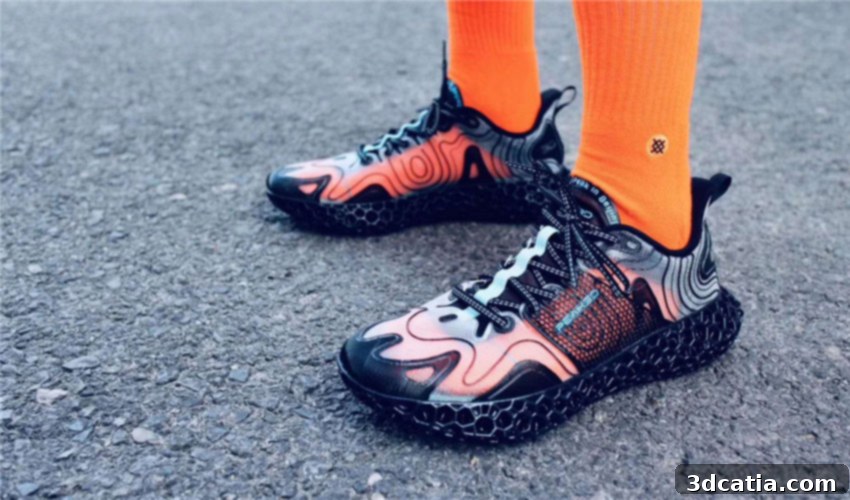
Revolutionizing Footwear: Peak Sports Unleashes Fully 3D Printed Future Fusion PEAK3D Sneakers
The landscape of sportswear innovation has witnessed a remarkable leap forward, spearheaded by the Chinese brand Peak Sports. The company recently captivated the global shoe market with the introduction of its groundbreaking sneakers, the Future Fusion PEAK3D. These aren’t just any new trainers; they represent a significant milestone in footwear manufacturing, being entirely designed and produced using cutting-edge 3D printing technologies. An initial limited run of 600 pairs, priced at approximately $190, was made available on the company’s online store, and the demand was unprecedented – they sold out in a matter of seconds. This immediate success underscores a powerful consumer appetite for truly innovative and technologically advanced athletic footwear.
What sets the Future Fusion PEAK3D apart is its comprehensive adoption of additive manufacturing. While many brands have experimented with 3D printing for specific components, particularly midsoles, Peak Sports has ventured further. Not only does this new model boast a 3D printed sole crafted using Selective Laser Sintering (SLS) technology, but its entire upper section was also fabricated through 3D printing, employing Fused Deposition Modeling (FDM) technology. This holistic approach to 3D printing in a consumer product marks a pivotal moment, showcasing the immense potential for creating lightweight, high-performance, and uniquely designed shoes.
The Evolution of 3D Printing in Footwear
For years, the intersection of 3D printing and footwear has primarily focused on the partial integration of additive manufacturing. Most frequently, this has involved the creation of intricate, performance-enhancing midsoles. Manufacturers leverage 3D printing to produce complex lattice structures that are impossible with traditional molding techniques, allowing for precise control over cushioning, energy return, and flexibility. These custom-engineered structures can be tailored to specific athletic demands or even individual biometric data, promising unprecedented levels of personalization and performance optimization.
Many prominent sportswear giants have already embraced this approach, making significant strides in bringing personalized and advanced footwear to market. Collaborations between technology firms and shoe brands have become common. For instance, the partnership between Carbon and Adidas led to the development of the Futurecraft 4D series, utilizing Carbon’s Digital Light Synthesis (DLS) technology to produce highly intricate and performance-tuned midsoles. Similarly, New Balance teamed up with Formlabs to introduce 3D printed components into models like the 990 Sport, aiming for enhanced cushioning and stability. Even before the Future Fusion PEAK3D, Peak Sports itself had delved into this market, introducing basketball shoes with 3D printed midsoles made from flexible TPU, designed to offer superior lightness and responsiveness for peak athletic performance on the court.
These initiatives have largely focused on the midsole, recognizing its critical role in shock absorption, comfort, and energy transfer. The ability to customize the density and geometry of the lattice structures within a midsole allows brands to create shoes that are truly optimized for different activities, body types, and running styles. However, the upper part of the shoe, traditionally made from textiles, leather, or synthetic fabrics, has remained largely untouched by widespread 3D printing integration – until now.
Peak Sports’ Breakthrough: The Future Fusion PEAK3D
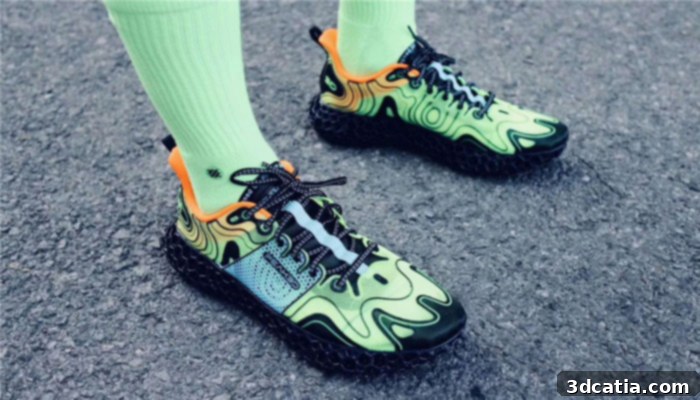
Future Fusion PEAK3D, fully 3D printed sneakers
The Future Fusion PEAK3D represents a paradigm shift, moving beyond partial 3D printing to deliver a fully additive manufactured sneaker. Peak Sports has ingeniously combined two distinct 3D printing technologies to achieve this feat, each optimized for specific parts of the shoe. For the sole, the company employed Selective Laser Sintering (SLS). SLS is a powder bed fusion technique where a laser selectively fuses powdered material (often nylon or TPU) layer by layer, building up complex three-dimensional objects. This method is particularly well-suited for creating intricate geometries and hollow structures, which Peak Sports leveraged to significant effect.
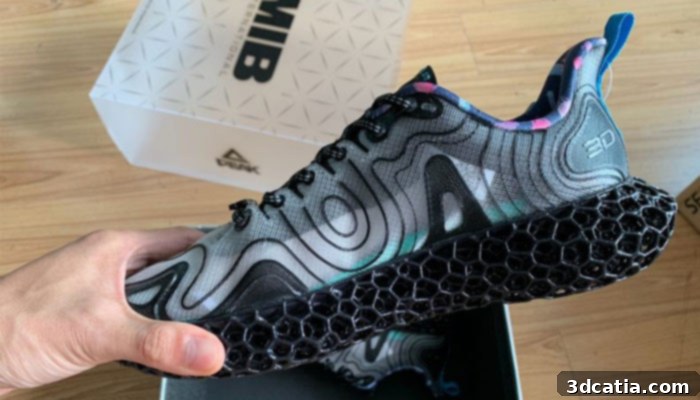
By utilizing SLS for the sole, Peak Sports was able to engineer a sophisticated hollow internal structure. This design choice is critical for several reasons: it dramatically reduces the amount of material needed, thereby cutting down on waste and raw material costs. More importantly, it results in an exceptionally lightweight sole without compromising structural integrity. According to Peak Sports, the entire Future Fusion PEAK3D shoe weighs only 250 grams (approximately 0.55 lb), a remarkable achievement for a performance sneaker. Furthermore, the carefully designed lattice within the hollow sole provides superior shock absorption, distributing impact forces more effectively and enhancing wearer comfort. The textured design also contributes to a non-slip property, offering better grip and stability, crucial for athletic endeavors.
The innovation doesn’t stop at the sole. The upper part of the trainer, which typically involves numerous pieces of fabric stitched or glued together, was also directly 3D printed. This was accomplished using Fused Deposition Modeling (FDM), a common and accessible 3D printing technology where a thermoplastic filament is heated and extruded layer by layer through a nozzle to build the object. While FDM is widely used for prototyping and functional parts, its application for an entire shoe upper, which requires flexibility, breathability, and durability, is quite pioneering.
Traditionally, brands like Voxel8 have customized shoes by creating 3D patterns or functional elements directly onto pre-existing fabric pieces that are then cut and assembled. This hybrid approach adds specific features but doesn’t replace the entire fabrication process of the upper. Peak Sports, however, apparently took the bold step of 3D printing the *entire* upper part of the shoe directly from plastic filament. This approach opens up new possibilities for seamless designs, customized ventilation patterns, and intricate aesthetic details that would be difficult or impossible to achieve with conventional manufacturing methods. It also suggests a significant reduction in waste typically generated during the cutting and assembly of textile uppers.
Market Reaction and the Future of Footwear Manufacturing
The phenomenal success of the Future Fusion PEAK3D’s limited release speaks volumes about consumer interest in technologically advanced and exclusive footwear. All 600 pairs were snapped up online within minutes, demonstrating not only the effectiveness of Peak Sports’ marketing but also a strong market demand for what 3D printing can offer in terms of innovation and performance. This rapid sell-out validates the concept of fully 3D printed sneakers and positions Peak Sports as a formidable innovator in the global sportswear industry. It signals a shift in consumer perception, where cutting-edge manufacturing processes are becoming a selling point in themselves.
This begs critical questions for the broader industry: Can filament extrusion (FDM) and powder bed fusion (SLS) technologies scale efficiently enough to meet widespread consumer demand? Will additive manufacturing entirely replace traditional shoe production processes, which rely heavily on skilled labor, sewing, and assembly lines? While current 3D printing speeds for large-scale production still lag behind conventional manufacturing for high-volume, low-cost goods, continuous advancements are being made. New generations of 3D printers are faster, more reliable, and capable of handling a wider range of materials, including flexible and durable polymers suitable for footwear. The cost per part is also decreasing as the technology matures and becomes more accessible.
The impact of 3D printing on the shoe market is poised to be transformative. It promises a future where mass customization is not just a niche offering but a standard. Imagine shoes precisely tailored to an individual’s foot shape, gait, and specific performance needs, all printed on-demand. This could revolutionize supply chains, reducing inventory, waste, and lead times. Instead of mass-producing shoes in distant factories and shipping them globally, local micro-factories equipped with 3D printers could produce footwear closer to the point of sale, offering unprecedented flexibility and sustainability benefits. This model significantly reduces the carbon footprint associated with transportation and overproduction.
Moreover, the design freedom offered by 3D printing allows for aesthetics and functional integration never before possible. Designers are no longer constrained by the limitations of cutting, stitching, and molding. They can create truly organic shapes, integrated ventilation channels, and multi-material structures within a single printing process. This opens up avenues for both unparalleled athletic performance enhancement and highly expressive, personalized fashion statements. The ongoing research into new materials, from bio-based filaments to advanced elastomers, will further expand the capabilities and applications of 3D printed footwear, making them more comfortable, durable, and environmentally friendly.
While a complete overhaul of traditional shoe manufacturing might be a distant future, a hybrid approach is more likely in the near term. This could involve 3D printing the most complex, performance-critical components (like the Future Fusion PEAK3D’s sole and upper) while integrating them with other traditionally manufactured parts. The success of Peak Sports’ Future Fusion PEAK3D serves as a powerful testament to the viability and desirability of fully 3D printed footwear, pushing the boundaries of what is possible and signaling a vibrant, innovative future for the global shoe market. The industry is watching closely, eager to see how these additive manufacturing technologies continue to disrupt and redefine how shoes are made, bought, and worn.
What are your thoughts on these fully 3D printed sneakers and their potential impact on the footwear industry? We’d love to hear your opinions. Share your insights in a comment below or join the conversation on our Facebook and Twitter pages! Don’t forget to sign up for our free weekly Newsletter to receive all the latest news in 3D printing delivered straight to your inbox and stay ahead of the curve in this rapidly evolving industry!