
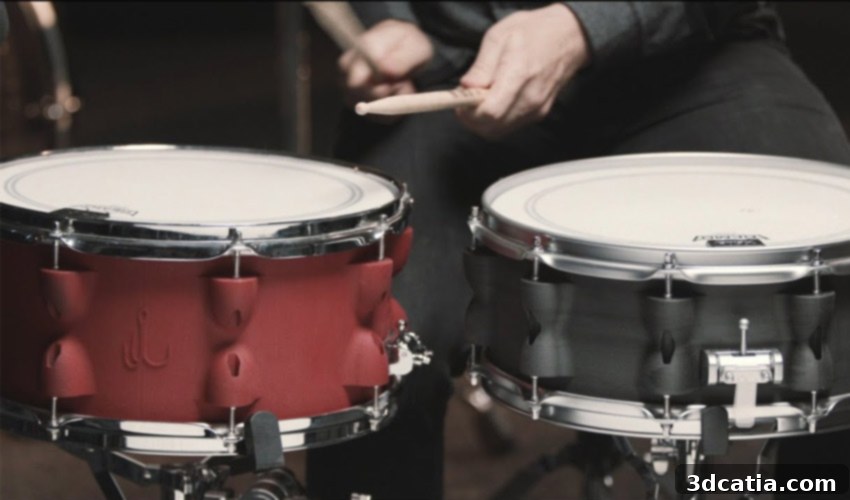
Revolutionizing Rhythm: How 3D Printing is Shaping the Future of Snare Drums
In a remarkable testament to the innovative power of additive manufacturing, Dan Pawlovich, the accomplished drummer for the internationally acclaimed band Panic! At The Disco, has pioneered a groundbreaking approach to instrument design. Pawlovich leveraged the precision and versatility of 3D printing technology to craft the body of his snare drum – the pivotal horizontal shell positioned between a drummer’s legs that produces the instrument’s signature crisp, high-pitched sound. This novel manufacturing method has not only redefined what’s possible in drum construction but has also enabled the musician to achieve a demonstrably cleaner and sharper sound quality. His ambitious project was realized through a strategic collaboration with Stratasys Direct Manufacturing, utilizing cutting-edge Selective Laser Sintering (SLS) technology. The venture proved to be an unequivocal success, as Dan has now been performing with this custom 3D printed snare drum for over eighteen months, gracing countless stages at the band’s high-energy concerts.
This innovative endeavor by Pawlovich is indicative of a broader and accelerating trend within the music industry: musicians are increasingly turning to additive manufacturing to push the boundaries of their craft. The technology offers unprecedented opportunities to innovate in terms of acoustic properties, explore intricate instrument geometries, and significantly enhance an instrument’s strength and durability. A memorable example of this robustness is the 3D printed unsmashable guitar developed by Sandvik, which famously withstood extreme abuse without breaking. For artists like Dan, 3D printing provides an invaluable platform for rapid iteration and continuous design refinement, allowing for the creation of superior instruments. This was precisely Dan’s ultimate objective: to meticulously iterate and design a snare drum that outperformed traditional models. He successfully managed to eliminate the conventional metal lugs – the small components typically used to hold the drumhead and tension rods in place. Dan explains that these metal lugs, while necessary in traditional construction, often have a detrimental impact on the precision and purity of the drum’s sound. His visionary solution was to seamlessly integrate these critical tensioning components directly into the very shell of the drum itself, a feat only achievable through the design freedom offered by additive manufacturing.

Dan Pawlovich at a concert | Credits: Jake Chamseddine
The Quest for Sonic Perfection: Dan Pawlovich’s Vision
Dan Pawlovich’s journey into 3D printed drums wasn’t merely a technological experiment; it was a dedicated pursuit of acoustic excellence. As a professional drummer, he understood the subtle nuances that contribute to a drum’s overall sound and performance. The traditional snare drum design, with its separate metal lugs, posed a challenge he was determined to overcome. These lugs are typically bolted onto the exterior of the drum shell, creating additional points of contact and vibration that can introduce unwanted resonance or dampen the purity of the drum’s tone. By integrating the tensioning mechanism directly into the drum shell, Pawlovich aimed to create a more monolithic, resonant structure, allowing the drumhead and shell to vibrate more harmoniously and freely. This integrated approach promised not only a cleaner sound but also potentially a more consistent and durable instrument, crucial for the rigors of touring. His vision was to simplify the drum’s construction while simultaneously elevating its acoustic output, an ambitious goal that conventional manufacturing methods could not easily accommodate.
Revolutionizing Instrument Design with Additive Manufacturing
The broader implications of Dan Pawlovich’s project extend far beyond a single musician’s innovative snare drum. Additive manufacturing, often known as 3D printing, is fundamentally transforming how musical instruments are conceived, designed, and produced. Its ability to create complex geometries and intricate internal structures that are impossible with traditional manufacturing techniques unlocks unprecedented creative freedom for instrument makers. This means musicians and designers can experiment with internal baffling, varying wall thicknesses, and unique acoustic chambers, all of which directly influence an instrument’s timbre, projection, and resonance. Beyond sound, the technology allows for the precise customization of ergonomics, enabling instruments to be tailored perfectly to an individual player’s body and playing style, enhancing comfort and performance. Furthermore, 3D printing facilitates rapid prototyping. A designer can create a new iteration of an instrument, print it, test it, and refine the design in a matter of days or even hours, significantly accelerating the research and development cycle compared to traditional methods that might involve lengthy and costly tooling processes. This iterative capability is invaluable for fine-tuning acoustic properties and structural integrity, as demonstrated by Pawlovich’s multiple prototypes.
Collaborating with Industry Leaders: Stratasys Direct Manufacturing
To bring his intricate vision to life, Dan Pawlovich sought the expertise of Stratasys Direct Manufacturing, a leader in additive manufacturing services. This collaboration was crucial, as fabricating such a specialized and high-performance component required not only advanced 3D printing technology but also deep knowledge in material science and engineering. Stratasys Direct Manufacturing provided the technical guidance and manufacturing capabilities needed to translate Dan’s digital designs into physical reality. Their experience with various additive manufacturing processes and materials proved instrumental in selecting the optimal technology and material for the snare drum shell, ensuring it met the demanding requirements of a professional touring musician. This partnership underscores the importance of combining artistic vision with leading-edge engineering to push the boundaries of what’s possible in instrument design.
From Concept to Concert Stage: The 3D Printing Process Unveiled
The journey from concept to a concert-ready 3D printed snare drum was a meticulous process, spanning 3.5 years of dedicated effort. Dan explains that he worked intensively with a skilled CAD (Computer-Aided Design) designer during this period, iterating through numerous virtual models before settling on a design that resonated with his acoustic and functional requirements. This extensive design phase was critical for refining every curve and cavity. Several key considerations guided the musician and his design team. Firstly, the drum body had to exhibit exceptional durability and resistance to wear and tear over time, capable of withstanding the stresses of continuous playing and the rigors of extensive touring. Secondly, and equally important, Dan Pawlovich stipulated that the 3D printed shell needed to be fully compatible with readily available, traditional drum components such as pull rods, rims, and drumheads. This ensures that these consumable parts could be easily replaced whenever they became worn out, guaranteeing the drum’s longevity and practicality for a working musician. To achieve this, the CAD design meticulously incorporated specific cavities and mounting points directly into the shell’s structure, making it effortless to attach standard drum hardware without any modifications to the traditional parts themselves. This thoughtful integration was vital for a seamless transition from traditional to additive manufacturing without sacrificing functionality or ease of maintenance.
Choosing the Right Technology: SLS, FDM, and Advanced Materials
After the extensive CAD design phase, the actual fabrication of the first prototype began. The band’s drummer specifically engaged Stratasys Direct Manufacturing’s 3D printing service, opting initially for a Selective Laser Sintering (SLS) machine. SLS is an industrial 3D printing technology that uses a high-power laser to selectively fuse small particles of polymer powder into a solid structure. This method is renowned for its ability to produce highly complex parts with excellent mechanical properties and without the need for support structures, allowing for intricate internal geometries. For the initial prototype, Nylon 12GF was selected. This advanced material is a glass-filled nylon known for its exceptional resistance to UV radiation, various weather conditions, moisture, and impact – making it an ideal choice for an instrument that would endure frequent transportation and diverse environmental conditions on tour. Following the printing process, the piece underwent essential post-processing steps, including dyeing, to achieve the distinctive red color seen in the final product. The manufacturing company didn’t stop there; they also experimented with other materials and technologies to explore different acoustic outcomes. This included utilizing Fused Deposition Modeling (FDM) technology with ABS (Acrylonitrile Butadiene Styrene) plastic. FDM is a more accessible 3D printing method where a continuous filament of thermoplastic material is extruded layer by layer to build a 3D object. While ABS offers good strength and temperature resistance, its acoustic properties differ significantly from Nylon 12GF. Each iteration, employing different materials and printing methods, produced a distinct sound profile, providing invaluable insights. This iterative approach prompted Dan Pawlovich to delve deeper into experimenting with multiple material compositions and manufacturing combinations, demonstrating the profound influence of material science on musical acoustics.
The Impact of Material and Method on Sound
The extensive material and technology experimentation led to a fascinating discovery regarding the sonic characteristics of 3D printed drums. Dan Pawlovich eloquently articulates this phenomenon, stating: “I have three cases, all the same dimensions, but made with two different 3D printing methods and three different materials. They look like completely different categories of drums.” This observation highlights a critical advantage of additive manufacturing: its capacity to fundamentally alter the acoustic signature of an instrument through precise material selection and fabrication technique. A drum printed with SLS using Nylon 12GF, with its robust and dense structure, will resonate differently than one printed with FDM using ABS, which might have different internal densities and surface finishes. The ability to fine-tune not just the physical geometry but also the material composition and internal structure opens up an entirely new dimension for instrument designers. Drummers can now, in theory, choose a material and printing process based on the desired attack, decay, sustain, and overall timbre, customizing their instrument’s sound in ways previously unimaginable. This level of sonic customization represents a paradigm shift in instrument manufacturing, moving beyond simple aesthetic choices to fundamental acoustic engineering.
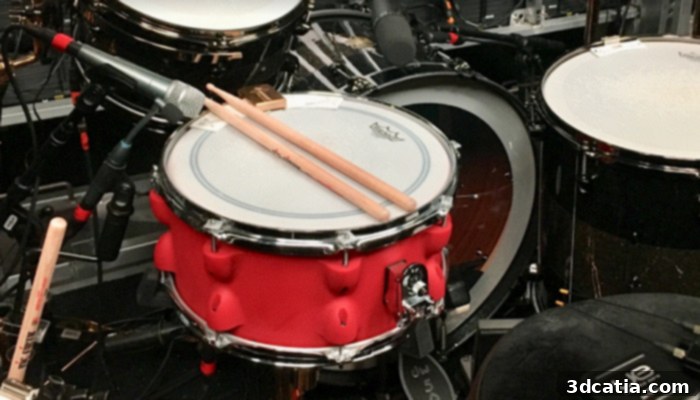
The hull of the drum was 3D printed
The Future is Now: Live Performance and Lasting Impact
The true validation of this innovative project comes from its integration into live performances. Indeed, Panic! At The Disco has seamlessly incorporated Dan Pawlovich’s 3D printed snare drum into their diverse concert repertoire, and the results have been overwhelmingly positive. Over the last year and a half, the drummer has consistently reported that the sound produced by his custom instrument is noticeably cleaner, more precise, and boasts a level of clarity that surpasses traditional snare drums. This sustained success in a high-stakes, professional touring environment unequivocally demonstrates the viability and superior performance capabilities of 3D printed musical instruments. Dan Pawlovich expresses his optimistic vision for the future, hoping that other drum makers and instrument manufacturers will embrace additive manufacturing as a standard production method. He believes that by leveraging this technology, the industry can usher in an era of better-performing instruments, offering musicians unparalleled customization, enhanced acoustics, and improved durability. This pioneering effort serves as a powerful case study, illustrating how the fusion of artistic vision and advanced manufacturing can redefine the boundaries of musical expression and instrument design. Experience the captivating sound of this innovative snare drum in action by watching the video below, and delve deeper into the project’s specifics by finding more information HERE.
Join the Conversation: Your Thoughts on 3D Printed Instruments
What are your thoughts on these innovative 3D printed snare drums and the broader impact of additive manufacturing on the music industry? We invite you to share your opinions, insights, and predictions in a comment below or join the discussion on our Facebook and Twitter pages! Stay informed about all the latest advancements in 3D printing technology and applications by signing up for our free weekly Newsletter, delivered straight to your inbox.