
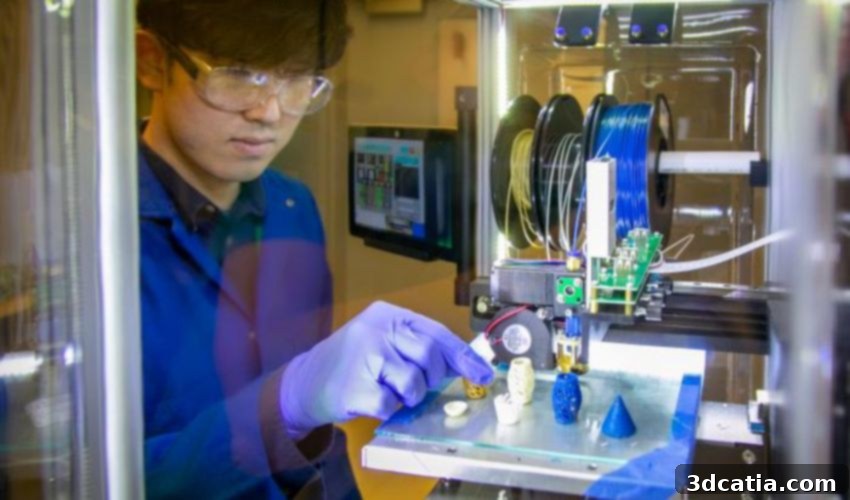
ORNL Pioneers Closed-Loop 3D Printing: Upcycling Plastic Waste for Sustainable Additive Manufacturing
In an era defined by pressing environmental challenges, the urgency of the climate crisis has propelled sustainability to the forefront of technological innovation. Nowhere is this more evident than in the dynamic field of additive manufacturing, or 3D printing. Groundbreaking research from the Department of Energy’s Oak Ridge National Laboratory (ORNL) has unveiled a transformative upcycling method, enabling the reuse of discarded plastics in Fused Filament Fabrication (FFF) 3D printing. This pioneering approach promises to establish a truly closed-loop additive manufacturing process, effectively eliminating waste and fostering a new paradigm of eco-conscious production. The ORNL team’s vision is that this readily adoptable and scalable technique will significantly contribute to a global reduction in plastic waste while simultaneously curbing carbon emissions associated with conventional plastic production.
Oak Ridge National Laboratory stands as a pivotal institution in the advancement of additive manufacturing research, particularly concerning its application in developing more effective energy policies within the USA. Their commitment to innovation has been previously highlighted by projects such as the development of 3D printed solar batteries. This latest breakthrough underscores ORNL’s dual commitment: not only to harness 3D printing for broader sustainable initiatives but also to inherently enhance the sustainability of additive manufacturing itself. The intricate details and remarkable findings of this research were meticulously documented and published in the prestigious journal Science Advances, under the article title “Closed-loop additive manufacturing of upcycled commodity plastic through dynamic cross-linking.” The esteemed authors behind this transformative work include Tominori Saito, Sungjin Kim, Anisur Rahman, Arif Arifuzzaman, and Edgar Lara-Curzio, whose collective expertise made this achievement possible.
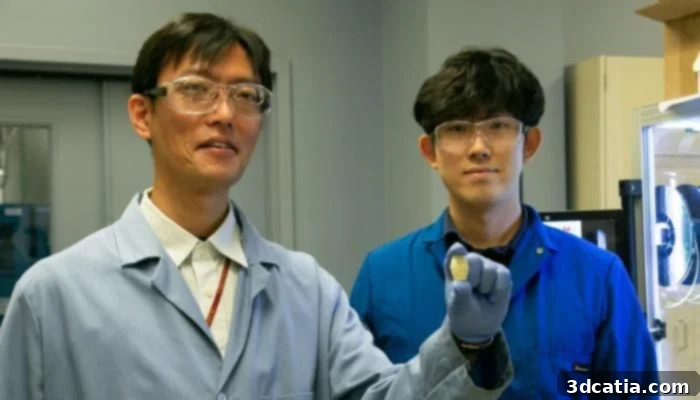
ORNL polymer scientists Tomonori Saito, left, and Sungjin Kim (photo credits: Genevieve Martin/ORNL, U.S. Dept. of Energy)
The pursuit of sustainability, particularly through the lens of a circular economy, has captivated considerable interest within the additive manufacturing industry. A circular economy represents a transformative model of production and consumption, fundamentally shifting away from the traditional linear “take-make-dispose” approach. Its core tenets revolve around reusing, repairing, and recycling products and materials for the longest possible duration, thereby minimizing waste and maximizing resource efficiency. Additive manufacturing is frequently identified as a cornerstone technology for enabling such an economy, primarily because its production methods can, depending on the specific technology employed, generate minimal to no waste. This inherent efficiency stands in stark contrast to conventional manufacturing processes, which often involve significant material removal and scrap. Tomonori Saito, the lead author from ORNL’s Chemical Sciences Division, profoundly articulated the significance of their work, emphasizing, “This effort demonstrates a closed-loop for manufacturing plastic items, potentially with higher value and performance, using only existing plastic waste in one of the most accessible areas of additive manufacturing.” This statement not only highlights the practical application of their research but also underscores its potential to elevate the utility and quality of recycled materials.
Unlocking the Mechanics: How Does Closed-Loop Additive Manufacturing Work?
At the heart of this innovative project lies the strategic enhancement of acrylonitrile butadiene styrene, widely recognized as ABS. This versatile thermoplastic is not only one of the most popular and accessible materials in the realm of 3D printing but also a ubiquitous choice for countless everyday items. From the durable construction of LEGO blocks to robust tennis balls and essential automotive components, ABS’s widespread application makes it an ideal candidate for large-scale upcycling efforts. However, a significant hurdle in conventional plastic recycling is the inherent degradation of material properties. When plastics are simply recycled into new products, they often lose critical mechanical integrity, becoming weaker, less durable, and less valuable than their virgin counterparts. This decline in performance limits the applications of recycled materials and often relegates them to lower-value uses, perpetuating a cycle where new plastics are still in high demand for high-performance applications.
Recognizing this fundamental challenge, the ORNL researchers embarked on a mission far more ambitious than mere recycling. Their objective was not only to preserve the intrinsic properties of ABS during the upcycling process but to fundamentally transform and improve them, making the resulting material even stronger and more resilient. Tomonori Saito elaborated on this visionary approach, stating, “We will need fundamental discoveries to overcome the challenges of increased costs and deteriorating material properties associated with recycling. Our goal was to develop an easily adoptable strategy that reuses plastic waste to create a more valuable material instead of generating fresh plastic.” This philosophy underscores a critical shift from simply mitigating waste to actively creating enhanced resources from existing waste streams, moving beyond the limitations of traditional recycling.
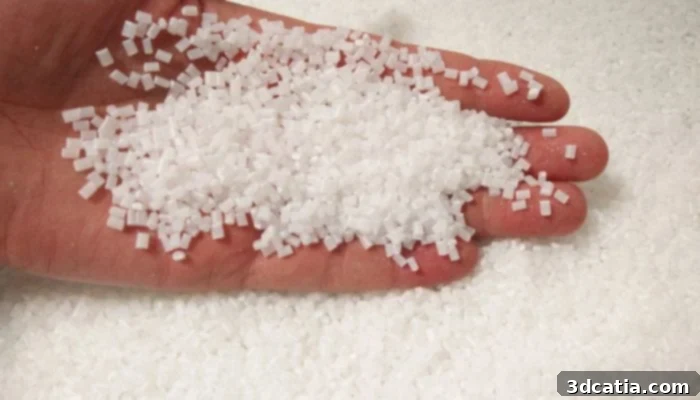
ABS, shown here in granular form, is a commonly used thermoplastic in both 3D printing filaments and everyday objects (photo credits: Jacorna, CC BY-SA 4.0, via Wikimedia Commons)
The team’s success in achieving this ambitious goal was resounding. The final results demonstrated that the upcycled ABS boasted an impressive doubling of both toughness and strength when compared to standard, virgin ABS. Beyond enhanced mechanical properties, it also exhibited superior solvent resistance, a crucial improvement for applications requiring durability in challenging environments. This remarkable transformation was orchestrated through the ingenious application of “click” chemistry. This highly efficient and reliable chemical reaction allowed researchers to precisely convert the molecular architecture of ABS into a novel material known as a virtimer. Virtimers are innovative polymers that ingeniously combine characteristics typically found in both thermoplastics and thermosets – a hybrid that conventionally presents compatibility challenges, especially within FFF processes. Essentially, this breakthrough allowed the ORNL scientists to achieve the best of both worlds: the resulting upcycled ABS virtimer retained the advantageous processability and recyclability inherent to thermoplastics, while simultaneously acquiring the superior mechanochemical properties, such as enhanced rigidity and heat resistance, commonly associated with thermosets. The creation process involved carefully mixing specific medical compounds, followed by a precise curing stage to solidify the material’s enhanced structure.
The profound implications of projects like this are immense, offering a tangible pathway toward genuinely reusing and recycling the staggering 400 million tons of plastic waste generated globally each year. Disturbingly, only a mere 10% of this colossal amount ever sees the light of a recycling facility. This innovative upcycling method offers a beacon of hope for significantly improving that dismal statistic. Dr. Sungjin Kim, another distinguished researcher on the ORNL project, encapsulated the transformative potential of their work, concluding, “Developing new, recyclable materials with superior properties for FFF creates opportunities to make a big impact on plastic production and expand additive manufacturing capabilities that have the potential to reduce our carbon footprint.” This sentiment highlights not just the environmental benefits of waste reduction and carbon emission cuts, but also the potential for advanced materials to unlock new applications and functionalities within additive manufacturing. By turning waste into a higher-performance resource, ORNL is not just tackling pollution; it’s redefining the economic and environmental value of plastic. More comprehensive information on this groundbreaking research can be found on the official ORNL website HERE.
What are your thoughts on this pioneering closed-loop additive manufacturing project from the Oak Ridge National Laboratory? We invite you to share your insights and comments below, or engage with us on our LinkedIn, Facebook, and Twitter pages! Don’t miss out on the latest advancements in 3D printing – remember to sign up for our free weekly Newsletter here, delivering the most current news straight to your inbox! Additionally, explore a wealth of informative videos on our dedicated YouTube channel.
*Cover Photo Credits: Genevieve Martin/ORNL, U.S. Dept. of Energy