
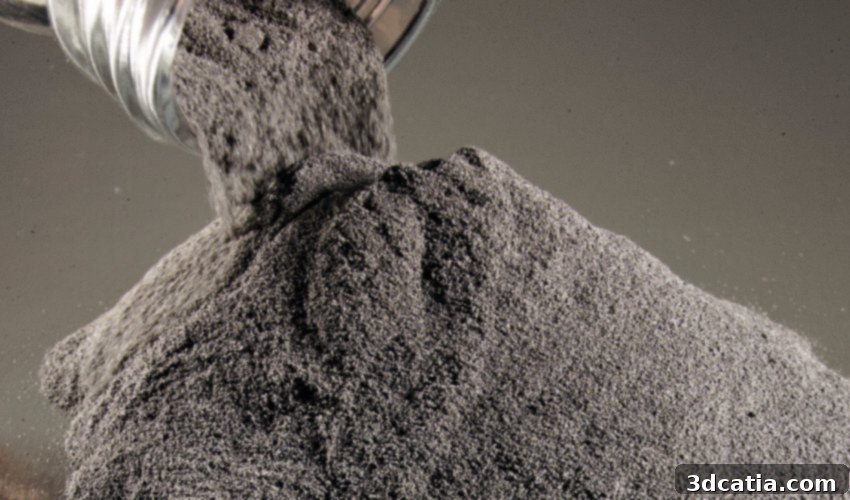
Revolutionizing Metal 3D Printing: Overcoming Tungsten’s Challenges with Innovative Alloys
The landscape of metal additive manufacturing is undergoing a rapid transformation, marked by an accelerating pace of innovation and adoption across diverse industries. This growth is evidenced by the proliferation of specialized 3D printing companies, an expanding array of metal printing machines, and continuous advancements in material science. From common industrial workhorses like aluminum, stainless steel, and iron to more specialized elements such as bronze, chrome, and copper, a wide spectrum of metals is now being processed through additive techniques. Many of these, frequently in the form of high-performance alloys, are already integral to modern manufacturing. The primary methods for processing these advanced materials typically involve sophisticated laser powder bed fusion (L-PBF) or electron beam melting (EBM), both of which enable the creation of highly complex and customized components layer by layer. Among these promising metals, tungsten stands out for its exceptional properties and vast potential in demanding applications. Known for its remarkable mechanical strength, unparalleled stiffness, and extraordinary thermal load capacity, tungsten is particularly coveted within the automotive and aerospace sectors, where extreme conditions necessitate materials of superior integrity and performance. However, leveraging tungsten’s full potential in additive manufacturing has, until recently, presented significant hurdles.
Tungsten possesses the highest melting point of all metals, soaring to approximately 6,152°F (3,400°C). This characteristic, while making it an ideal candidate for high-temperature applications in energy production, lighting technology, and defense, simultaneously presents formidable challenges for its manufacturing, especially in advanced processes like 3D printing. The extreme temperatures required to melt tungsten place immense strain on existing additive manufacturing equipment and necessitate specialized processing environments. One of the most critical issues encountered when attempting to 3D print tungsten parts has been their inherent susceptibility to cracking. This problem is particularly pronounced when fabricating components with intricate geometries, fine curves, or precise internal features, leading to significant quality degradation and high scrap rates. Traditional manufacturing processes, such as machining or conventional casting, are often incapable of achieving the level of complexity and precision that modern engineering demands, leaving a critical gap that additive manufacturing is uniquely positioned to fill. However, the cracking tendency of tungsten has largely limited its widespread adoption in AM for these complex parts. This long-standing challenge has driven intensive research into innovative material solutions, leading to a significant breakthrough by Bayerische Metallwerke GmbH. This pioneering company has successfully developed a novel manufacturing process for tungsten alloys, specifically WNiFe (tungsten, nickel, and iron) and WNiCu (tungsten, nickel, and copper), securing a patent for their innovation in early 2021. This development promises to unlock new possibilities for manufacturing high-performance tungsten components with additive methods.
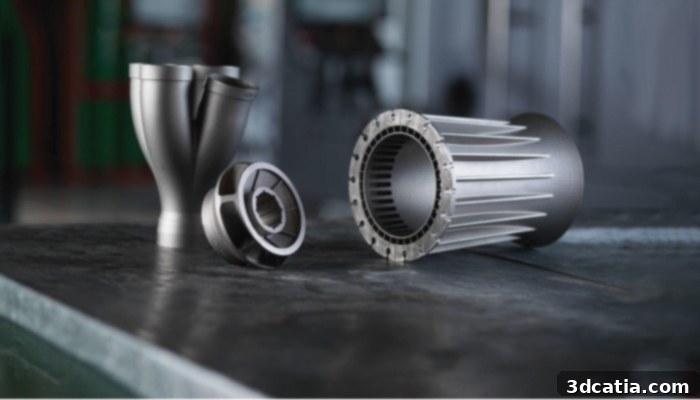
More and more metals can be used in additive manufacturing. (Photo Credits: 3D Systems)
At the heart of Bayerische Metallwerke’s groundbreaking method lies a multiphase solid solution alloy, meticulously crafted and supplied in a fine powder form. Dr. Hany Gobran, the esteemed research and development manager at Bayerische Metallwerke, sheds light on this transformative development: “The distinguishing feature of our tungsten-nickel-iron alloy is its availability as a pre-alloyed powder. This makes it an ideal starting material for sophisticated 3D printing and advanced coating processes.” This innovative approach directly addresses the limitations of previous methods. Historically, attempts to make tungsten suitable for components with complex geometries in additive manufacturing relied on mixed powders. These blends, comprising separate particles of tungsten and binder elements like nickel and iron, presented a significant processing challenge. Due to the disparate melting points of the individual constituents, much of the added binder elements would evaporate uncontrollably during the high-temperature melting phases of 3D printing. This uncontrolled evaporation led to inconsistent material composition, reduced part density, compromised mechanical properties, and crucially, contributed to the prevalent cracking issues observed in previous tungsten prints. Bayerische Metallwerke’s patented pre-alloying process revolutionizes this by ensuring that all three elements – tungsten, nickel, and iron (or copper in WNiCu) – are homogeneously combined as a multiphase material within each individual powder particle. This uniformity guarantees precise control over the final product’s composition and elemental distribution, virtually eliminating the loss of vital binder metals and paving the way for superior material integrity and performance.
A significant advantage of this new pre-alloyed tungsten powder developed by Bayerische Metallwerke GmbH is its remarkable versatility and customizability. The composition of the alloy can be finely tuned to meet the specific demands of various applications, offering unprecedented flexibility to engineers and designers. Dr. Gobran elaborates on this adaptability: “The higher the proportion of tungsten in the final product, the greater its resistance to aggressive substances like molten aluminum, and concomitantly, the better its thermal conductivity. Conversely, if an application prioritizes superior ductility and enhanced mechanical machinability, the tungsten content in the alloy can be judiciously reduced.” This means that manufacturers can precisely tailor the material properties to optimize performance for a given application, whether it requires extreme temperature resistance, wear resistance, or the ability to be easily post-processed. This level of compositional control is critical for diverse industries, from high-temperature tooling and aerospace components to radiation shielding and medical devices. Beyond compositional adjustment, the physical characteristics of the powder itself can also be precisely controlled. Parameters such as the powder’s flow behavior and grain size can be varied within a broad range of 10 to 200 µm. This granular control over powder morphology is crucial for optimizing print quality, enabling compatibility with a wide array of additive manufacturing technologies beyond just laser powder bed fusion, and ensuring consistent and reliable part production. Such flexibility makes the development highly adaptable, suitable for numerous processes, and positions it as a game-changer for high-performance additive manufacturing. Furthermore, the innovative tungsten alloy boasts compelling economic and environmental benefits. Its exceptional density makes it an outstanding, non-toxic alternative to lead, a heavy metal known for its harmful effects and increasingly restricted use in various applications such as radiation shielding, counterweights, and ammunition. The ability to replace lead with a safer, high-density material offers significant advantages for environmental safety and human health. Nabil Gdoura, a research and development engineer at Bayerische Metallwerke GmbH, highlights an additional sustainability aspect: the alloy is produced from industrial offcuts or chips, meaning that waste products from conventional manufacturing processes can be effectively re-integrated into the material cycle. This commitment to upcycling and circular economy principles not only reduces reliance on virgin raw materials but also minimizes industrial waste, leading to a more sustainable and resource-efficient manufacturing paradigm. This holistic approach underscores the alloy’s potential to drive advancements in both material science and environmental responsibility.
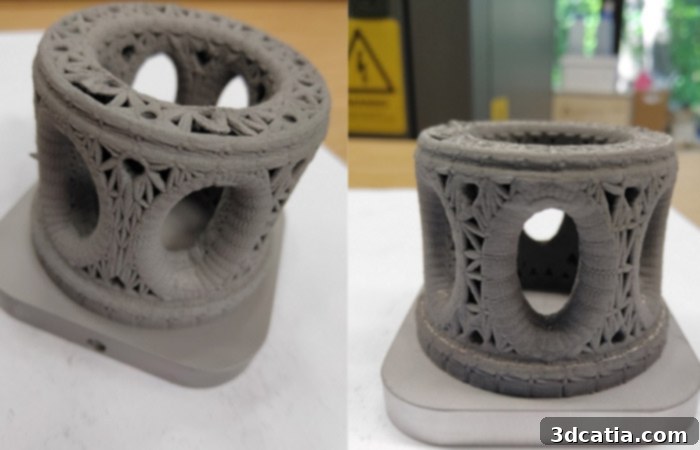
A part printed using the tungsten alloy (photo credits: Bayerische Metallwerk GmbH)
In conclusion, the development of these advanced pre-alloyed tungsten powders by Bayerische Metallwerke GmbH represents a pivotal moment for metal additive manufacturing. By effectively addressing the long-standing challenges associated with printing high-purity tungsten, particularly the issue of cracking in complex geometries, this innovation paves the way for a new generation of high-performance components. The ability to produce stable, crack-free parts from tungsten alloys with customizable properties opens up vast possibilities in sectors demanding extreme reliability and performance, such as aerospace, automotive, energy, and medical. The dual benefits of precise material control through pre-alloying and the significant environmental advantages derived from lead replacement and waste upcycling position this technology at the forefront of sustainable and advanced manufacturing. This breakthrough not only expands the material palette available for 3D printing but also reinforces the potential of additive manufacturing to create more efficient, robust, and environmentally responsible solutions for future industrial needs. The commercialization of WNiFe and WNiCu alloys in pre-alloyed powder form marks a crucial step forward in making tungsten a more accessible and reliable material for complex additive manufacturing applications, promising to unlock new design freedoms and functional capabilities previously deemed impossible. This innovation underscores the relentless pursuit of excellence in materials science and its profound impact on transforming modern production methods.
What are your thoughts on this revolutionary tungsten alloy powder and its potential impact on additive manufacturing? Let us know in a comment below or join the conversation on ourFacebook,Twitter andLinkedIn pages! Don’t miss out on the latest advancements; sign up for our free weeklyNewsletter here, and get the freshest 3D printing news delivered straight to your inbox!
*Thumbnail Photo Credits: Eos