
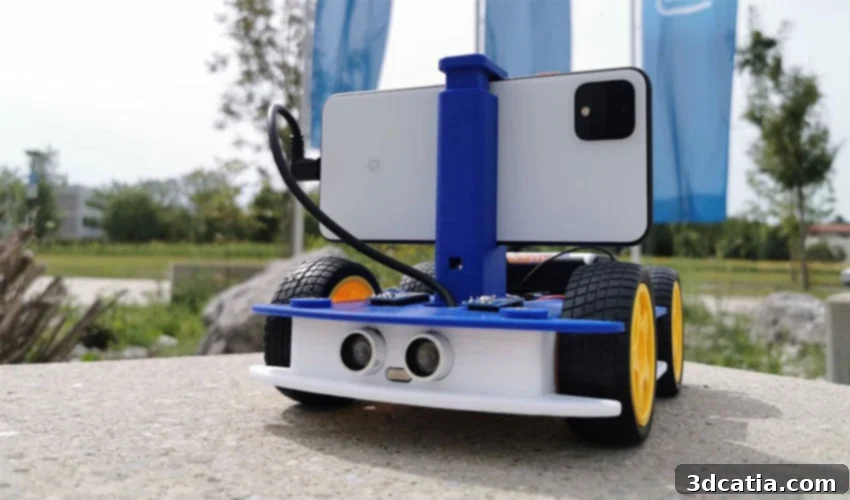
Intel’s OpenBot: Revolutionizing Affordable Robotics with a 3D Printed, Open-Source, Smartphone-Powered Robot
Based in the heart of Silicon Valley, California, Intel stands as an undisputed leader in the global technology landscape, a multinational corporation consistently pushing the boundaries of innovation. Its renowned research division, Intel Labs, has recently made a significant splash in the world of accessible technology by releasing the 3D printable files for their groundbreaking robot, OpenBot. This innovative device, available open-source, cleverly leverages the power of a smartphone and can be constructed for less than $50, making sophisticated robotics more attainable than ever before. OpenBot isn’t just a static model; it’s a dynamic platform capable of autonomous movement and performing a myriad of recognition tasks, thanks to the computational prowess of a connected smartphone. This ambitious project from Intel raises a crucial question: is OpenBot a pivotal step towards truly democratizing robotics, making advanced capabilities accessible to hobbyists, educators, and researchers worldwide?
The integration of additive manufacturing into the robotics sector has become increasingly common, transforming how robots are designed, produced, and deployed. This synergy is particularly evident in projects aiming to create more agile and cost-effective robotic solutions. For instance, we’ve seen innovative approaches like robots designed to work in swarms to optimize manufacturing processes, exemplified by our Startup of the Year 2019, AMBOTS. Often, the primary driver for incorporating 3D printing technology is to drastically lower the manufacturing cost of robot components, which are traditionally quite expensive. This cost-efficiency has been a central theme in various research endeavors, such as the Flexoskeleton project from UC San Diego, which developed insect-like robots, and the impressive Solo 8 robot dog. Intel’s OpenBot project aligns perfectly with this objective. The American tech giant not only aimed to reduce the financial barrier to entry for robotics but, more importantly, to make the entire platform open-source. This open-source philosophy fosters a collaborative environment, encouraging a global community of developers, engineers, and enthusiasts to contribute improvements, develop new functionalities, and expand the robot’s capabilities. As researchers from Intel explain, their motivation was clear: “Current robots are either expensive or make significant compromises on sensory richness, computational power, and communication capabilities. We propose to leverage smartphones to equip robots with extensive sensor suites and access to a thriving software ecosystem, in a small electric vehicle that costs $50.” This statement encapsulates Intel’s vision for OpenBot – to create a high-capability, low-cost robotics platform by intelligently utilizing existing widespread technology.
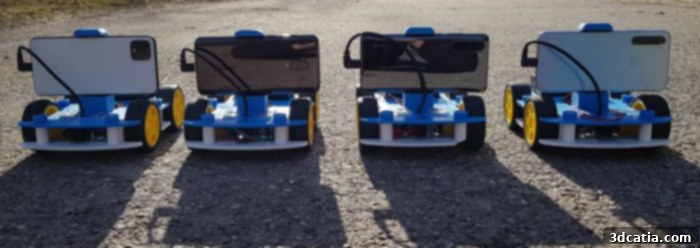
Openbot was tested with a range of different smartphones.
The OpenBot Project: Detailed Design and Accessible Construction
The Making of OpenBot: From Digital Files to Tangible Robotics
The design and construction of OpenBot have been carefully orchestrated by Intel Labs to ensure maximum accessibility and ease of replication. For the 3D printing of the robot’s various components, Intel Labs specifically recommends using PLA (Polylactic Acid) material. PLA is widely regarded as one of the simplest thermoplastics to extrude, making it an ideal choice for hobbyists and educational institutions that may not possess advanced technical machinery. Its low melting point and minimal warping make it forgiving to work with on most FDM (Fused Deposition Modeling) 3D printers. The researchers themselves opted for an Ultimaker S5 to fabricate the OpenBot chassis, a premium desktop 3D printer known for its reliability and precision. This choice underscores the importance of quality in the base components, even within an affordable framework. The chassis itself is ingeniously designed, consisting primarily of a bottom plate attached to a protective cover using just six screws. This modular approach simplifies both the printing process and the final assembly.
A key feature of the cover is its integrated universal smartphone holder, equipped with an adjustable spring mechanism. This clever design ensures compatibility with a wide array of smartphone models and sizes, highlighting Intel’s commitment to making OpenBot truly adaptable. Furthermore, the cover includes a strategically placed opening for attaching an Arduino microcontroller, which serves as the robot’s low-level control system and is powered conveniently via a USB connection. The team provided detailed estimates for the 3D printing process, indicating that the bottom plate requires approximately 13.5 hours to print, while the cover, incorporating the phone holder, takes about 9.5 hours. While it is certainly possible to accelerate the printing speed, doing so would inevitably compromise the final precision and overall quality of the components. For those meticulous about their build, adhering to the recommended print settings ensures optimal performance and durability. In terms of weight, the bottom plate weighs in at about 146 grams, and the lid at 103 grams, contributing to the robot’s lightweight and agile nature, crucial for its mobility. Despite the various components, the assembly process is remarkably straightforward. According to the creators of OpenBot, the entire robot can be put together in a brisk 30 to 60 minutes, making it an engaging and rewarding project for individuals of varying technical skill levels.
The Power of the Smartphone: OpenBot’s Intelligent Core
Intel Labs based a significant part of the OpenBot project on the assumption that a vast majority of the global population, estimated at over 40%, now owns a smartphone. This ubiquitous device, often underestimated for its computational power and sensor suite, becomes the ‘brain’ of the OpenBot. The question for Intel was simple yet profound: why not harness the inherent capabilities of these personal devices to propel their robotics project further? This led to the development of a dedicated Android application, which serves as the primary interface for users. This application allows users to collect valuable data from the robot’s environment, control its various functions, and manage its workload with intuitive ease. The Android app seamlessly integrates with an Arduino Nano microcontroller, which handles the essential low-level functions such as precise motor control and sensor input processing. This division of labor is efficient: the smartphone, with its powerful processor, high-resolution cameras, IMUs (Inertial Measurement Units), and extensive connectivity options, manages complex tasks like computer vision, AI model execution, and high-level decision-making. Meanwhile, the Arduino provides reliable, real-time control over the robot’s physical movements, ensuring smooth and responsive operation. This innovative architecture not only dramatically reduces the overall cost of the robot but also grants OpenBot access to a rich software ecosystem and continuous advancements in mobile technology.
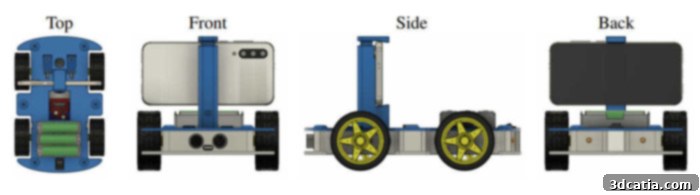
The chassis of the OpenBot are 3D printed.
OpenBot’s Capabilities and the Future of Accessible Robotics
Rigorous testing, involving a diverse range of smartphone brands including Samsung, Huawei, Xiaomi, and Nokia, confirmed OpenBot’s impressive capabilities. The robot demonstrated its ability to move autonomously and execute various recognition tasks with remarkable precision, such as seamlessly following a person. This is achieved by leveraging the smartphone’s camera for real-time video processing and onboard machine learning models for object detection and tracking. The sophisticated AI algorithms running on the smartphone’s powerful processor enable OpenBot to interpret its surroundings and react intelligently, mimicking more expensive, purpose-built robotic systems. While Intel has not yet announced plans to develop a dedicated application for iOS, the open-source nature of the project means that community contributions could potentially bridge this gap in the future, expanding OpenBot’s reach even further. The implications of such an accessible and capable platform are vast.
OpenBot holds immense potential for STEM education, offering students a tangible, hands-on learning experience in robotics, programming, and artificial intelligence at a fraction of the cost of traditional educational robots. For researchers, it provides an agile and customizable platform for experimenting with new algorithms in areas like autonomous navigation, human-robot interaction, and computer vision. Hobbyists and DIY enthusiasts can explore personal automation projects, turning their smartphones into the brains of smart home assistants or mobile surveillance units. The ease of 3D printing the components allows for rapid prototyping and customization, empowering users to modify and adapt OpenBot to suit specific needs or innovative new applications. Imagine OpenBots deployed for basic inventory checks in small businesses, for assisting the elderly, or even as interactive learning companions for children. The open-source model further accelerates innovation by allowing a global community to share code, designs, and ideas, leading to continuous improvement and the development of specialized functionalities. Are you ready to embark on your own robotics journey and create your custom robot? All the necessary files, documentation, and instructions are readily available HERE. To gain an even deeper insight into this remarkable project and see OpenBot in action, don’t hesitate to watch the informative video below.
Join the Robotics Revolution: Your Thoughts on OpenBot
What are your thoughts on this innovative 3D printed OpenBot by Intel Labs? Do you believe projects like OpenBot can truly revolutionize the field of robotics by making advanced technology accessible to a wider audience? Are you interested in printing one for yourself, perhaps as an educational tool, a personal project, or a platform for your own research? We’d love to hear your opinions and insights! Share your comments below or engage with us on our Facebook and Twitter pages. To stay informed about the latest breakthroughs in 3D printing and accessible technology, be sure to sign up for our free weekly Newsletter, delivering all the essential news straight to your inbox!