

Revolutionizing Spine Surgery: NuVasive’s Journey with Advanced 3D Printed Titanium Implants
The landscape of medical device manufacturing is undergoing a profound transformation, largely thanks to the rapid advancements in 3D printing, also known as additive manufacturing. This innovative technology has made the creation of medical devices not only simpler and more efficient but also significantly more patient-friendly. Leading this charge in the spinal sector is NuVasive, a company that has fully embraced 3D technologies to specialize in the development and production of next-generation spinal implants. NuVasive is dedicated to revolutionizing spine surgery by offering advanced 3D printed titanium implants, which are rigorously clinically tested and meticulously adapted to the unique morphology of each patient. To delve deeper into this groundbreaking process and understand the company’s vision for the future of the market, we had the privilege of speaking with Shaeffer Bannigan, Development Manager at NuVasive.
Introducing Shaeffer Bannigan and NuVasive’s Commitment to Additive Manufacturing
“My name is Shaeffer Bannigan, and I serve as the development manager for NuVasive’s Advanced Materials Science Interbody team,” Shaeffer begins. “NuVasive stands as a recognized leader in its field, with an unwavering focus on technological innovation. Our core mission today is to transform spinal surgery through the provision of integrated, cutting-edge solutions. Within this broader objective, my team specifically champions additive manufacturing. We leverage this powerful technology for the development of advanced interbody spine implants, as well as the sophisticated surgical instrumentation required for their precise implementation. Our work is at the forefront of combining material science with advanced manufacturing techniques to deliver superior patient outcomes.”
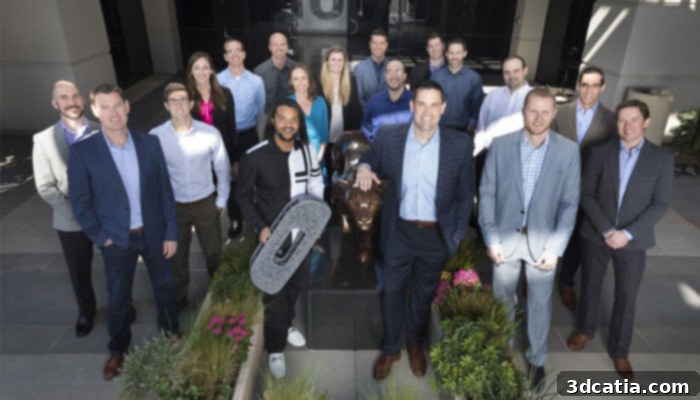
The NuVasive Advanced Materials Science Interbody Team: Pioneering 3D Printed Spinal Implants
Unveiling the Manufacturing Process of a 3D Printed Spinal Implant
When asked about the intricate process of manufacturing a 3D printed implant, Shaeffer elaborates, “The manufacturing journey at NuVasive commences with a finely powdered titanium alloy. This material, chosen for its exceptional biocompatibility and strength, forms the foundation of our implants. The process utilizes a sophisticated method known as powder bed fusion, specifically Selective Laser Melting (SLM). Once the metallic powder is evenly spread across the printing plate in an incredibly thin layer – often no thicker than a human hair – a high-energy laser precisely melts and fuses this powder into specified shapes, meticulously adhering to the digital design of the implant. This controlled melting process occurs at extremely high temperatures, ensuring a robust metallic bond.
Once a layer is completed, a new, equally thin layer of powder is spread over the top, and the laser process is repeated. Crucially, each new layer is welded directly to the layer below it. This layer-by-layer additive approach allows us to construct highly complex structures with intricate internal geometries, all built seamlessly from the ground up. This capability is paramount, as it allows us to mimic the natural porous structure of human bone, which is impossible with traditional manufacturing methods. While the precision is astounding, the process is not instantaneous. A single ‘impression,’ which typically consists of 50 to 100 individual implants, can take several days to complete. However, the efficiency gained through simultaneous production and the resulting advanced properties of the implants make this investment in time invaluable.”
Navigating the Challenges in Creating 3D Printed Implants for Spine Surgery
The creation of 3D printed implants, particularly for critical applications like spine surgery, comes with its own set of significant challenges. Shaeffer explains, “At NuVasive, the developmental process for our 3D printed spine components and implants is executed through a series of meticulously controlled, small steps, each demanding substantial energy and precision. The input parameters for our advanced 3D printers must be monitored and verified with extraordinary accuracy. These are highly sophisticated machines, capable of fabricating incredibly complex geometries, but their performance is acutely sensitive to numerous variables. If even one of these variables – such as laser power, the flow rate of inert gases like argon, or the heat distribution within the build chamber – deviates outside an acceptable, tightly defined range, the entire print run must be abandoned. This zero-tolerance approach is essential for ensuring the absolute quality and safety of each implant.
Determining this ‘acceptable range’ for every critical parameter, while simultaneously maintaining a significant safety factor, is an extremely laborious but utterly essential process for each new implant design. The human body is, by its very nature, not a particularly hospitable environment for an implant; it inherently ‘fights’ against foreign objects. Furthermore, spine surgery leaves absolutely no room for error due to the delicate and critical nature of the spinal cord and surrounding neural structures. These complex biological conditions and the high stakes involved necessitate that we scrutinize every single detail of our manufacturing process. We must fully comprehend and control all characteristics of our vertebral implants to ensure they not only perform as expected but also integrate seamlessly and safely within the patient’s body for long-term success.”
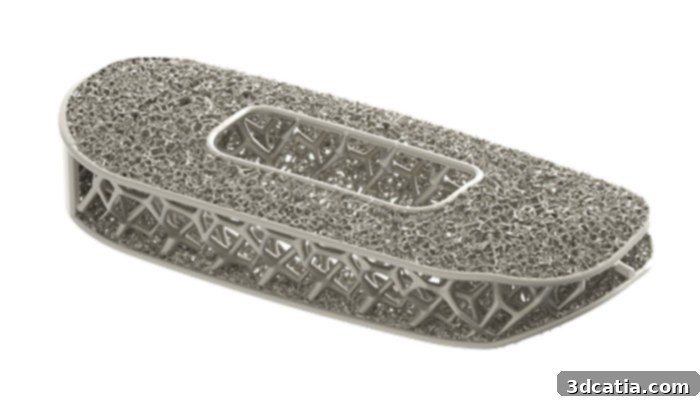
A 3D printed titanium spinal implant, demonstrating advanced geometric complexity
The Unparalleled Advantages of Additive Manufacturing in the Medical Sector
The shift to additive manufacturing brings a multitude of benefits, especially in the demanding medical field. Shaeffer highlights these advantages: “At NuVasive, our overarching goal is to significantly improve patient outcomes. To achieve this, NuVasive has strategically leveraged 3D printing to engineer ‘smarter’ structures for our spinal implants. This technology allows us to optimize the resistance and mechanical properties of the implant while simultaneously minimizing the overall material usage. More importantly, 3D printing facilitates the creation of unique, porous architectures that are designed to actively promote the natural healing process and, ultimately, reduce recovery times for patients who receive our spinal implants.
To accomplish this, we firmly believe it is paramount to imitate the intricate design and biological properties of the human body – particularly the human spine – as closely as possible within our implant designs. 3D printing is the only manufacturing method currently available that can offer us this unique combination of capabilities. It enables us to create complex, scaffold-like models that more accurately mimic the natural properties of human bone, such as its porosity and modulus of elasticity, compared to traditionally manufactured solid spinal implants. This biomimicry is critical for encouraging osteointegration – the direct structural and functional connection between living bone and the surface of a load-bearing implant. By facilitating robust bone ingrowth, we aim for a more stable and lasting fusion, leading to superior clinical results and an enhanced quality of life for patients. The ability to customize these intricate micro-architectures for optimal biological response is truly revolutionary for spinal care.”
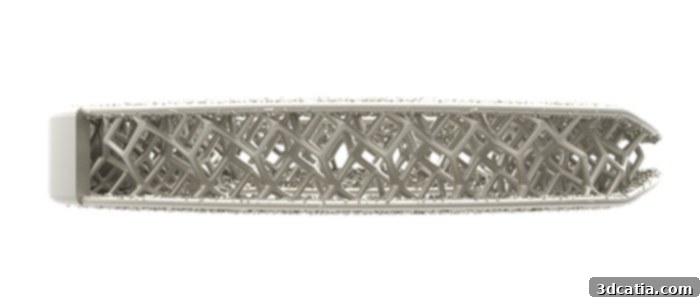
Future Trajectories for Additive Manufacturing at NuVasive
Looking ahead, the potential applications of 3D printing are vast and continually expanding. Shaeffer shares NuVasive’s forward-looking perspective: “As you can imagine, the possibilities unlocked by 3D printing are virtually limitless, extending far beyond our current applications. At NuVasive, we work diligently and strategically to selectively apply the immense power of 3D printing to our various research and development initiatives. Our primary focus is on identifying and pursuing opportunities that will most directly benefit our customers – the surgeons – and, by extension, their patients. This means continually evaluating where additive manufacturing can offer the most significant clinical advantages, whether through novel implant designs, improved material properties, or enhanced surgical techniques.
We are constantly exploring the best and most impactful ways to harness this incredible technological tool. This includes investigating new materials that could further enhance biocompatibility and mechanical performance, as well as refining our existing processes to achieve even greater precision and efficiency. We are also looking into how advanced computational design tools and artificial intelligence could further optimize implant geometries for specific patient anatomies or biomechanical requirements. The journey with additive manufacturing is one of continuous learning, adaptation, and innovation, ensuring that we remain at the forefront of spinal care technology.”
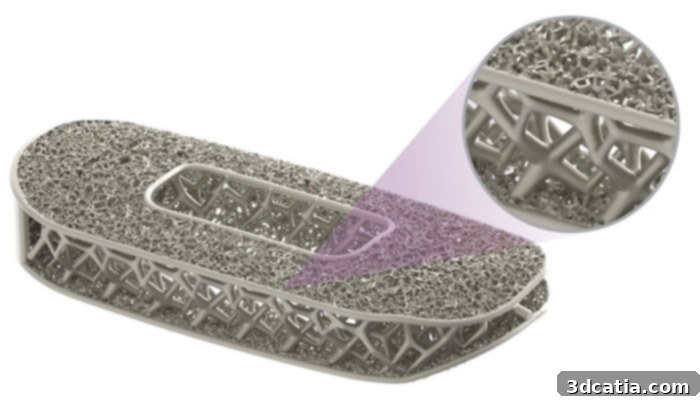
Additive manufacturing empowers the creation of high geometric complexity in medical devices
A Concluding Message to Our Readers
In closing, Shaeffer offers a powerful message: “My advice to your readers is simple yet profound: keep exploring new and innovative ways to utilize this emerging technology to solve everyday human problems. Advances in technologies such as 3D printing are not merely incremental improvements; they are truly revolutionizing the way we approach the design, development, and production of critical medical devices like spinal implants. This revolution empowers surgeons to significantly improve the lives of countless patients suffering from debilitating spinal conditions. As our dedicated team at NuVasive continues to learn, experiment, and push the boundaries of what’s possible, our positive impact on the real world will undoubtedly continue to grow exponentially.
By remaining meticulous in our experimentation, by rigorously testing every hypothesis, and by embracing the spirit of continuous innovation, we consistently realize that there are genuinely no limits to the creation and enhancement of life-changing solutions. We invite you to find more comprehensive information about our groundbreaking work and our commitment to patient care on our official website.”
We’d love to hear your thoughts on the innovative implants created by NuVasive and the future of 3D printing in medicine! Let us know your perspective in a comment below or join the conversation on our Facebook and Twitter pages! And remember to sign up for our free weekly Newsletter to receive all the latest news in 3D printing sent straight to your inbox!