
Nomad Prototypes: Revolutionizing Drone Technology with Advanced 3D Printing Innovations
The landscape of aviation has been profoundly transformed by the advent of 3D printed drones. These remarkable devices, representing a seamless fusion of cutting-edge 3D printing techniques and modern aerospace engineering, offer an unprecedented degree of flexibility, adaptability, and functional customization. From assisting in critical search and rescue operations to supporting intricate construction projects, or even executing complex military reconnaissance missions, 3D printed drones are redefining what’s possible in aerial operations. Their ability to be rapidly prototyped, customized for specific tasks, and produced with lightweight yet robust structures positions them as a cornerstone of future aerial innovation, pushing the boundaries of design and application.
At the forefront of this revolution is Nomad Prototypes, an innovative company strategically located in the United Arab Emirates. Nomad Prototypes has distinguished itself by introducing groundbreaking resin-based 3D printed drones, presenting a compelling alternative to traditional thermoplastic models. Their initial designs showcase impressive capabilities, such as a high-performance drone achieving a flight time of 37 minutes without a payload, powered by an efficient battery system. However, Nomad Prototypes’ ambition extends far beyond current capabilities. The company is intensely focused on pioneering new 3D printing methodologies, driven by the audacious goal of manufacturing the world’s largest 3D printed drone, a feat that promises to redefine the scale and potential of additive manufacturing in aviation.
Overcoming Additive Manufacturing Challenges for Drone Scalability
One of the significant hurdles Nomad Prototypes has identified and actively addresses in the realm of 3D drone printing, particularly with widely used FDM (Fused Deposition Modeling) technology, is the inherent challenge of part strength variance. FDM technology, by its nature, builds objects layer by layer. This directional printing process inevitably leads to anisotropic properties, meaning the material’s strength varies depending on the direction of applied stress. Simply put, this results in weaker points along the layer lines, making FDM printed parts less robust when forces are applied perpendicular to the print direction. While this limitation might be acceptable for smaller, less demanding drone applications, the issue becomes critically apparent when attempting to scale up.
For larger drones, increasing structural thickness to compensate for FDM’s inherent weakness often amplifies the overall weight without delivering a proportionate gain in strength compared to traditional manufacturing methods like injection molding or composite fabrication. This weight penalty directly impacts flight performance, payload capacity, and energy efficiency, making FDM a suboptimal choice for large-scale, high-performance drones. Recognizing these fundamental limitations, Nomad Prototypes has dedicated the past decade to extensively exploring and experimenting with a wide array of advanced 3D printing techniques. Their comprehensive research has spanned technologies such as FDM, SLA (Stereolithography), SLS (Selective Laser Sintering), and Multi Jet Fusion, meticulously evaluating each for its suitability in demanding aerospace applications. In their ambitious endeavor to construct the world’s largest 3D-printed plastic drone, Nomad Prototypes has strategically opted for a synergistic combination of SLA and advanced pellet extrusion methods. This deliberate choice leverages the distinct advantages of each technology – SLA for high-resolution details and isotropic properties, and pellet extrusion for larger, stronger parts using high-performance materials – to achieve optimal results that transcend the capabilities of any single method.
Pioneering New Materials and Design Paradigms
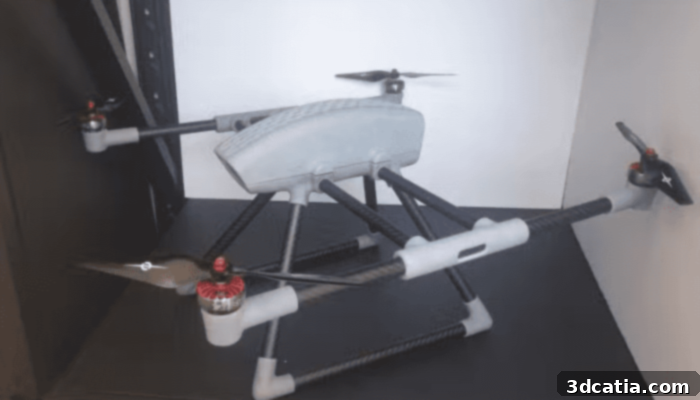
Nomad Prototypes’ initial fleet of drones showcases the power of their material selection. These early models are small, multi-rotor drones fabricated using Liqcreate StrongX resin. This specific photopolymer resin is engineered for superior mechanical properties, undergoing a unique dual-curing process involving both UV light and subsequent thermal treatment. This innovative curing methodology significantly enhances the resin’s strength and durability, making the drones exceptionally resilient and capable of withstanding the rigors of flight. The successful deployment of these early models has provided invaluable data and validation for Nomad’s material-centric approach.
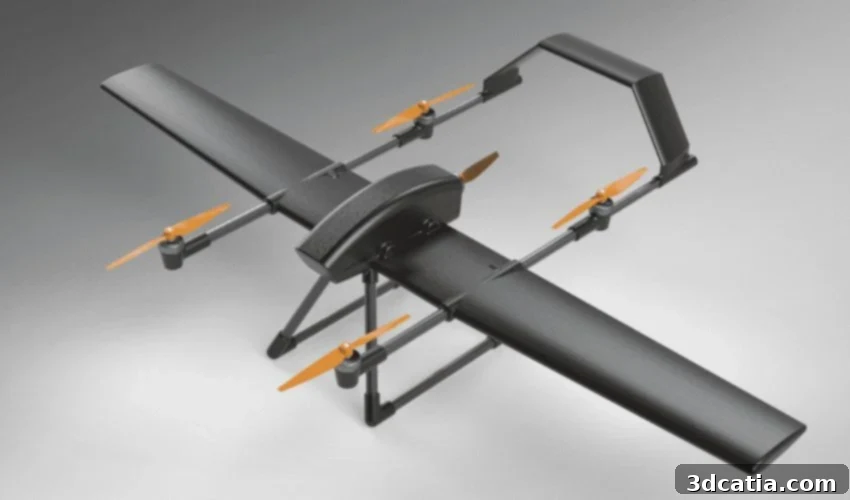
Building on this success, the company is rapidly progressing with its next generation of aerial vehicles. The second model in their series represents a significant leap forward: a highly modular drone designed for exceptional versatility. This innovative platform can be seamlessly transformed into a fixed-wing aircraft, equipped with advanced vertical take-off and landing (VTOL) capabilities. The shift to a fixed-wing design with VTOL functionality offers extended flight range, increased speed, and greater operational flexibility compared to multi-rotor systems. To achieve the required performance, this advanced drone will be crafted from a specially developed tough, flexible resin. Crucially, its wings are meticulously optimized to achieve an ideal balance of thinness and strength – a design feat that Nomad Prototypes emphatically states is simply not feasible with conventional FDM technology due to its inherent limitations in producing fine details with consistent structural integrity. This commitment to advanced resin technology allows for aerodynamic profiles and structural resilience previously unattainable, opening new avenues for drone design and utility.
Scaling to Unprecedented Sizes with FGF Technology
The ambition of Nomad Prototypes truly takes flight with their next major project: a drone with an impressive 3.2-meter wingspan. This monumental undertaking will harness the power of FGF (Fused Granular Fabrication) 3D printing technology, a method particularly well-suited for large-scale production using high-performance, pelletized materials. This larger drone is designed to achieve a maximum take-off weight of approximately 15 kg, pushing the boundaries of what is possible with additive manufacturing in the aerospace sector. To ensure structural integrity and longevity, it will be engineered to fly at reduced speeds, thereby minimizing stress on its expansive airframe.
The choice of FGF is critical for this project, primarily due to its compatibility with advanced materials not available in filament form. Phillip Keane, the visionary founder of Nomad Prototypes, elaborates on this crucial material advantage: “Some of these new pellets have incredibly high carbon fiber loads, reaching up to 50% carbon fiber. This would be impossible to print in filament format, as the filament is so stiff, it would snap as soon as it reaches the extruder.” This statement underscores the paradigm shift enabled by FGF: the ability to process composite materials with significantly higher filler concentrations. Carbon fiber, renowned for its exceptional strength-to-weight ratio, is a coveted material in aerospace. By utilizing pellets with such high carbon fiber content, Nomad Prototypes can produce drone components that are both incredibly lightweight and immensely strong, a combination vital for large-scale aerial vehicles. This innovative approach to material science and manufacturing technology is what sets Nomad Prototypes apart, allowing them to overcome the traditional barriers of 3D printing for large, structurally demanding applications.

The Ultimate Horizon: Manned 3D Printed Flight
Looking even further into the future, Nomad Prototypes harbors an ambitious long-term vision: the creation of a 3D printed drone capable of safely carrying a person. This monumental goal represents the zenith of additive manufacturing in aviation, pushing the boundaries of material science, structural engineering, and regulatory approval. The company firmly believes that the continued expansion and refinement of 3D-printed fixed-wing drones are absolutely crucial steps toward realizing this audacious objective. Fixed-wing designs inherently offer greater lift efficiency and stability for human transport compared to multi-rotor configurations.
While the concept might seem futuristic, the underlying technological pathways are already being explored. Phillip Keane sheds light on the technical feasibility: “It’s certainly possible to 3D print a wing out of metal that could support the weight of a human being in flight, although it would be extremely expensive to do so at present.” This insight highlights both the promise and the current economic challenges. While advanced metal additive manufacturing technologies exist, the sheer scale and complexity required for human-rated aircraft components mean that costs remain prohibitive. However, with ongoing advancements in materials, printing speeds, and post-processing techniques, the cost barrier is expected to diminish over time. The development of advanced composite materials with superior strength-to-weight ratios and the ability to print them at scale will be critical enablers for manned 3D printed flight. Nomad Prototypes’ journey, from small resin-based drones to potentially person-carrying aircraft, illustrates a bold and methodical approach to revolutionizing the aerospace industry through the transformative power of additive manufacturing.
What are your thoughts on these innovative 3D printed drones and Nomad Prototypes’ vision for the future of aviation? Let us know in a comment below or on our LinkedIn, Facebook, and Twitter pages! Don’t forget to sign up for our free weekly newsletter here for the latest 3D printing news straight to your inbox! You can also find all our videos on our YouTube channel.
*All Photo Credits: Phillip Keane