

Materialise NIP Connector: Revolutionizing COVID-19 Respiratory Care with 3D Printing
The global healthcare landscape faced an unprecedented challenge with the rapid onset of the COVID-19 pandemic. Hospitals worldwide grappled with a critical shortage of essential medical equipment, particularly mechanical ventilators, which are vital for patients suffering from severe respiratory complications. In this environment of urgent need and innovation, the Belgian company Materialise, a pioneer in additive manufacturing, stepped forward with a groundbreaking solution: the Materialise NIP Connector. This ingenious 3D-printed device offers a rapid and accessible way to convert readily available standard hospital equipment into a highly effective non-invasive PEEP (Positive End-Expiratory Pressure) mask, providing crucial respiratory support to COVID-19 patients and significantly easing the burden on conventional ventilators.
The core brilliance of the Materialise NIP Connector lies in its simplicity and adaptability. Designed to integrate seamlessly with existing medical supplies, it creates a non-invasive ventilation (NIV) solution that is both familiar and easy for medical professionals to assemble. The connector acts as a crucial bridge, bringing together a standard non-invasive ventilation mask, a specialized filter, and a PEEP valve. This assembly works in concert to facilitate breathing for patients, ensuring they receive the necessary oxygen and support without requiring the more complex and scarce mechanical ventilators. This innovation has proven invaluable, allowing hospitals to scale up their respiratory support capabilities quickly and efficiently, directly addressing the immediate and overwhelming demand during the pandemic’s peak.
Addressing the Critical Ventilator Shortage with Additive Manufacturing
The COVID-19 crisis highlighted a glaring vulnerability in global healthcare infrastructure: the limited supply of mechanical ventilators. These sophisticated machines are essential for life support in critically ill patients, helping them breathe when their lungs are too compromised to function effectively on their own. As the virus spread, the demand for these devices skyrocketed, far outstripping the production capacity of manufacturers. This severe shortage forced healthcare providers to make agonizing decisions and spurred an urgent search for alternative solutions. Materialise’s 3D-printed connector emerged as a beacon of hope in this challenging environment. By creating positive pressure within the lungs, the NIP Connector assists patients in taking in oxygen and expelling carbon dioxide, thereby providing vital respiratory assistance and potentially preventing the need for invasive mechanical ventilation.
This innovative approach means that mechanical ventilators, which are resource-intensive and require specialized settings, can be reserved for patients in the most extreme critical condition, where non-invasive methods are insufficient. The NIP Connector’s ability to utilize existing hospital stock not only saves lives but also optimizes the allocation of highly specialized equipment. Materialise acted with remarkable speed, aiming to supply this critical connector to hospitals by mid-April, demonstrating the agility and responsiveness inherent in modern additive manufacturing capabilities when faced with a global health emergency. This rapid deployment capability underscores why 3D printing has become an indispensable tool in crisis response, moving from niche application to frontline medical innovation.
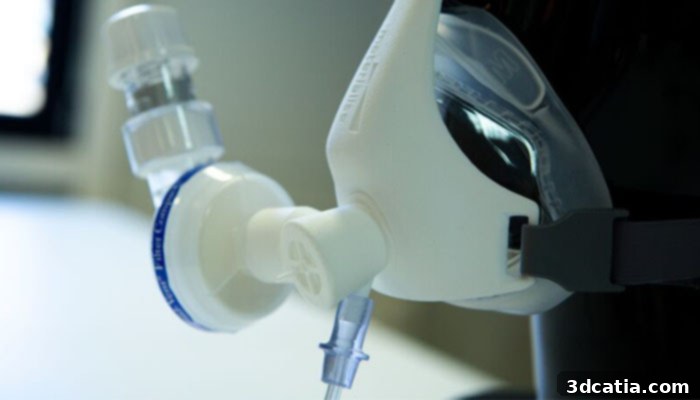
The 3D printed connector from Materialise connects a NIV mask, a PEEP valve and a filter together to facilitate breathing for COVID-19 patients | Image via Materialise
The Engineering Behind the 3D Printed Oxygen Mask Connector
Materialise emphasizes that its foremost priority is the safety and well-being of both medical staff and patients. This commitment guided the extensive research, development, and rigorous testing phases for the NIP Connector. Collaborating closely with leading pulmonologists and medical specialists, Materialise ensured that the device met the highest standards of clinical efficacy and safety. Professor Wilfried de Baker, an acclaimed expert in pneumology, highlighted a key advantage of the connector: its design minimizes gaps through which the virus could potentially spread into the surrounding environment, thereby protecting healthcare workers and other patients. This aspect is particularly crucial in highly infectious disease settings like those seen during the COVID-19 pandemic, where airborne transmission is a significant concern.
Beyond containment, the NIP Connector also plays a critical role in patient physiology. It effectively provides the necessary positive expiratory pressure (PEEP), which helps to keep the air sacs (alveoli) in the lungs open. This sustained pressure prevents the collapse of lung tissue and pushes fluids out of the lungs, significantly facilitating the absorption of oxygen. For patients struggling with acute respiratory distress syndrome (ARDS), a common complication of severe COVID-19, this physiological support can be life-saving. The manufacturing of the Materialise NIP Connector leverages advanced Selective Laser Sintering (SLS) 3D printing technology. Production takes place in Materialise’s state-of-the-art, ISO 13485 certified facilities located in Belgium and Plymouth, ensuring adherence to the stringent quality management system requirements for medical devices.
Brigitte De Vet, Vice President of Materialise Medical, succinctly captured the essence of 3D printing’s impact during the crisis: “3D printing is playing a crucial role in fighting the global coronavirus pandemic by making it possible to develop innovative solutions and have them available worldwide very quickly. At the same time, it is crucial that the medical products we put on the market are safe and effective. Materialise has decades of experience in certified medical 3D printing which allows us to bring 3D printed devices to the market quickly and safely.” Her statement underscores the dual importance of speed and stringent quality control, principles that have guided Materialise throughout its journey in medical additive manufacturing. The ability to rapidly iterate, prototype, and then mass-produce a medically certified device like the NIP Connector demonstrates the transformative power of this technology, not just in crisis, but for the future of personalized and responsive healthcare.
Rapid Regulatory Pathways and Clinical Validation
In an emergency situation like a global pandemic, the speed of innovation must be matched by the efficiency of regulatory approval. Materialise has been diligently accelerating the regulatory registration of the NIP Connector in key regions, including Europe and the United States. This expedited process is critical for ensuring that the device can be deployed legally and safely where it is needed most. Simultaneous to regulatory efforts, Materialise embarked on a vital clinical trial to thoroughly evaluate the impact and effectiveness of its NIP Connector on COVID-19 patients. The results from these trials were eagerly anticipated within weeks of the connector’s announcement, providing crucial real-world data to validate its clinical utility and ensure optimal patient outcomes. This comprehensive approach – rapid development, robust testing, expedited regulatory navigation, and clinical validation – exemplifies a responsible and effective response to a pressing public health crisis.
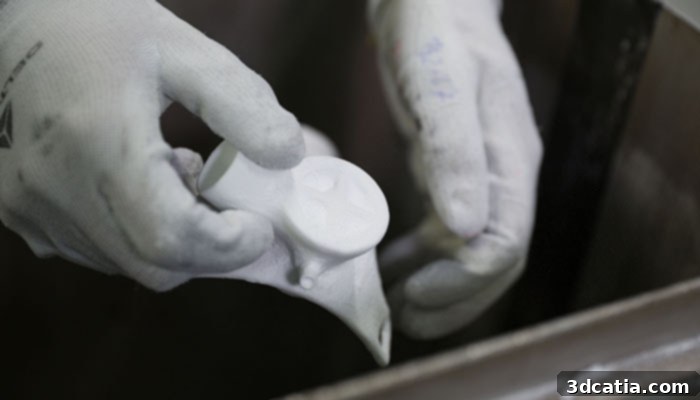
The connector was 3D printed on an SLS machine | Image via Materialise
The success of the Materialise NIP Connector during the COVID-19 pandemic serves as a powerful testament to the potential of additive manufacturing in emergency preparedness and innovative healthcare solutions. By transforming standard hospital equipment into a life-saving non-invasive PEEP mask, Materialise not only provided immediate relief during a critical ventilator shortage but also demonstrated a sustainable model for rapid response. This breakthrough highlights the flexibility, speed, and certification capabilities of industrial 3D printing, positioning it as an indispensable technology for future medical device development and disaster response. More information about this innovative solution and Materialise’s ongoing efforts can be found HERE.
What are your thoughts on this innovative 3D-printed device and its role in combating global health crises like COVID-19? Share your opinions and insights below or engage with us on our Facebook and Twitter pages!