
Automating Additive Manufacturing: Key Post-Processing Trends and Challenges from the 2021 PostProcess Technologies Survey
The rapid evolution of additive manufacturing continues to transform industrial production, but realizing its full potential, particularly for scaling to high volumes, often hinges on the efficiency of post-processing. PostProcess Technologies, a leading manufacturer of post-processing solutions, has recently released the third edition of its comprehensive Annual Additive Post-Printing Survey: Trends Report 2021. This influential report not only reiterates critical observations from last year’s edition but also provides fresh insights into the industry’s overarching goals: a concerted effort to significantly shorten the often time-consuming post-printing phase, a relentless pursuit of improved quality for finished parts, and a strategic ambition to empower operators by allowing them to concentrate on higher value-added tasks. Fundamentally, the survey reveals a widespread consensus among additive manufacturing users: there is an urgent and growing demand to automate various post-processing steps as extensively as possible, especially as companies transition towards mass production models and seek to integrate 3D printing into mainstream manufacturing workflows.
The increasing relevance and impact of this annual study are clearly demonstrated by a remarkable doubling in the number of participants this year, indicating a burgeoning industry-wide interest in optimizing additive manufacturing processes beyond the printing phase itself. Moreover, a significant 50% of respondents reported a complete understanding of the specific post-processing methodologies employed within their organizations, signaling a heightened awareness and active engagement with this critical production stage. The PostProcess Technologies study meticulously categorizes and analyzes post-processing trends according to the diverse 3D printing processes adopted by the participating companies. As expected, the most prevalent technologies underpinning current industrial additive manufacturing—namely Fused Deposition Modeling (FDM), various photopolymerization techniques (including Stereolithography and Digital Light Processing), and Selective Laser Sintering (SLS)—emerged as the top three. These were closely followed by HP’s MultiJet Fusion (MJF) and material jetting processes. It is crucial to acknowledge that each of these additive manufacturing processes inherently presents its own distinct set of post-processing requirements and operational constraints, a foundational understanding that informs the entirety of this insightful report.
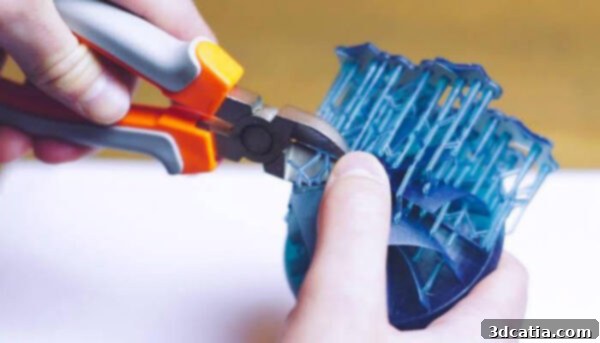
The selection of post-processing techniques is directly influenced by the specific 3D printing technology employed and the intended final application of the part (photo credits: Nikko Industries)
Current Post-Processing Techniques and Their Impact on Production Efficiency
The extensive variety of additive manufacturing processes naturally leads to an equally broad spectrum of post-processing methodologies. These indispensable steps range from fundamental tasks like the removal of supports and excess unfused materials, to critical procedures such as surface finishing, precision polishing, and even advanced heat treatments designed to optimize material properties. The exact duration and inherent complexity of post-processing are intrinsically linked to both the chosen 3D printing process and, perhaps more significantly, the precise functional and aesthetic demands of the final application for the 3D printed component. Manual post-processing, while traditional, is often labor-intensive, time-consuming, and prone to inconsistencies, directly impacting production throughput and part quality. The 2021 report confirms that the most widely adopted post-processing methods largely mirror those identified in previous years, reflecting persistent industry needs. Topping the list, with a substantial 82% of participants citing its use, is the removal of printing supports. This is closely followed by surface finishing, reported by 67% of respondents, essential for achieving desired aesthetics and functional characteristics. Resin removal, crucial for photopolymerization-based processes, is utilized by 45%, while powder removal, a cornerstone for powder-bed fusion technologies, is performed by 44% of companies. These findings are highly consistent with the prevalence of FDM, SLA/DLP, and SLS/MJF technologies in today’s market, each inherently requiring these specific and often challenging post-processing operations. The drive towards automating these core tasks is therefore not just about convenience, but about achieving higher throughput, ensuring greater part consistency, and substantially reducing overall labor costs.
The report further highlights specific technological challenges, focusing particularly on HP’s MultiJet Fusion (MJF) process, which has garnered significant attention for its capabilities in high-volume and mass production. Despite its potential, survey participants clearly indicate that MJF post-processing represents a formidable obstacle to achieving seamless integration into true mass production workflows. A telling statistic reveals that less than 18% of current MJF technology users consider the available post-processing solutions to be adequate for their requirements. This insight is particularly critical given the broader industry’s strategic pivot from predominantly rapid prototyping applications to robust mass production. While numerous industry players are actively working to smooth this transition, the study underscores a vital point: the market, especially concerning comprehensive and automated post-processing solutions tailored for technologies like MJF, is not yet fully mature, despite a noticeable increase in dedicated initiatives. Recognizing this inherent challenge, HP itself has proactively responded throughout 2021, channeling significant development efforts into creating more automated post-processing solutions. This strategic focus directly aligns with the imperative for streamlined and efficient production. It suggests that while post-processing remains a considerable challenge today, a more sophisticated, integrated, and automated post-processing ecosystem for MJF is likely to evolve and mature significantly in the coming years, ultimately unlocking its full industrial scalability and widespread adoption.
Persistent Post-Processing Challenges in 2021: Barriers to Industrial Scalability
The 2021 edition of the PostProcess Technologies report consistently highlights a set of challenges that remain strikingly similar to those identified in previous years, underscoring persistent and fundamental hurdles within the additive manufacturing landscape. These challenges are crucial barriers impeding the broader adoption and successful scaling of 3D printing for true industrial applications. A significant majority of survey participants, specifically 53%, emphatically state that the post-processing cycle time is excessively long, a concern that holds true regardless of whether they are utilizing FDM, Stereolithography (SLA), or Selective Laser Sintering (SLS). This protracted cycle time directly constrains overall production throughput, making it incredibly difficult for companies to meet tight deadlines and demanding lead times for high-volume orders. In today’s highly competitive manufacturing environment, optimizing every stage of production is paramount, and delays in post-processing translate directly to higher costs and reduced competitive advantage.
Another pervasive and critical pain point, articulated by 52% of respondents, is the profound difficulty in consistently achieving uniform finished parts. This lack of repeatability and consistency represents a major impediment to robust quality control, especially for components that demand stringent tolerances, specific mechanical properties, or flawless aesthetic finishes. Inconsistent post-processing can lead to significant variances in surface quality, dimensional accuracy, and overall part performance, resulting in elevated scrap rates, costly rework, and ultimately, a detrimental erosion of confidence in the reliability and predictability of 3D printed components for demanding applications. The ability to reliably produce identical parts with predictable and certified properties is not merely desirable but fundamental for industrial scalability and widespread acceptance. Furthermore, the availability of skilled labor continues to pose a considerable hindrance in performing complex post-processing operations. While the additive manufacturing market is experiencing rapid expansion, there remains a noticeable deficit of individuals possessing the specialized expertise and hands-on experience required to adeptly execute these often intricate, delicate, and technically demanding post-processing tasks. This labor shortage not only drives up operational costs but also severely limits the capacity of companies to effectively scale their 3D printing operations, highlighting the urgent need for enhanced training programs and, more crucially, for automated solutions that reduce the reliance on specialized manual labor.
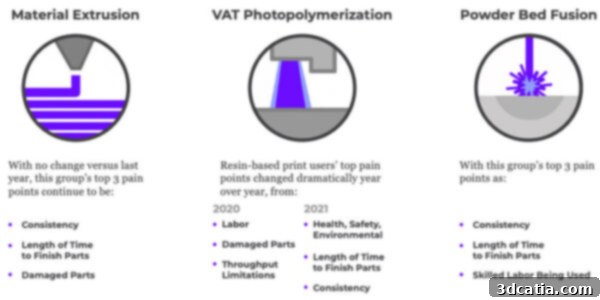
The most significant post-processing challenges identified in 2021, categorized by the most frequently used additive manufacturing processes (photo credits: PostProcess Technologies)
The study further illuminates specific challenges that are intrinsically linked to different material types and printing technologies. For companies involved in powder removal – an essential step for parts produced via Selective Laser Sintering (SLS) or MultiJet Fusion (MJF) – the process is not only perceived as messy, labor-intensive, and time-consuming but also demonstrably slows down the overall manufacturing process and significantly inflates total operational expenses. The manual extraction of unfused powder, often requiring specialized containment systems and rigorous safety protocols to prevent inhalation hazards or cross-contamination, adds substantial time and cost to the production cycle. Moreover, the subsequent management, treatment, and recycling of excess powder introduce their own set of logistical and economic complexities. Conversely, for resin removal, a process predominantly associated with photopolymerization technologies like SLA or DLP, the most pronounced challenges revolve around critical issues of safety, stringent hygiene requirements, and complex waste management. Liquid resins are frequently irritating or hazardous, necessitating meticulous handling, dedicated ventilation systems, and the consistent use of personal protective equipment. The inherently messy nature of resin-based post-processing mandates rigorous hygiene practices to maintain a clean and safe working environment. Furthermore, the disposal of uncured resin waste raises significant environmental concerns, requiring responsible and often costly waste management solutions. These specific, material-dependent challenges underscore the nuanced difficulties and varied priorities faced by companies based on their chosen 3D printing technology and materials.
What’s in Store for Post-Processing’s Future: Strategic Investment, Innovation, and Sustainability
While the array of identified challenges might initially suggest a pessimistic outlook, the PostProcess Technologies report powerfully emphasizes an encouraging and robust willingness among participants to invest more substantially in advanced post-processing solutions. This underlying optimism is a clear and compelling indicator of the perceived strategic value and undeniable necessity of overcoming these hurdles to unlock additive manufacturing’s full potential. A remarkable 30% of the companies surveyed reported dedicating more than a quarter of their entire additive manufacturing budget specifically to post-processing. This substantial financial commitment signifies a profound strategic shift: post-processing is no longer viewed as a mere afterthought but rather as a pivotal and integral component of the overall production strategy. Among various industrial sectors, automotive companies stand out as those for whom this investment holds the greatest importance, reflecting their stringent demands for high-quality, repeatable parts and streamlined production for both rapid prototyping and, increasingly, final end-use components. This sector’s proactive commitment signals a growing industry-wide recognition that advanced and automated post-processing is paramount for leveraging additive manufacturing to achieve a competitive advantage.
But precisely where do participants intend to channel these significant investments? The survey provides illuminating clarity. For a commanding 76% of respondents, the primary objective driving their investment is to achieve superior finished part quality. This goal is absolutely crucial for expanding the range of applications for 3D printed components, especially in industries where performance, aesthetic perfection, and unwavering reliability are non-negotiable prerequisites. Whether it involves achieving ultra-smooth surfaces for aerospace components, ensuring precise fits for intricate medical devices, or producing aesthetically appealing consumer goods, enhanced quality serves as a direct pathway to broader market acceptance and sustainable growth. Concurrently, a substantial 45% of participants are motivated by the desire to significantly reduce overall cycle time. By intelligently automating and meticulously optimizing post-processing workflows, manufacturers aim to drastically boost throughput, dramatically decrease lead times, and ultimately render additive manufacturing a far more viable and attractive option for higher volume production. These two interconnected priorities—achieving superior quality and accelerating production speed—are fundamental drivers for widespread industrial adoption and represent the core areas where innovative post-processing solutions are most critically needed and poised to deliver the greatest impact.
Peering further into the future, a highly encouraging and transformative trend emerges: a significant 60% of companies surveyed express a strong and deliberate intent to improve health, safety, and sustainability (HSS) issues within their post-processing workflows. This represents a critical evolution, as HSS considerations are progressively gaining paramount importance across the entire value chain of additive manufacturing. This focus extends beyond merely the environmental impact of materials to encompass the well-being and safety of operators and the holistic ecological footprint of the entire production process. Manual post-processing frequently involves direct exposure to fine particulate powders, hazardous chemical resins, and repetitive physical tasks, all of which pose inherent health and safety risks. Automated solutions offer a powerful means to significantly mitigate these risks by enclosing hazardous processes, substantially reducing manual handling, and ensuring consistent, controlled environmental conditions. Furthermore, broader sustainability concerns, such as minimizing material waste, optimizing energy consumption, and facilitating comprehensive material recovery and recycling, are rightfully gaining increasing prominence. This collective and emphatic focus on HSS is not merely a matter of regulatory compliance but a strategic imperative that will undeniably shape the development of next-generation post-processing technologies and best practices in the years to come. Companies that proactively and effectively address these crucial concerns will likely gain a substantial competitive edge and contribute meaningfully to the establishment of a more responsible, efficient, and resilient additive manufacturing industry. The complete, in-depth study from PostProcess Technologies can be accessed directly HERE for a comprehensive understanding of these trends.
*Cover Photo Credits: Hubs
What are your insights on the identified post-processing trends and challenges for 2021, and how do you envision the additive manufacturing industry evolving in response? We encourage you to share your valuable thoughts and observations in a comment below, or connect with us on our LinkedIn, Facebook, and Twitter pages! And don’t forget to sign up for our complimentary weekly Newsletter here, ensuring you receive the very latest 3D printing news directly to your inbox! You can also explore all our compelling videos and comprehensive industry coverage on our dedicated YouTube channel.