
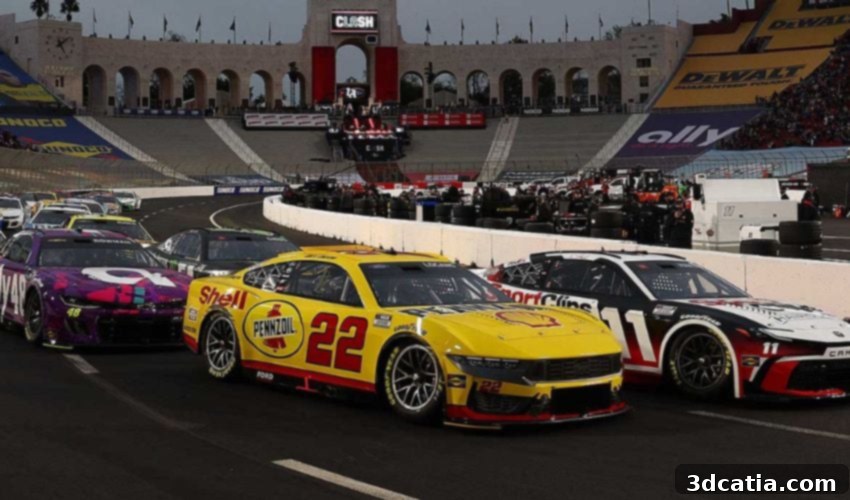
From Pit Stop to Production: How NASCAR is Driving Performance with Stratasys 3D Printing
While Formula 1 has long been recognized as a trailblazer in adopting additive manufacturing for performance gains and rapid innovation, its American counterpart, NASCAR, has been steadily embracing the technology with increasing fervor. This commitment was recently solidified through a landmark announcement: NASCAR has officially selected Stratasys as its exclusive 3D printing partner for the design of critical parts and essential tools. This strategic collaboration extends beyond current applications, as Stratasys solutions are set to play a pivotal role in NASCAR’s cutting-edge 3D printing laboratory, a state-of-the-art facility poised to open its doors at the NASCAR Research & Development Center in Concord, North Carolina. This partnership underscores a significant shift in how American motorsports are leveraging advanced manufacturing techniques to push the boundaries of speed, safety, and efficiency.
The automotive sector, particularly high-stakes motor racing, has witnessed a profound increase in the adoption of additive manufacturing due to its unparalleled advantages. These benefits include the ability to create incredibly lightweight components without compromising structural integrity, and the drastic shortening of lead times for parts production—a crucial factor in a sport where every fraction of a second and every design iteration counts. NASCAR itself is no stranger to the capabilities of 3D printing, having integrated the technology into its operations for several years. For instance, in 2022, the organization publicly announced its intention to incorporate Stratasys’ advanced technologies to equip all NASCAR Next Gen racecars with 3D printed production parts. This latest official partnership with Stratasys, therefore, is not merely a new venture but a powerful reaffirmation of NASCAR’s serious, long-term commitment to additive manufacturing as a cornerstone of its innovation strategy and competitive edge.
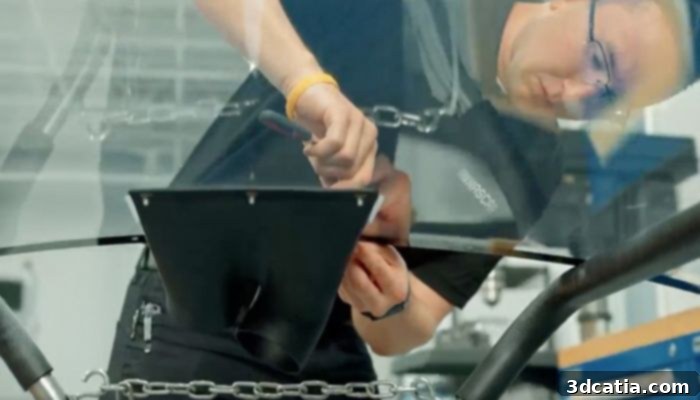
A NASCAR engineer attaches a 3D printed duct (photo credits: Business Wire)
NASCAR’s Accelerated Drive Towards Advanced 3D Printing Use
As previously highlighted, NASCAR’s engagement with Stratasys and other 3D printing technologies spans several years, making this recent announcement an evolution rather than a revolution. What elevates the significance of this official partnership is its dual impact: it not only indelibly cements Stratasys’ position as a critical, indispensable technology provider for NASCAR but also serves as a catalyst for NASCAR to significantly scale up its additive manufacturing capabilities across the board. A core aspect of this expansion will see Stratasys bolstering the existing FDM (Fused Deposition Modeling) capabilities within the NASCAR R&D center. This facility already boasts an impressive array of Stratasys 3D printers, including the robust F370, the versatile 450mc, and the industrial-grade F900. These machines are engineered to facilitate larger-scale, high-performance part production, crucial for racecar development.
Beyond strengthening FDM, the partnership is set to diversify the R&D center’s technological portfolio with the integration of the NEO800 3D printer. This addition marks a significant leap, expanding the center’s offerings to include advanced stereolithography (SLA) capabilities. While FDM is renowned for its strength, durability, and a wide range of thermoplastic materials, SLA excels in producing parts with incredibly fine details, smooth surface finishes, and high accuracy, making it ideal for intricate prototypes, complex tooling, and certain functional components. This multi-technology approach provides NASCAR engineers with unparalleled flexibility, allowing them to choose the most suitable printing process and material for each specific application, thereby accelerating design iterations and optimizing part performance like never before. The combination of these advanced systems ensures that NASCAR’s R&D efforts are at the forefront of motorsports innovation, capable of rapid prototyping and on-demand manufacturing with unmatched precision.
“Partnering with Stratasys allows NASCAR to push the boundaries of performance and accuracy like never before,” explains John Probst, executive vice president, chief racing development officer at NASCAR. He elaborates on the profound impact of this collaboration: “Their 3D printing technology empowers us to quickly iterate and optimize components, ensuring that our staff has the best possible machines to stay ahead in this high-stakes environment. Stratasys has proven to be a valuable partner, and this agreement represents our commitment to staying at the forefront of motorsports innovation.” This statement highlights the critical role 3D printing plays in reducing development cycles, enabling engineers to test multiple design variations rapidly, and ultimately delivering superior components that directly contribute to competitive advantage on the track. The ability to innovate quickly and adapt to evolving performance demands is paramount in professional racing, and additive manufacturing provides an unparalleled toolset for this purpose.
Accelerating Design Cycles and On-Demand Production with AM
The implementation of 3D printing by NASCAR is strategically focused on two primary objectives: dramatically faster design cycles and the efficient, on-demand production of highly customized components. These capabilities are transformative for an organization that thrives on continuous improvement and innovation. For instance, the technology is invaluable for rigorous aerodynamic testing, allowing engineers to produce numerous iterations of intricate aerodynamic parts—such as diffusers, wings, and body panels—with speed and precision. These prototypes can then be quickly evaluated in wind tunnels or on the track, leading to rapid optimization of a vehicle’s airflow characteristics, which is vital for speed and stability.
Beyond prototyping, 3D printing facilitates the creation of production parts that are often lighter, stronger, or more complex than those achievable with traditional manufacturing methods. It also enables the production of high-precision tooling, jigs, and fixtures, which streamline assembly processes and ensure consistent quality in the final racecar build. The flexibility of additive manufacturing means that engineers can design and produce highly specific, custom parts tailored to individual race conditions, driver preferences, or unique vehicle configurations without incurring the significant costs and lead times associated with traditional tooling. This agility is a game-changer in a sport where minute adjustments can determine victory. In fact, engineers at NASCAR have already been actively collaborating with Stratasys to develop innovative solutions for NASCAR Cup Series cars, a testament to the practical, immediate impact of this partnership. It is a remarkable fact that, currently, every vehicle on the track is equipped with a variety of 3D printed parts, showcasing the pervasive integration of this technology into the sport’s highest echelons.
Real-World Applications: Enhancing Racecar Performance
To illustrate the tangible benefits of their collaboration, specific examples of 3D printed parts in NASCAR racecars underscore the practical applications of additive manufacturing. One notable case involves the development of a cold air inlet vent, a crucial component for driver comfort and performance. This part was engineered in conjunction with Stratasys Direct Manufacturing and fabricated using a H350 SAF printer. The material chosen for this application was plant-based Nylon11, selected for its optimal balance of strength, lightweight properties, and sustainability considerations. The primary function of this vent is to effectively channel cool air into the car’s cockpit, providing a regulated temperature environment for the driver, which is essential for maintaining focus and physical endurance during intense, prolonged races under challenging conditions.
Another compelling example is a NACA duct strategically positioned on the lower engine panel. The purpose of this duct is critical for thermal management: to efficiently vent out hot air from the engine bay, preventing overheating and ensuring optimal engine performance. For this particular component, ULTEM 9085 was the material of choice, processed using an FDM 3D printer. ULTEM 9085 is a high-performance thermoplastic known for its exceptional strength-to-weight ratio, high heat resistance, and flame-retardant properties, making it perfectly suited for demanding applications within the extreme temperatures of a racecar’s engine compartment. These examples demonstrate how Stratasys’ diverse portfolio of materials and printing technologies allows NASCAR to tailor solutions precisely to the functional requirements of each part, extracting maximum performance benefits while ensuring reliability and safety.
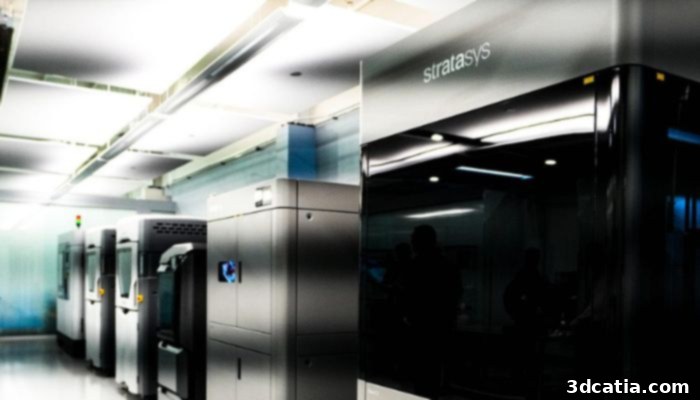
Some of the Stratasys printers that are available to NASCAR (photo credits: Stratasys)
Broader Impact: From the Racetrack to the Road
Rich Garrity, chief business unit officer at Stratasys, eloquently summarizes the symbiotic relationship and far-reaching implications of this partnership: “Our partnership with NASCAR allows Stratasys to showcase the unique advantages of 3D printing in motorsports.” He emphasizes the dual benefits for NASCAR: “From on-demand manufacturing of custom components to speeding up the design cycle, we’re helping NASCAR with faster production times and enhanced part performance.” This statement encapsulates the core value proposition of additive manufacturing in a competitive environment—the ability to iterate rapidly and produce specialized parts efficiently. However, Garrity also points to a broader, more impactful ripple effect: “Furthermore, our work in high-performance environments like NASCAR spurs innovation in the production of commercial vehicles, demonstrating the broader impact of additive manufacturing across the automotive industry.”
This “trickle-down” effect is a significant aspect of motorsports innovation. Technologies and materials rigorously tested and proven under the extreme conditions of NASCAR racing often find their way into mainstream automotive design and manufacturing. For instance, lessons learned in lightweighting racecar components or developing robust, heat-resistant parts through 3D printing can directly inform the creation of more fuel-efficient, safer, and higher-performance commercial vehicles. This partnership, therefore, is not just about gaining a competitive edge on the track; it’s about accelerating the adoption and refinement of additive manufacturing processes and materials that will ultimately benefit the entire automotive ecosystem, driving innovation from the highest levels of performance racing down to everyday vehicles.
The Future of Motorsports Innovation
The deepening alliance between NASCAR and Stratasys heralds a transformative era for motorsports. By leveraging cutting-edge additive manufacturing technologies, NASCAR is not only optimizing its current racecars but also laying the groundwork for future advancements in vehicle design, engineering, and driver safety. The new 3D printing lab in Concord, equipped with diverse capabilities from FDM to stereolithography, will undoubtedly become a hotbed of innovation, fostering a culture of rapid experimentation and bespoke solutions. This partnership represents a forward-thinking approach to technological integration, ensuring that NASCAR remains at the pinnacle of racing excellence and a leader in applying advanced manufacturing techniques within the sports and automotive industries. As materials evolve and printer capabilities expand, the possibilities for creating even more complex, lighter, and stronger components will only grow, further blurring the lines between concept and reality on the racetrack.
What are your thoughts on Stratasys becoming the official 3D printing partner of NASCAR and the implications for motorsports innovation? Let us know your insights in a comment below or connect with us on ourLinkedIn,Facebook, andTwitter pages! Don’t miss out on the latest 3D printing news—sign up for our free weeklyNewsletter here, delivered straight to your inbox! You can also find all our compelling videos on ourYouTube channel for more in-depth content.
*Cover Photo Credits: NASCAR