
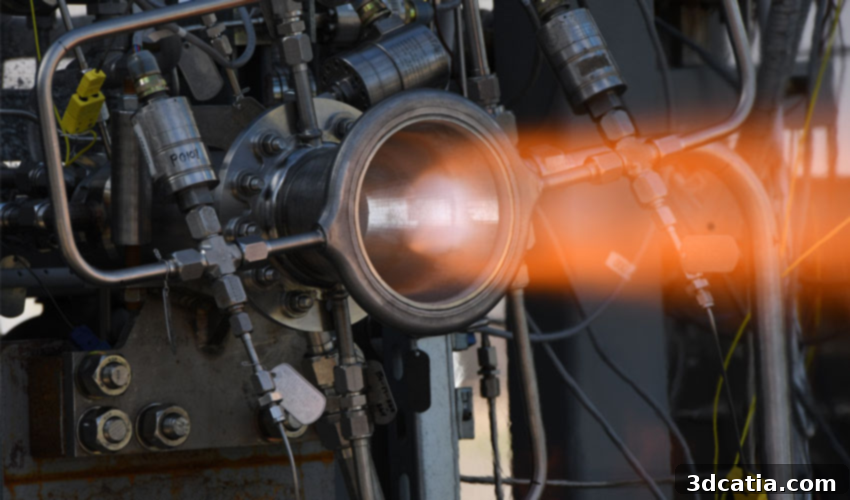
NASA’s Laser Wire Direct Closeout (LWDC): Revolutionizing Rocket Engine Nozzle Manufacturing with Advanced 3D Printing
Engineers at NASA’s Marshall Space Flight Center in Huntsville, Alabama, have achieved a significant breakthrough in advanced manufacturing with the development and rigorous testing of a novel metal additive manufacturing method known as Laser Wire Direct Closeout (LWDC). This innovative process holds immense promise for the aerospace industry, offering a pathway to produce critical rocket engine components, such as nozzles, with unprecedented speed and at substantially reduced costs. The introduction of LWDC signifies a pivotal step in NASA’s long-standing commitment to leveraging cutting-edge manufacturing techniques to streamline production, enhance performance, and accelerate the ambitious goals of space exploration.
NASA has been at the forefront of additive manufacturing adoption for a considerable period, integrating its capabilities across various facets of its operations. From facilitating 3D printing in space to enabling the development of stronger, more resilient materials and the design of sophisticated equipment, additive manufacturing has proven to be an indispensable tool. Furthermore, the agency actively fosters collaborations with external partners, exemplified by its partnership with companies like Relativity Space, which specializes in creating entire rockets through advanced additive manufacturing processes. These collaborations underscore NASA’s strategy to combine internal innovation with industry expertise to push the boundaries of what’s possible in aerospace engineering.
Relativity Space tests 3D-printed rockets at NASA Space Center
The recently unveiled Laser Wire Direct Closeout (LWDC) process represents a significant leap forward in metal additive manufacturing. Unlike traditional powder-bed fusion techniques, which rely on layers of metal powder, LWDC employs a concentrated energy wire metal deposition approach. This method utilizes a laser to melt and fuse metal wire, building up complex metal parts layer by layer with exceptional precision. NASA has already filed a patent for this groundbreaking LWDC technology, recognizing its potential to dramatically slash manufacturing timelines for complex components, reducing production cycles from several months to a mere few weeks. This acceleration in manufacturing speed is critical for rapid prototyping, agile development, and ultimately, faster mission readiness.
A core application of the LWDC process lies in its ability to meticulously close the delicate internal cooling channels of 3D-printed rocket engine nozzles. These channels are absolutely essential for the operational integrity and longevity of the nozzle. During engine operation, these incredibly thin nozzle walls are exposed to extremely high temperatures and immense thermal stresses, which could lead to catastrophic failure without effective cooling. The cooling channels are designed to circulate high-pressure coolant, which absorbs and dissipates this intense heat, thereby protecting the structural integrity of the nozzle and ensuring its proper function.
The necessity for active cooling in rocket engine nozzles is paramount. The internal cooling channels, precisely engineered within the engine nozzle’s structure, are responsible for maintaining optimal operating temperatures. For these channels to function effectively, they must be perfectly sealed to contain the high-pressure coolant, preventing leakage and ensuring that the nozzle walls are adequately cooled. Historically, closing these intricate channels has been a complex and time-consuming step in traditional manufacturing. NASA’s LWDC process excels in this critical function, allowing for the precise and robust closure of these cooling channels. Furthermore, it simultaneously forms a supportive “jacket” or outer structure that is integral to the nozzle’s ability to withstand the immense structural loads and pressures experienced during engine operation and thermal cycling.
Crédits photo : NASA/MSFC/Emmett Given
Paul Gradl, a senior propulsion engineer in Marshall’s Engine Components Development & Technology Branch, articulated the driving force behind this innovation, stating, “Our motivation behind this technology was to develop a robust process that eliminates several steps in the traditional manufacturing process.” He further elaborated on the inherent challenges, explaining, “The manufacturing process is further complicated by the fact that the hot wall of the nozzle is only the thickness of a few sheets of paper and must withstand high temperatures and strains during operation.” This highlights the extreme demands placed on rocket engine components and the need for manufacturing methods that can meet these stringent requirements while simplifying production. LWDC directly addresses these complexities by integrating multiple manufacturing steps into a single, efficient additive process, thereby reducing potential failure points and improving overall reliability.
The strategic advantages of LWDC extend beyond mere speed and cost. By moving away from powder-bed systems, LWDC inherently reduces material waste, as it only deposits material where needed. This “near-net-shape” manufacturing minimizes post-processing, which is often a costly and time-consuming aspect of traditional and even other additive manufacturing methods. The ability to directly build features like the cooling channel closeout and the structural jacket in one continuous process also simplifies the supply chain and reduces the number of specialized tools and fixtures required. This leads to a more agile and sustainable manufacturing ecosystem, crucial for the future of space exploration where every gram and every dollar counts.
The efficacy and reliability of NASA’s newly developed additive manufacturing technology have been thoroughly validated through extensive testing. Keystone Synergistic, a key partner, subjected a 3D-printed rocket engine nozzle, manufactured using the LWDC process, to a demanding testing regimen. The nozzle was tested for over 1040 seconds – a duration surpassing the operational time of many actual rocket firings – under extremely high pressures and temperatures designed to simulate real-world flight conditions. The successful completion of these rigorous tests unequivocally demonstrates the robustness and readiness of the LWDC technology for flight applications, paving the way for its integration into future rocket engines. This validation is a critical milestone, signifying that the technology is not just a laboratory curiosity but a viable, high-performance solution for some of the most challenging engineering problems in aerospace. Further detailed information and insights into this pioneering work can be found on NASA’s official website.
The implications of NASA’s LWDC technology are vast, promising to reshape not only how rocket engines are built but also to accelerate the pace of future space missions. By enabling faster, more cost-effective production of critical components, LWDC will support ambitious endeavors like the Artemis program, which aims to return humans to the Moon and establish a sustainable presence, and ultimately, missions to Mars. The ability to rapidly iterate on designs and quickly manufacture high-performance parts will provide engineers with unprecedented flexibility and responsiveness, fostering greater innovation in propulsion systems. This breakthrough solidifies additive manufacturing’s role as a cornerstone technology for the next generation of aerospace engineering, pushing the boundaries of what is achievable in space exploration.
What are your thoughts on this revolutionary 3D printing technology from NASA and its potential impact on space exploration? We invite you to share your insights in a comment below or engage with us on our Facebook and Twitter pages! Don’t miss out on the latest advancements in additive manufacturing – be sure to sign up for our free weekly Newsletter, delivering all the essential 3D printing news directly to your inbox!