

Revolutionizing Rocket Propulsion: NASA’s Groundbreaking Bimetallic 3D Printed Igniter
In a monumental leap forward for advanced manufacturing and space exploration, NASA has successfully tested a rocket engine igniter prototype meticulously crafted from two distinct metal alloys using cutting-edge 3D printing technology. This pivotal achievement marks a significant stride towards the widespread adoption of fully 3D-printed rocket engines, promising to redefine the landscape of aerospace manufacturing. For years, engineers at NASA have dedicated themselves to pushing the boundaries of additive manufacturing, and this latest innovation, employing a novel laser printing method, stands as a testament to their unwavering commitment. The immediate implications are profound: this new process is poised to dramatically accelerate production speeds by doubling them, concurrently reducing manufacturing costs by an estimated one-third.
The Evolution of 3D Printing in Rocketry
While the concept of 3D-printed rocket engines is not entirely new, with numerous developments and prototypes surfacing over the past decade, this particular breakthrough from NASA’s Marshall Space Flight Center represents an unprecedented milestone. It is the first instance where a rocket engine component has been successfully 3D-printed using more than one metal alloy in a single, continuous process, moving beyond conventional methods that typically involve single-material prints or complex post-processing. This intricate igniter, a critical component responsible for initiating the combustion process in rocket engines, demanded the collaborative expertise of engineers at Huntsville to achieve its bimetallic composition through additive manufacturing.
“It is a technological achievement to 3-D print and test rocket components made with two different alloys,” stated Preston Jones, Director of the Engineering Directorate at Marshall Space Flight Center, underscoring the innovative nature and inherent complexity of this groundbreaking work.
Historically, joining different metals for high-performance applications like rocket engines was a laborious and expensive endeavor. Traditional methods relied on welding or brazing, which often involved using a filler metal to bond the distinct materials. This process was not only time-consuming and cost-intensive but also introduced potential weak points due to the inherent stress concentrations at the interfaces of dissimilar materials. The advent of this new 3D printing methodology offers a transformative solution, presenting monumental benefits by eliminating these traditional constraints and opening doors to unprecedented material integration.
NASA’s Revolutionary Manufacturing Process: Automated Blown Powder Laser Deposition
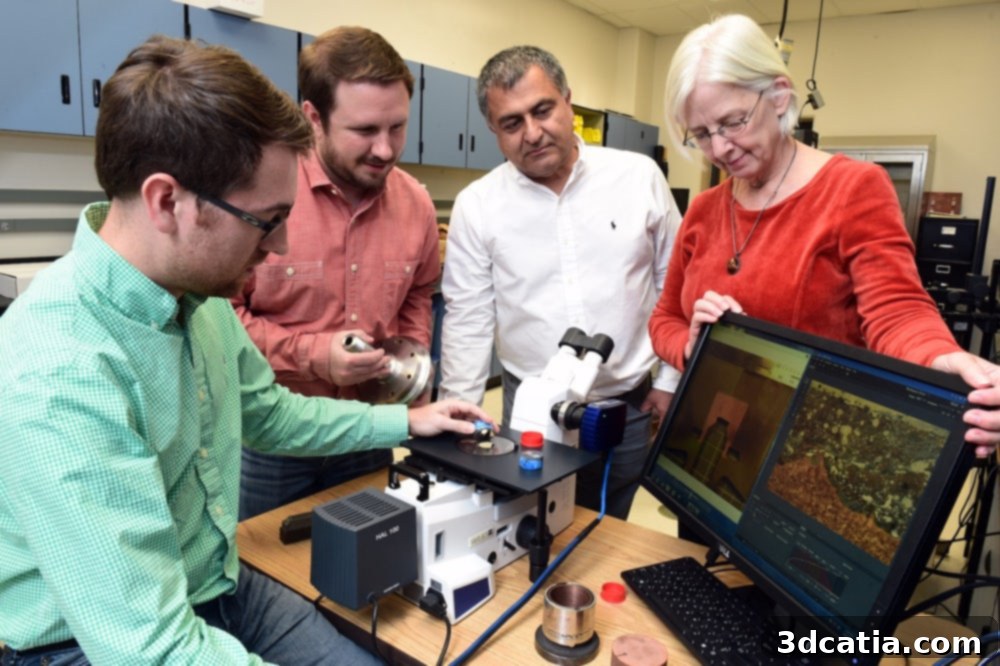
NASA engineers working on this recent breakthrough in bimetallic 3D printing.
The cornerstone of this innovation lies in a sophisticated technique NASA calls “Automated Blown Powder Laser Deposition.” This advanced additive manufacturing process effectively eliminates the need for post-print welding or brazing, simplifying the manufacturing workflow and enhancing structural integrity. In this method, a precisely controlled stream of metallic powder is introduced directly into the focal point of a powerful laser. The laser energy melts and fuses the powder particles, simultaneously bonding them with the underlying alloy layer that is being built. This continuous deposition process allows for the seamless integration of different materials within a single component. For this particular igniter, NASA capitalized on this technology to forge an incredibly robust material by fusing a copper alloy, renowned for its excellent thermal conductivity, with Inconel, a superalloy celebrated for its exceptional strength and resistance to extreme temperatures and corrosive environments. This strategic combination leverages the best properties of both materials, creating a component optimized for the harsh conditions inside a rocket engine.
The Power of Bimetallic Design and Integrated Production
The implementation of Automated Blown Powder Laser Deposition in conjunction with a hybrid computer-controlled machine allowed for the entire igniter to be manufactured as a single, monolithic piece. This represents a monumental improvement over previous designs, which typically required four separate components that had to be painstakingly joined together through traditional means. Creating the igniter in one integrated piece inherently boosts its reliability and structural integrity, removing the potential failure points associated with assembly and joining processes. Furthermore, this innovative method facilitated the creation of a new, high-performance bimetallic alloy that not only met but exceeded expectations. The prototype igniter successfully endured a rigorous testing regime in July, passing 30 low-pressure, hot-fire tests. These demanding tests simulate the extreme thermal and pressure environments encountered during actual rocket engine operation, validating the material’s durability and performance under stress.
Majid Babai, the project lead at Marshall’s Materials and Processes Laboratory, emphasized the multifaceted benefits of this technological advancement: “Eliminating the brazing process and having bimetallic parts built in a single machine not only decreases cost and manufacturing time, but it also decreases risk by increasing reliability.” He further elaborated on the foundational material science: “By diffusing the two materials together through this process, a bond is generated internally with the two materials and any hard transition is eliminated that could cause the component to crack under the enormous forces and temperature gradient of space travel.” This seamless internal diffusion is key to creating a truly robust and resilient component capable of withstanding the unparalleled stresses of rocket propulsion.
Transforming Aerospace Manufacturing and Space Exploration
The implications of NASA’s success extend far beyond the igniter itself. This pioneering work lays a strong foundation for the future of rocket engine manufacturing, paving the way for more complex, high-performance, and cost-effective propulsion systems. The ability to integrate multiple materials with disparate properties into a single, cohesive component opens up a new realm of design possibilities, allowing engineers to tailor parts precisely to specific functional requirements within an engine. Imagine nozzles with optimized thermal management zones, combustion chambers with enhanced structural integrity, and turbo-pumps with improved efficiency – all achievable through advanced bimetallic 3D printing.
The significant reduction in manufacturing time and cost, coupled with an increase in component reliability, will have a cascading effect across the aerospace industry. It will enable faster iteration of designs, reduce lead times for new rocket development, and potentially lower the overall cost of launching payloads into space. This efficiency is crucial for both government-led space missions and the rapidly expanding commercial space sector, fostering greater innovation and accessibility to space. NASA’s continued investment in additive manufacturing technologies underscores its commitment to pushing technological boundaries and enhancing the nation’s capabilities in space exploration.
The Future is 3D Printed
This achievement is a clear indicator that 3D printing is not just a prototyping tool but a transformative manufacturing method poised to become indispensable in the production of flight-ready hardware for the most demanding applications. As research continues, we can anticipate even more sophisticated bimetallic and multi-material components emerging from laboratories, further accelerating the pace of innovation in rocket science. The seamless integration of materials, once a formidable engineering challenge, is now becoming a reality, allowing for previously impossible designs to be manufactured with precision and efficiency. NASA’s pioneering efforts with the bimetallic igniter set a new standard for what is achievable in additive manufacturing and propel humanity closer to a future where space travel is more sustainable, reliable, and commonplace.
Are you interested in hearing about more exciting developments in the world of 3D printing and its impact on various industries? We encourage you to share your thoughts and questions in a comment below or join the conversation on our Facebook and Twitter pages! Don’t miss out on the latest breakthroughs – sign up for our free Newsletter to receive all the crucial news in 3D printing directly in your inbox!