
NASA’s 3D-Printed Spring Deployed in Space: Revolutionizing Spacecraft Technology
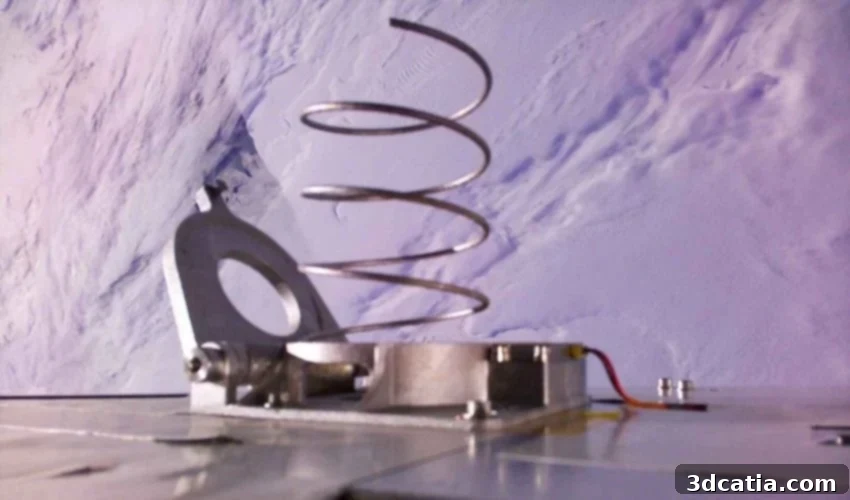
On February 3rd, as the Mercury One satellite soared across the Earth’s orbit, a groundbreaking experiment unfolded. A small container released a titanium spring, demonstrating a simple yet disruptive movement. This was the JPL Additive Compliant Canister (JACC), a technology demonstration developed by NASA’s Jet Propulsion Laboratory (JPL) to showcase the immense potential of additive manufacturing, also known as 3D printing, in space applications.
The JACC represents a significant advancement in spacecraft technology. It’s a compact spring system meticulously designed to precisely deploy antennas on future orbiters. These sophisticated spacecraft are designed to circle planets or moons for extended periods, diligently studying them from the vast expanse of space. NASA strategically chose to rigorously test the capabilities of additive manufacturing under genuine operating conditions, and the results have been overwhelmingly successful, paving the way for future innovations in space exploration.
The JACC spring serves as an exemplary model of Design for Additive Manufacturing (DfAM). DfAM is a design approach that optimizes a part’s design specifically for 3D printing, leveraging the unique capabilities of the technology. This approach enables the creation of parts with complex geometries, intricate internal structures, and tailored material properties that are challenging or even impossible to achieve with traditional manufacturing methods. The JACC spring expertly embodies this principle, utilizing three times fewer components than comparable structures. This is achieved by ingeniously combining a hinge, a panel, a compression spring, and two torsion springs into a single, unified part. The innovative spring design draws inspiration from communication antennas, which are commonly used on satellites for transmitting and receiving data.
Deployment of the JACC over the Pacific Ocean. Credits: NASA / JPL
Key Figures for the JACC Component:
-
Material: Titanium
-
Weight: 498 grams
-
Size of the entire system: Approximately 10 cm per side
-
Spring deployment range: Extends from 3 cm (compressed) to 15 cm (full deployment height)
-
Development time: Achieved in less than one year
The JACC was meticulously 3D printed entirely in titanium, capitalizing on the metal’s exceptional strength-to-weight ratio and remarkable elastic response. These properties are crucial for ensuring the spring’s reliability and performance in the harsh conditions of space. In a press release, NASA’s Jet Propulsion Laboratory emphasized the significance of this achievement, stating: “The success of JACC unequivocally demonstrates that 3D-printed mechanisms can be constructed faster, more economically, and with significantly less complexity compared to traditionally manufactured space hardware.” This statement underscores the transformative potential of additive manufacturing in revolutionizing the way spacecraft components are designed and produced.
The JACC wasn’t launched in isolation. It was an integral part of the PANDORASBox experiment, which also featured the SUM deployable antenna. What truly distinguishes this project and resonates within the industry is the remarkable speed of execution. Both the JACC and the SUM antenna were meticulously designed, expertly manufactured, rigorously tested, and successfully delivered for flight in under a year, all while adhering to minimal budgetary constraints. This showcases the agility and efficiency that additive manufacturing can bring to space exploration projects. For those interested in delving deeper into the details, you can access the Jet Propulsion Laboratory’s official statement here.
The successful deployment of the 3D-printed JACC spring in space marks a pivotal moment in the advancement of space exploration technology. The ability to create complex, high-performance components rapidly and cost-effectively through additive manufacturing opens up a realm of possibilities for future missions. From designing more efficient antennas to developing innovative deployment mechanisms, 3D printing is poised to play a crucial role in shaping the future of space exploration. This technology enables engineers to create customized solutions tailored to the specific needs of each mission, optimizing performance and reducing development time. As 3D printing technology continues to evolve, we can anticipate even more groundbreaking applications in the realm of space exploration, propelling us further into the cosmos.
Let’s discuss the implications of this achievement. What do you envision as the future applications of 3D printing in space? How will this technology shape the way we design and build spacecraft? Share your thoughts in the comments below and join the conversation on our LinkedIn or Facebook pages! Also, be sure to subscribe to our complimentary weekly Newsletter to stay up-to-date with the latest advancements in the 3D printing industry. You can also find insightful videos on our YouTube channel. If you’re interested in learning more about the applications of 3D printing in the automotive and transportation sectors, visit our dedicated page HERE.
*Cover photo: The JACC mechanism as the spacecraft flew over Antarctica. Credits: Proteus Space / Jet Propulsion Laboratory.
The impact of the JACC extends far beyond a single successful deployment. It provides valuable data and insights for future projects, demonstrating the reliability and durability of 3D-printed components in the extreme environment of space. This opens the door for further exploration of additive manufacturing for critical applications such as structural components, propulsion systems, and even in-space manufacturing. Imagine a future where astronauts can 3D-print replacement parts or tools on demand, reducing the need for costly and time-consuming resupply missions. This could revolutionize long-duration spaceflights and enable more ambitious exploration endeavors.
The JACC project also highlights the importance of collaboration between industry, academia, and government agencies in advancing technological innovation. By working together, these entities can pool their resources and expertise to overcome challenges and accelerate the development of groundbreaking technologies. This collaborative approach is essential for driving progress in space exploration and ensuring that the benefits of these advancements are shared by all. The success of the JACC is a testament to the power of collaboration and a shining example of what can be achieved when diverse talents come together to pursue a common goal.
Furthermore, the JACC serves as an inspiration for aspiring engineers and scientists, demonstrating the potential of additive manufacturing to transform the way we design and build things. By showcasing the possibilities of this technology, the JACC can spark curiosity and encourage young people to pursue careers in STEM fields, contributing to the next generation of innovators. As 3D printing becomes more accessible and affordable, it empowers individuals and small businesses to create their own solutions to real-world problems, fostering entrepreneurship and driving economic growth. The JACC is a symbol of innovation and a reminder that anything is possible with creativity, determination, and the right tools.
In conclusion, NASA’s successful deployment of the 3D-printed JACC spring in space is a significant milestone in the evolution of space exploration technology. It demonstrates the transformative potential of additive manufacturing to reduce costs, improve performance, and accelerate development timelines. The JACC is a testament to the power of innovation, collaboration, and the human spirit of exploration. As we continue to push the boundaries of what is possible, 3D printing will undoubtedly play an increasingly important role in shaping the future of space exploration and enabling us to reach for the stars.