
Nanoscribe’s Precision Microfabrication: Advancing Nanoscale 3D Printing with Two-Photon Polymerization (2PP)
Since its inception, Nanoscribe has been at the forefront of revolutionizing microfabrication. In 2007, the company embarked on a journey to redefine the capabilities of additive manufacturing by integrating its groundbreaking two-photon polymerization (2PP) technology into advanced 3D printers. This pioneering move enabled the fabrication of structures with unparalleled precision across nano, micro, and mesoscales. Today, Nanoscribe stands as a global leader in high-precision nanoscale additive manufacturing, boasting a vast customer base spanning over 30 countries across both scientific research and industrial applications. Their continuous pursuit of innovation consistently pushes the boundaries of what is possible in the realm of advanced microfabrication solutions. A testament to this technological prowess was recently shared in a captivating fly-over video sequence, composed of intricate scanning electron microscope (SEM) images, vividly demonstrating the extraordinary power and versatility of their systems.
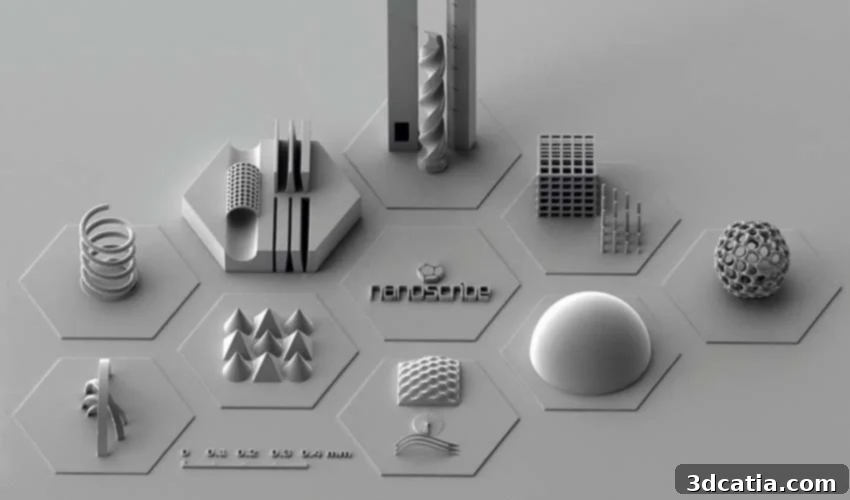
The aforementioned video offers a breathtaking glimpse into the world of ultra-precise 3D printing, showcasing an array of exquisitely intricate and filigree structures produced using Nanoscribe’s cutting-edge systems. In a remarkable display of efficiency and capability, 18 distinct objects and complex structures were fabricated in just over one hour, demonstrating the speed and precision inherent in their 2PP technology. As observers can clearly discern in the video, these objects span a multitude of diverse shapes and geometries. This includes challenging features such as delicate undercuts, highly porous designs, intricate curved surfaces, stable upright structures, and impeccably smooth finishes. This diverse output underscores Nanoscribe’s claim that their state-of-the-art microfabrication tools are designed to overcome previously insurmountable design limitations that plagued traditional manufacturing methods. The ability to create such a wide variety of complex geometries with submicron resolution opens up unprecedented possibilities for researchers and engineers alike. Nanoscribe further elaborates on this, explaining that their technology facilitates the creation of customizable topographies, featuring both continuous and discrete modulations, which can seamlessly alternate with complex, delicate 3D micro lattices. This level of control ensures that the surface roughness of the fabricated parts remains exceptionally low, typically in the range of just a few nanometers, a critical factor for many high-performance applications in fields like optics and microfluidics.
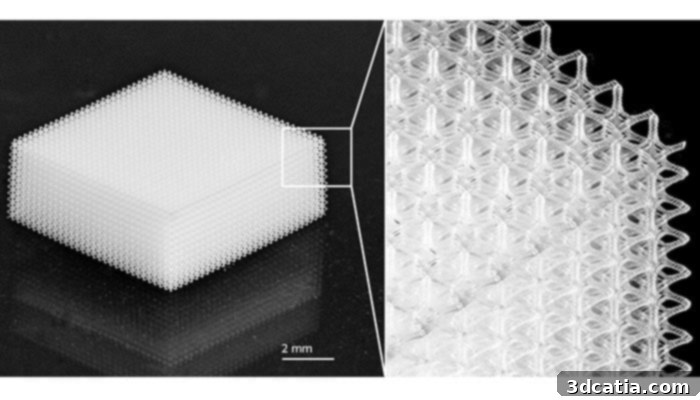
The filigree scaffold on the millimeter scale (7.5 x 7.5 x 3 mm³) with micrometer precision structural details | Credits: Nanoscribe
At the heart of Nanoscribe’s advanced microfabrication ecosystem lies the Photonic Professional GT2 printer. This sophisticated system masterfully merges the extraordinary precision afforded by two-photon polymerization with a streamlined 3D printing workflow, tailored specifically for the creation of structures across the nano, micro, and mesoscales, extending up to impressive millimeter dimensions. The unique advantages of 2PP technology are critical here: it enables true 3D printing by focusing a femtosecond laser into a photopolymer resin. This highly localized polymerization process allows for the creation of features far smaller than the wavelength of light itself, bypassing the diffraction limit that constrains many other additive manufacturing techniques. This fundamental capability is what empowers the Photonic Professional GT2 to achieve such incredibly fine details and complex geometries. Furthermore, the printer boasts an open materials system, providing users with exceptional flexibility and a broad spectrum of material choices. This extensive material range includes various photopolymer resins – both widely available commercial resins and custom-formulated options – as well as specialized hydrogels, and even bespoke materials developed for niche applications. This versatility makes the Photonic Professional GT2 an indispensable tool for a diverse array of applications, spanning from the highly specialized fields of micro-optics and photonics, where precise light manipulation is paramount, to critical areas such as bioengineering, for scaffolding and cell research, and the development of micro-electromechanical systems (MEMs), which require exact geometries at tiny scales. To complement its open materials platform, Nanoscribe also diligently develops and provides its own proprietary range of high-performance liquid negative-tone resins, specifically optimized for 2PP-based 3D printing. Among their latest innovations in material science is IP-Q, a revolutionary printing material. IP-Q is celebrated as the ideal choice for rapid mesoscale fabrication, distinguishing itself with its ability to reliably produce object volumes of up to cubic millimeters with remarkable speed and precision, further expanding the scope of what Nanoscribe’s technology can achieve in industrial and research settings.

Credits: Nanoscribe
Beyond their revolutionary hardware and materials, Nanoscribe also provides comprehensive software solutions meticulously designed to integrate seamlessly with their Photonic Professional systems. This integrated software suite is a cornerstone of the user-friendly experience, simplifying the entire 3D printing workflow from design to physical output. According to Nanoscribe, this sophisticated software enables users to effortlessly transform complex CAD models – often originating from intricate computer-aided design processes – into tangible, high-precision 3D printed parts. The critical advantage here is the ability to achieve submicron precision, meaning details are reproduced with an accuracy of less than one micrometer. This level of detail is essential for the functionality of micro-optical components, the efficacy of bio-scaffolds, and the reliable operation of MEMS devices. The intuitive interface and powerful processing capabilities of the software ensure that even highly complex geometries, with their aforementioned undercuts, porous structures, and delicate lattices, can be prepared for printing with minimal effort. This complete ecosystem, combining cutting-edge 2PP hardware, versatile materials, and intelligent software, positions Nanoscribe as a comprehensive solution provider for advanced nanoscale additive manufacturing. Their integrated approach ensures that customers can fully leverage the immense potential of two-photon polymerization for their specific research and industrial needs, fostering innovation across a wide array of scientific and engineering disciplines. By providing a holistic solution, Nanoscribe not only supplies equipment but also empowers its users to push the boundaries of miniaturization and functionality in their respective fields.
Nanoscribe’s consistent innovation and global presence underscore its pivotal role in the future of high-precision manufacturing. Their technology is not merely an incremental improvement; it represents a paradigm shift in how intricate, micro- and nanoscale devices are conceived and produced. From developing next-generation micro-optics that can steer light with unprecedented accuracy, to creating highly complex and biocompatible scaffolds for advanced tissue engineering, the applications of Nanoscribe’s 2PP 3D printing solutions are continually expanding. The company’s commitment to an open materials platform further democratizes advanced microfabrication, allowing researchers and industrial partners to experiment with novel photopolymers and custom formulations, thereby accelerating discovery and product development. This adaptability is crucial in fast-evolving fields like personalized medicine, advanced electronics, and quantum computing, where the ability to rapidly prototype and iterate on microscopic designs is a significant competitive advantage. As industries increasingly demand miniaturization without compromising performance, Nanoscribe’s role as a leader in nanoscale additive manufacturing will only grow, shaping the landscape of future technological advancements and enabling breakthroughs that were once confined to the realm of science fiction.
For those eager to delve deeper into Nanoscribe’s pioneering work and their comprehensive range of microfabrication solutions, further information is readily available HERE.
We invite your thoughts on these remarkable nano 3D printed structures and the incredible potential of Nanoscribe’s technology. Share your insights by leaving a comment below, or engage with us on our Facebook and Twitter pages! To stay abreast of all the latest advancements and news in the dynamic world of 3D printing, don’t miss out – sign up for our free weekly Newsletter, delivering the most important updates directly to your inbox!