
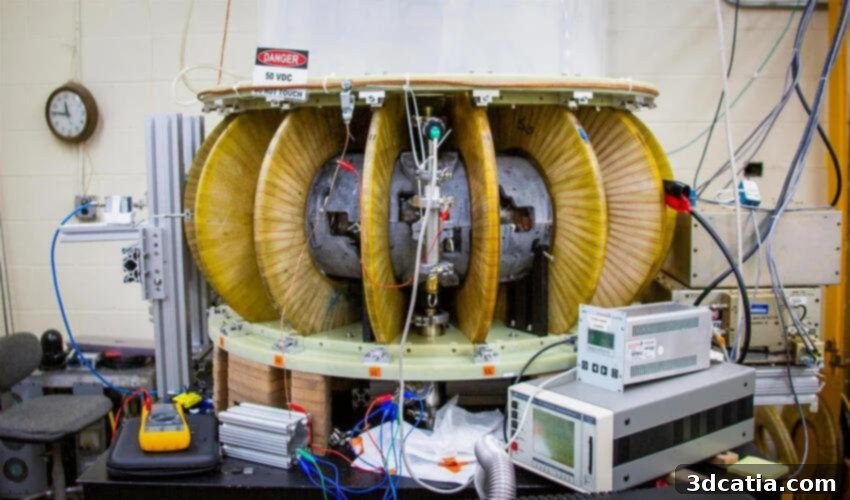
Unlocking Affordable Fusion: How 3D Printing and Permanent Magnets Are Revolutionizing Stellarator Design at PPPL
The global quest for sustainable and clean energy has never been more urgent. As humanity grapples with the challenges of climate change and dwindling fossil fuel reserves, technological advancements in energy production, particularly those free from reliance on fossil fuels, are experiencing exponential growth. This progress is largely facilitated by the emergence of new energy sources and increasingly cleaner, more efficient processes. Among these innovations, nuclear fusion stands out as a beacon of hope, promising a virtually limitless and inherently safe power source. Central to harnessing this immense power is the study of plasma, often referred to as the fourth state of matter. While plasma holds incredible potential due to its immense strength and energy, it is also notoriously unstable and challenging to control. To explore and ultimately harness its power for fusion, highly specialized devices are meticulously engineered and constructed, such as stellarators – complex magnetic confinement devices designed to create and sustain the extreme conditions necessary for fusion reactions. Today, we delve into a prime example of such groundbreaking innovation: the MUSE stellarator, a project at the forefront of plasma research, which is experiencing a surge in advancements largely thanks to the transformative capabilities of additive manufacturing.
The Princeton Plasma Physics Laboratory (PPPL), a world leader in fusion energy research, has brought together a team of dedicated researchers and engineers to create a new type of stellarator generator known as MUSE (Multi-faceted University Stellarator Experiment). What makes MUSE particularly innovative is its pioneering use of permanent magnets and a novel, precisely engineered 3D printed housing. This groundbreaking approach to stellarator design is not merely an incremental improvement; it represents a significant leap forward in making nuclear fusion research more accessible and affordable. MUSE is based on a less complex and significantly less expensive production technique compared to its predecessors, a development poised to open up new avenues of study in nuclear fusion power plants and accelerate the timeline for practical fusion energy. The researchers at PPPL turned to the development of MUSE as an enhanced solution for two pivotal reasons. Firstly, they have ingeniously opted for magnets with simpler geometries, moving away from the intricate and costly electromagnets typically used. Secondly, and equally crucial, 3D printing has enabled the creation of an exquisitely precise, flawlessly circular casing, perfectly suited for containing the volatile plasma and providing the necessary structural integrity for the entire assembly.
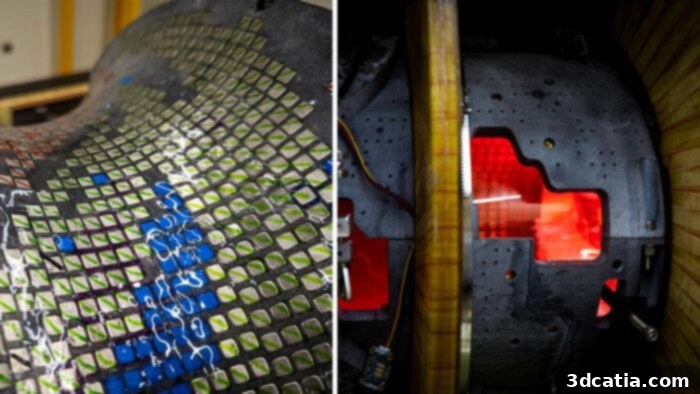
Permanent magnets from MUSE (left). The 3D printed housing (right).
Historically, the star generators or stellarators manufactured for fusion research have been prohibitively expensive, a major barrier to accelerating scientific progress in the field. This high cost primarily stemmed from their reliance on complex electromagnetic structures. These traditional stellarators required intricately shaped electromagnets, which not only possessed highly complex geometries but also demanded a continuous, substantial flow of electricity to generate their own powerful magnetic fields. This constant energy consumption added significantly to operational costs and engineering complexity. However, recent pioneering research at PPPL has demonstrated a paradigm-shifting alternative: the feasibility of using permanent magnets. These “refrigerator magnets,” as they are sometimes playfully referred to, possess inherent magnetic fields and, under optimal conditions, can perform the critical function of plasma confinement previously reserved for energy-intensive electromagnets. This discovery is a game-changer, promising substantial reductions in both construction and operational expenses. To effectively support and position these permanent magnets, while also ensuring they can withstand the immense magnetic forces generated during operation, a robust, precisely shaped circular structure was indispensable. This is precisely where the unparalleled capabilities of additive manufacturing, or 3D printing, emerged as the ideal solution.
The Critical Role of 3D Printing in Manufacturing the MUSE Stellarator
The successful realization of the MUSE stellarator hinges significantly on the judicious application of additive manufacturing. In their conclusive findings, the PPPL researchers revealed that 3D printing not only met but exceeded all the rigorous manufacturing requirements for the intricate outer casing of the device. Leveraging the unparalleled design freedom offered by additive manufacturing, they were able to create a unique double-curvature bracket. This bracket is incredibly complex, featuring multiple cavities of varying inclinations and radii, each meticulously designed to house the array of permanent magnets. Such a project, characterized by its superior geometric complexity and precision demands, would have been exceedingly difficult, if not impossible, to achieve with conventional manufacturing methods. Traditional machining or molding processes would have faced severe limitations in producing the intricate internal geometries and complex curvatures required for optimal magnet placement and plasma containment. Furthermore, 3D printing facilitated rapid prototyping, an invaluable advantage during the developmental stages. Several partial and full-scale prototypes were manufactured, all utilizing 3D printing, allowing the team to test, iterate, and refine their design with unprecedented speed and efficiency before committing to the final build. This iterative design process significantly reduced development time and costs, highlighting the transformative power of additive manufacturing in advanced scientific research.
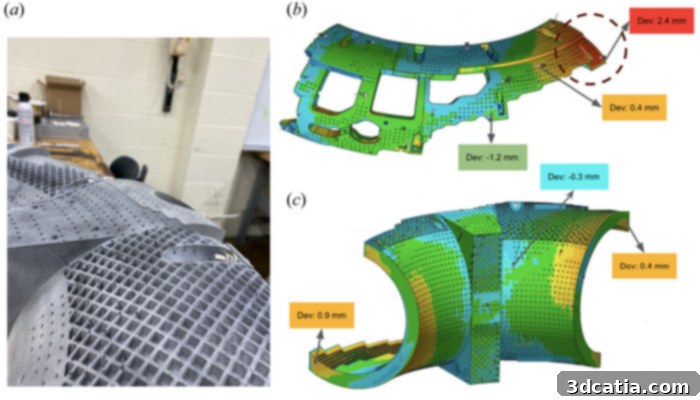
Printed part and its rendering in OpenSCAD
The journey from concept to tangible reality for MUSE involved a sophisticated blend of advanced design software and cutting-edge 3D printing technology. The stellarator’s intricate components were meticulously crafted using OpenSCAD, a powerful programmatic 3D CAD modeling software. OpenSCAD’s script-based approach allowed the researchers to define complex geometries with extreme precision and parameterization, which is crucial for such an experimental device. This design flexibility was essential for creating the unique double-curvature structure and the precise magnet cavities. To bring these designs into the physical world, PPPL utilized the advanced capabilities of HP’s Multi Jet Fusion (MJF) technology. The research team carefully weighed their manufacturing options and ultimately settled on MJF for its remarkable ability to capture even the smallest details with exceptional finesse and accuracy, ensuring that the critical tolerances required for magnetic confinement were met. While exploring alternatives such as selective laser sintering (SLS), concerns arose regarding potential distortions due to uneven cooling during the manufacturing process. These thermal distortions could compromise the dimensional accuracy and structural integrity of the final part, a critical risk in a device designed for high-precision plasma control. Consequently, the team opted out of the SLS approach, reinforcing MJF as the superior choice for this demanding application.
The implications of MUSE’s successful development extend far beyond the laboratory. As stated in a recent PPPL press release, the creation of MUSE could profoundly impact the field of fusion energy by laying the groundwork for the development of more affordable and more widely accessible stellarator generators. The integration of 3D printing has unequivocally conferred significant advantages, reducing the costs associated with both the extensive testing phases and the final product. Michael Zarnstorff, a senior research physicist at PPPL, articulates this economic benefit succinctly: “MUSE is largely built with commercially available parts. By working with 3D printing companies and magnet suppliers, we can shop around and buy the precision we need instead of making it ourselves.” This strategic shift from in-house, custom fabrication of every complex component to leveraging commercially available, precisely manufactured parts, marks a critical step towards democratizing fusion research. It allows more institutions to engage in vital experiments without the exorbitant upfront investment previously required, thereby accelerating the pace of discovery and innovation in this crucial sector. The MUSE project exemplifies how innovative manufacturing techniques, combined with smart material choices, can significantly lower the barrier to entry for advanced scientific research, bringing the dream of clean, limitless fusion energy closer to reality.
This pioneering work demonstrates a clear path forward for future fusion devices, emphasizing both cost-effectiveness and precision. As the world increasingly seeks sustainable energy solutions, projects like MUSE highlight the critical role that advanced manufacturing technologies, especially 3D printing, play in enabling scientific breakthroughs. The ability to rapidly prototype, iterate designs, and produce highly complex components with unprecedented accuracy and affordability is not just changing how stellarators are built; it is fundamentally altering the trajectory of fusion energy research. This fusion of physics, engineering, and additive manufacturing represents a powerful synergy that promises to unlock the immense potential of plasma and deliver a cleaner, brighter energy future for generations to come. To delve deeper into the intricate details of this transformative project, including the specific design parameters and experimental results, please click here to access the full research paper.
What do you think of this MUSE project and its implications for the future of fusion energy? We invite you to share your thoughts and insights in a comment below or join the conversation on our LinkedIn, Facebook, and Twitter pages! Don’t forget to sign up for our free weekly newsletter here to receive the latest 3D printing news straight to your inbox! You can also find all our compelling videos and interviews on our dedicated YouTube channel, exploring more innovations in additive manufacturing.
*All Photo Credits: PPPL