
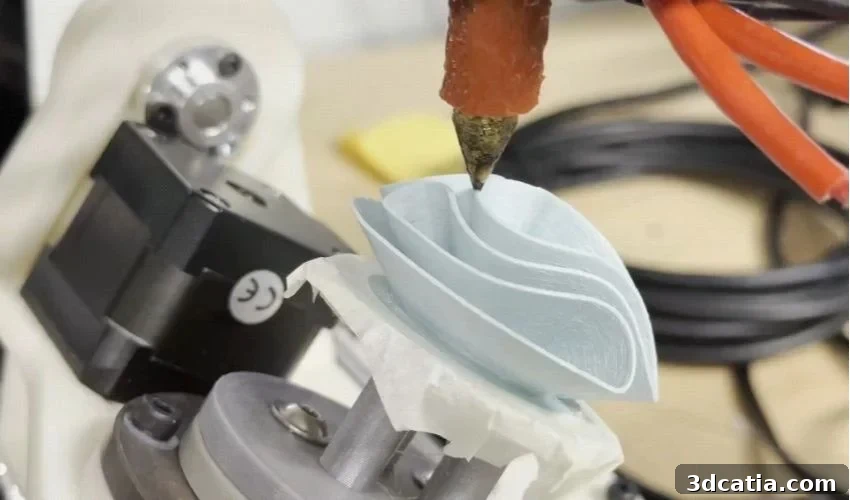
In the world of technology, 3D printing can sometimes feel like science fiction. While many of us are familiar with printers building objects layer by layer along the traditional X, Y and Z axes, a newer approach is gaining traction: multi-axis 3D printing. By expanding movement beyond the conventional three directions, this technique opens possibilities for more complex geometries, improved mechanical performance, and reduced post-processing. This article explains how multi-axis printing works, why it matters, and which developments are driving adoption.
At its core, multi-axis 3D printing adds rotational and tilting motions to the standard linear movements of conventional systems. Typical printers—Cartesian, CoreXY or Delta—operate on three linear axes: forward-backward, left-right and up-down. Multi-axis machines augment those motions with additional degrees of freedom, often reaching five, six or more axes. Rotation can be integrated into the print head, the build plate, or both, and the movements are coordinated to lay material down in alignment with the part’s geometry. This enables conformal or non-planar deposition, where the nozzle follows curves and contours instead of producing a stack of flat, stepped layers.
Advantages of Multi-Axis 3D Printing
Orienting the contact point between the nozzle and the part addresses many of the common drawbacks of fused deposition modeling (FDM):
- No supports required: By tilting the part or the nozzle as it prints, overhangs can be deposited onto already-printed geometry, reducing material waste and cutting down on manual post-processing.
- Improved structural integrity and near-isotropy: Standard layered prints can be weak between layers. Multi-axis deposition aligns material with load paths, increasing strength in the intended directions and reducing anisotropy.
- Smoother surfaces: Eliminating the stair-step effect on curved surfaces markedly reduces roughness. Field tests report surface roughness improvements from values near 38 µm down to about 12 µm, often avoiding the need for sanding.
Reliable multi-axis printing depends on tight synchronization between hardware and software. Hardware approaches include gantry systems, which prioritize stability, and robotic arms, which provide reach and flexibility. Software handles path planning, collision avoidance and optimized material flow; examples of dedicated toolchains for this kinematics include ADAXIS’s AdaOne and specialized multi-axis slicers that generate coordinated motion commands in real time.
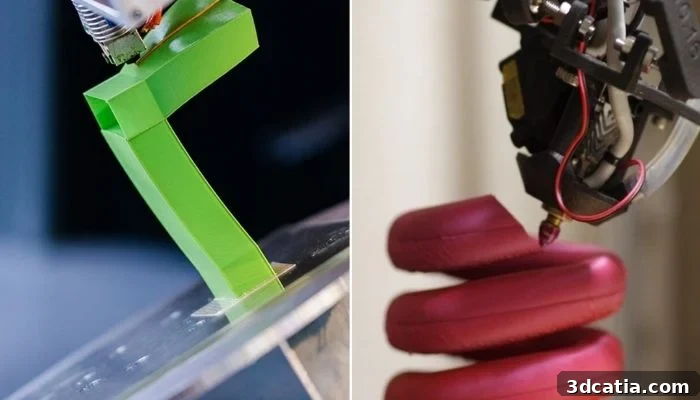
In multi-axis 3D printing, the material follows the actual geometry of the design (photo credits: University of Stuttgart [left], MAGE Printing [right]).
Applications of Multi-Axis 3D Printing
The additional control over orientation and deposition makes multi-axis printing valuable across several industries:
- Aerospace: fabrication of turbine blades and optimized lightweight supports with complex internal cooling channels.
- Construction: robotic-arm concrete printing for walls and facades with significant overhangs, enabling architectural freedom.
- Repair and maintenance: rebuilding worn or damaged areas on metal components without full part replacement.
- Electronics: direct printing of conductive traces onto curved or organic surfaces for integrated devices.
Hybrid machines from established manufacturers—combining metal additive processes and CNC milling—have brought multi-axis capabilities to industrial production. Companies like DMG Mori, Meltio and Mazak integrate multi-axis metal deposition with subtractive finishing in single units. Historically confined to large-scale industrial use, multi-axis kinematics are now moving toward smaller, professional platforms; for example, collaborations between Aibuild and Generative Machine Company produced a 5-axis desktop printer aimed at professional users.
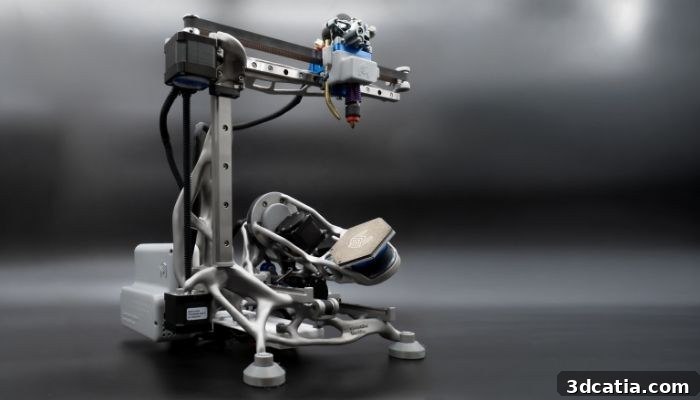
The FFF GenerationOne 5-Axis printer from Aibuild and Generative Machine Company (photo credit: Generative Machine).
Multi-axis 3D printing demonstrates the industry’s shift from simple layered manufacturing toward more flexible, geometry-driven processes. By enabling deposition that conforms to the part rather than forcing the part to conform to layered steps, these systems deliver efficiency, performance and surface quality improvements that expand the range of printable designs.
What are your thoughts on multi-axis 3D printing? Share your perspective in the comments. If you follow industry discussions on social networks, you can continue the conversation on your preferred platforms. Sign up for newsletters from trusted sources to stay informed about advances in additive manufacturing and related technologies.
*Cover Photo Credit: Ivan Revenga Riesco