
Mosquito Proboscis: A Novel Biodegradable Micro-Nozzle for High-Resolution 3D Printing
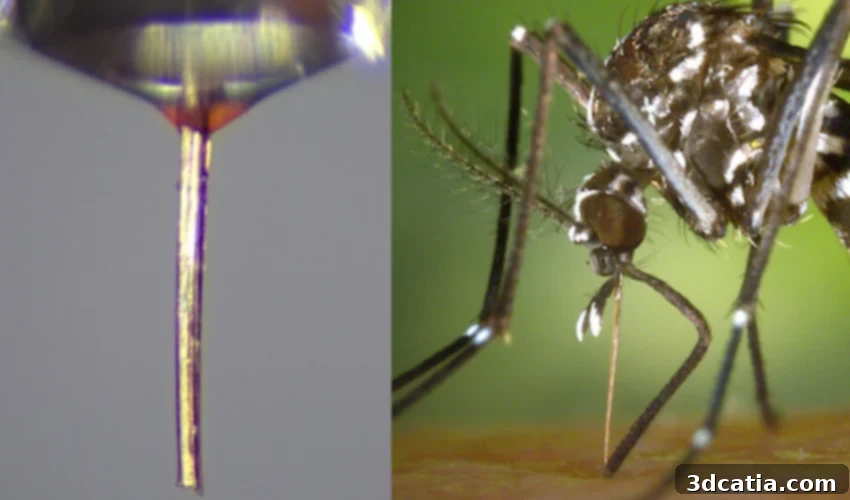
Imagine using mosquitoes, typically seen as irritating pests, as tools for advanced micro-fabrication. Researchers at McGill University have pioneered a groundbreaking technique demonstrating that the proboscis of a deceased female mosquito can be repurposed as a biodegradable micro-nozzle for high-resolution 3D printing. This innovative approach, dubbed “3D necroprinting,” leverages the natural microfluidic structure of the mosquito’s proboscis to achieve printing resolutions comparable to, and in some cases exceeding, those of commercially available micro-nozzles, but at a significantly lower cost.
Conventional high-precision nozzles, essential for ultra-fine printing in various fields like biomedicine and microelectronics, are often expensive and designed for single-use applications. This leads to both high operational costs and significant waste generation, presenting a barrier to widespread adoption of micro-scale 3D printing. The McGill team sought a more sustainable and cost-effective solution by exploring naturally occurring microfluidic structures. Their investigation led them to the mosquito proboscis, a slender, elongated structure perfectly suited for micro-scale extrusion due to its inherent geometry. The proboscis exhibits a naturally straight, uniformly shaped channel with an inner diameter ranging from 20 to 25 micrometers, making it an ideal candidate for precise material deposition.
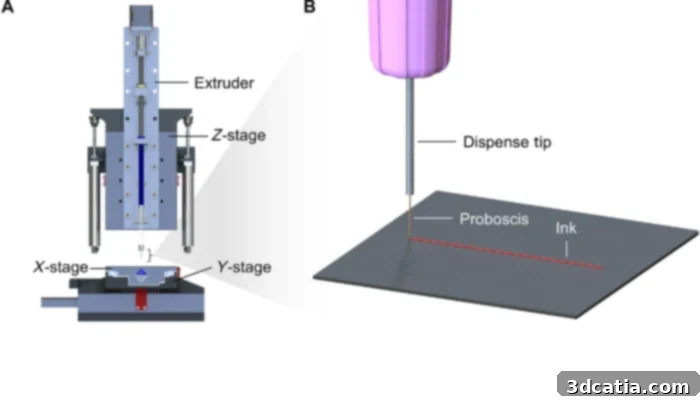
Concept and configuration of 3D necroprinting (Photo Credit: Scientific Advances)
Turning Mosquitoes into Micro-Printing Powerhouses
Despite its seemingly fragile appearance, the mosquito proboscis possesses remarkable structural integrity. Tests conducted by the researchers revealed that the proboscis can withstand internal pressures of up to 60 kilopascals without rupturing. This pressure tolerance is sufficient to effectively push viscous bioinks through the narrow channel, enabling the printing of complex microstructures. To demonstrate the feasibility of this approach, the McGill team developed a direct ink writing setup. They carefully attached the mosquito proboscis to a standard 30G metal tip, which served as an interface to a syringe-based extruder. This configuration allowed for precise control over the movement of the proboscis across the print bed, facilitating the layer-by-layer construction of three-dimensional objects.
Ensuring consistent and reliable printing required a thorough understanding of how different inks behave within the natural channel of the proboscis. The researchers meticulously analyzed the flow characteristics of various materials, identifying optimal operating conditions that minimized the risk of clogging or breakage. Within these carefully defined parameters, the mosquito-based nozzle demonstrated surprisingly robust performance. Using commercially available bioinks, such as Cellink Start and Pluronic F 127, the team successfully printed intricate honeycomb structures and three-dimensional scaffolds containing B16 cancer cells. The resulting filaments exhibited remarkably consistent diameters, ranging from 18 to 28 micrometers. Notably, cell viability within the printed scaffolds remained high, averaging around 86 percent, indicating that the printing process did not significantly compromise cell health.
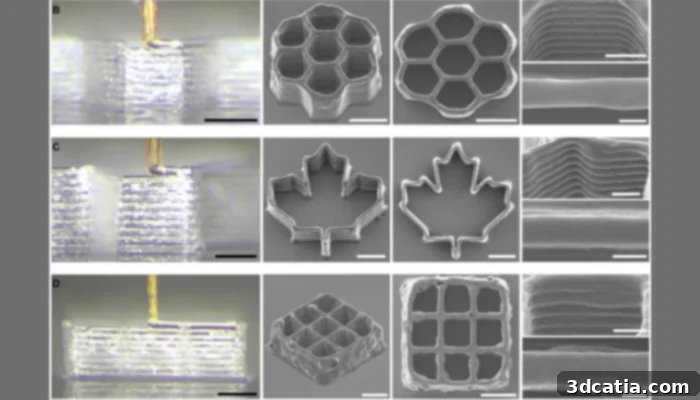
Printed Microstructures of 3D Necroprinting. (Photo Credit: Scientific Advances)
The Sustainable Future of Micro-Scale 3D Printing
The primary advantages of 3D necroprinting lie in its cost-effectiveness and environmental sustainability. Mosquitoes can be raised inexpensively in controlled environments, making them a readily available resource. The researchers estimate that the cost of producing each bio-nozzle is less than one dollar, a fraction of the cost of traditional micro-nozzles. Furthermore, the mosquito proboscis is biodegradable, reducing the environmental impact associated with disposable printing components. When stored properly, the proboscis can remain functional for several months, making it a practical consumable for research laboratories and other applications.
While glass pulled nozzles can achieve even higher resolutions than mosquito-based nozzles, they are brittle, costly to manufacture, and prone to inconsistencies in their dimensions. The mosquito-based nozzle occupies a unique niche, offering a compelling balance of fine resolution, predictable performance, and significantly reduced waste. This makes it an attractive alternative for applications where cost and sustainability are paramount considerations. The potential applications extend beyond biomedical research, including microelectronics, materials science, and even art and design.
3D necroprinting represents a paradigm shift in how biological structures can be integrated into additive manufacturing. Rather than simply mimicking nature, this innovative approach directly utilizes natural components. In this case, the often-despised mosquito is transformed from a nuisance into a valuable tool for advanced manufacturing. This bio-inspired approach opens new avenues for sustainable and cost-effective micro-fabrication, pushing the boundaries of what is possible in the field of 3D printing.
The research highlights a novel approach to micro-scale 3D printing, leveraging readily available and biodegradable materials to achieve high resolution at low cost. The use of mosquito proboscises represents a significant step towards more sustainable and accessible micro-fabrication technologies. This innovation has the potential to revolutionize various fields, from biomedical engineering to advanced materials research, by providing a cost-effective and environmentally friendly alternative to traditional methods.
Beyond its practical applications, 3D necroprinting also raises intriguing ethical considerations regarding the use of biological materials in manufacturing processes. As the field progresses, it will be crucial to address these ethical concerns and ensure that the technology is developed and implemented responsibly.
The McGill University research team’s work has sparked considerable interest within the scientific community and beyond. Researchers are now exploring the possibility of using other natural structures, such as spider silk or plant fibers, as templates for micro-fabrication. The success of 3D necroprinting demonstrates the vast potential of bio-inspired design in addressing complex technological challenges.
Ultimately, 3D necroprinting offers a glimpse into a future where manufacturing processes are more sustainable, cost-effective, and seamlessly integrated with the natural world. By embracing bio-inspired approaches, we can unlock new possibilities for innovation and create a more environmentally responsible future for manufacturing.
What are your thoughts on repurposing mosquito proboscises as micro-nozzles for high-resolution 3D printing? To delve deeper into this fascinating topic, consult the original research article. Share your opinions in the comments section below or on our LinkedIn and Facebook pages. Stay updated with the latest 3D printing news by subscribing to our free weekly Newsletter. For more engaging content, visit our YouTube channel. Explore our dedicated page for medical and dental 3D printing news HERE.
*Cover Photo Credit: Scientific Advances