
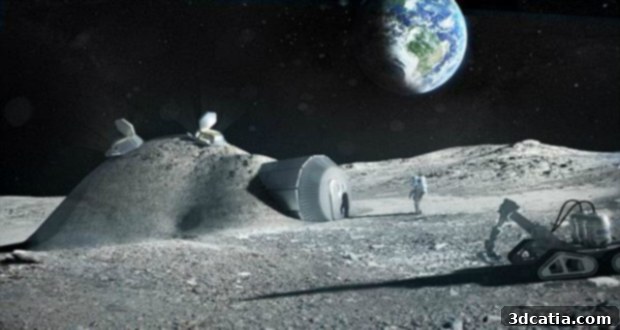
3D Printing the Moon Village: Paving the Way for Sustainable Space Habitation
The audacious vision of building a future for humanity in space, once relegated to the realm of science fiction and distant dreams, is now rapidly transitioning into a tangible reality. At the forefront of this monumental shift is the groundbreaking potential of 3D printing technology, particularly when coupled with the abundant resources found on the Moon. This innovative approach promises to revolutionize how we envision and execute extraterrestrial construction, making sustainable lunar habitation a truly achievable goal.
A significant leap forward in this endeavor has come with the recent endorsement from the European Space Agency (ESA). Working in close collaboration with leading architects and experts, ESA is meticulously assessing the viability of utilizing lunar soil – known as regolith – as the primary building material for creating a permanent “Moon Village.” This ambitious project aims to establish a habitable outpost on our celestial neighbor, marking a pivotal step in humankind’s journey beyond Earth.
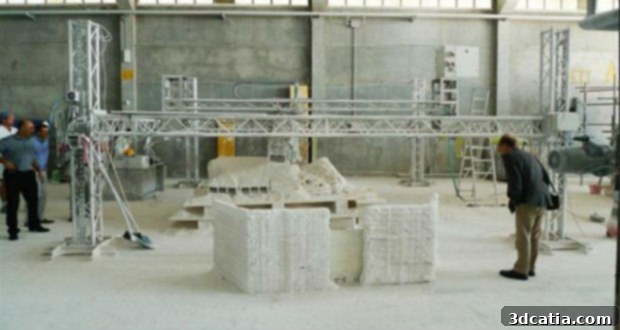
The European Space Agency’s Bold Vision: Establishing a Lunar Outpost
The concept of a Moon Village is more than just a collection of structures; it represents a bold, international vision for a sustainable future in space. It’s a testament to human ingenuity and our collective desire to explore and expand our presence beyond Earth. This collaborative initiative by the ESA seeks to create a multi-purpose base that can serve scientific research, resource utilization, and even as a stepping stone for future deep-space missions.
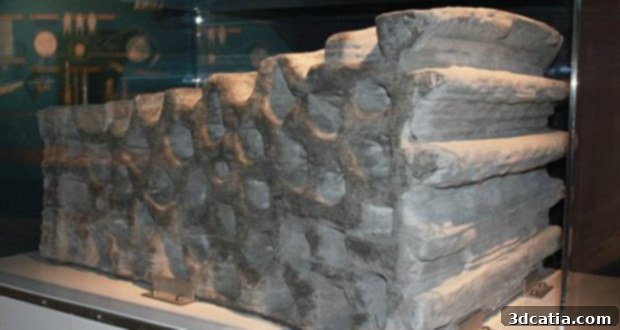
These 3D printed blocks, fabricated from simulated lunar regolith, showcase the foundational material for future lunar habitats.
Laurent Pambaguian, the project head at ESA, underscores the transformative power of additive manufacturing. “3D terrestrial printing technology has already proven its capability to produce entire structures,” he explains. “Our industrial team is now rigorously investigating how this proven technology can be adapted and optimized for the unique challenges of constructing a lunar habitat. The goal is to move beyond simple prototypes and develop robust, scalable methods for extraterrestrial construction.” This forward-thinking approach leverages existing knowledge while pushing the boundaries of what’s possible off-world.
3D Printing: The Revolutionary Enabler for Lunar Construction
The core of this ambitious project lies in the application of advanced 3D printing techniques. Unlike traditional construction methods that rely on transporting heavy materials and complex machinery from Earth, additive manufacturing offers an elegant solution: build directly on-site using local resources. This drastically reduces the logistical burden and cost, which are paramount considerations for any space mission. Specialized industrial 3D printers are being designed to operate in the Moon’s vacuum and extreme temperature fluctuations, extruding layers of molten regolith to gradually build durable structures.
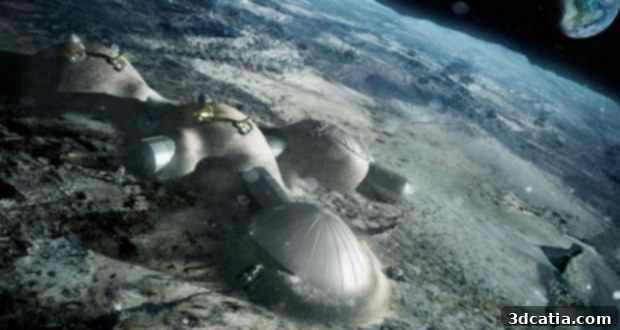
According to Pambaguian, ESA partners have already made significant progress in structural design. They have developed a sophisticated dome design featuring a multi-layered cell wall. This innovative architectural solution is not merely aesthetically pleasing but is engineered with critical protective capabilities. The cellular structure is specifically designed to shield future occupants from the constant threat of micrometeorites – tiny, high-velocity particles that pose a significant danger in space – and the harmful effects of space radiation, which is far more intense on the Moon than on Earth dues to the lack of a protective atmosphere or strong magnetic field. Such considerations are fundamental to ensuring the long-term safety and well-being of lunar inhabitants.
Leveraging Lunar Resources: Regolith as the Ultimate Building Material
One of the most compelling aspects of this project is the ingenious use of lunar regolith – the layer of loose, rocky material that covers the solid rock of the Moon. Instead of shipping building materials from Earth, which is prohibitively expensive and logistically complex, scientists and engineers are focusing on utilizing what’s already there. Lunar regolith, while seemingly just dust and rocks, possesses unique properties that make it an ideal candidate for 3D printing. It’s abundant, ubiquitous across the lunar surface, and can be processed into a printable material. The printing process involves heating the regolith to its melting point or binding it with specialized agents, then extruding it layer by layer to form solid structures.
The design of the lunar base takes into account the specific properties of this extraterrestrial soil, from its granular composition to its thermal characteristics. The initial step involves the meticulous construction of foundational blocks, which will then be assembled or printed in situ to form larger modules and habitats. This phased approach allows for rigorous testing and refinement of techniques before full-scale construction commences. The implications of successfully using lunar regolith are profound: it represents a paradigm shift towards truly sustainable space exploration, where human settlements can become self-sufficient rather than solely dependent on Earth’s finite resources.
Economic and Logistical Advantages of On-Site Manufacturing
The logistical challenges of space exploration are immense, with every kilogram sent into orbit costing thousands of dollars. This is where 3D printing on the Moon offers unparalleled advantages. Scott Hovland of the ESA flight team emphasizes this point, stating, “3D printing offers an exceptionally economical way to create a lunar base with a significant reduction in logistics from Earth.” By utilizing lunar resources, the need to transport heavy construction materials, tools, and potentially even structural components from Earth is drastically minimized. This reduction in launch mass translates directly into substantial cost savings and simplified mission planning, making ambitious projects like a Moon Village far more feasible than ever before.
Moreover, the ability to manufacture on-site fosters a greater degree of self-sufficiency for lunar settlements. Instead of being entirely reliant on continuous resupply missions from Earth, lunar inhabitants could repair, expand, or even construct new modules as needed, using readily available local materials. These new opportunities are now being seriously considered by leading international space agencies as an integral part of developing a common, coordinated exploration strategy for humanity’s future in space. The shift towards in-situ resource utilization (ISRU) is not just an efficiency gain; it’s a foundational principle for sustainable long-term human presence beyond Earth.
Rapid Progress: Building at Extraterrestrial Speeds
The technological advancements in lunar 3D printing are progressing at an impressive pace. Current prototypes of these advanced extraterrestrial printers are already capable of building structures at a rate of approximately 2 meters (about 6.6 feet) per hour. This speed is remarkable given the harsh operating environment and the novelty of the technology. The development teams are not stopping there; they project that this rate will soon increase to 3.5 meters (about 11.5 feet) per hour. Such rapid construction capabilities mean that an entire primary building or habitat module could theoretically be completed within a single week. This accelerated timeline is crucial for quickly establishing infrastructure and expanding a lunar base, providing more living and working space for astronauts and researchers. The ability to rapidly deploy and expand habitats will be a key enabler for extended missions and ultimately, permanent settlements.
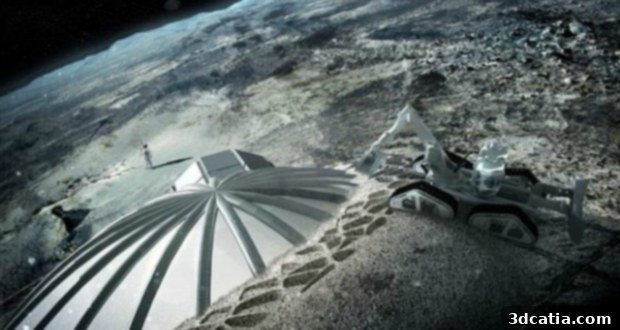
An artist’s rendering of the innovative dome design, engineered to provide maximum protection and livability for the future Moon Village.
A Global Endeavor: International Cooperation in Space
The vision for the Moon Village transcends national boundaries, aiming for truly international cooperation. Construction is anticipated to commence within the next 15 years, and the project is actively seeking collaboration with countries across the globe. Jan Wörner, a former Director General of the European Space Agency, eloquently articulated the broader philosophical significance of such an endeavor: “We have enough terrestrial problems between different nations. Space can help resolve these earthly problems, and the Moon seems like a good place to start.” His sentiment highlights how ambitious space projects can serve as powerful catalysts for fostering global unity, shared purpose, and technological advancement that benefits all of humanity.
Despite historical differences or competing priorities, agencies like ESA and NASA are working in increasingly close partnership to advance humankind’s efforts in deep space exploration. For instance, ESA is providing the crucial service module for the upcoming NASA Orion spacecraft. This collaboration ensures that future missions, including those with 3D-printed components, benefit from a pooling of resources, expertise, and technological innovation from both sides of the Atlantic. The Orion capsule, intended for human exploration beyond low Earth orbit, will itself incorporate parts that were manufactured using advanced 3D printing techniques, showcasing the widespread integration of this technology into cutting-edge space hardware.
Beyond the Moon: Paving the Way for Deep Space Exploration
While it might be more than a decade before we definitively know whether Mars or the Moon will serve as humanity’s next permanent extraterrestrial home, one fact remains undeniably clear: any significant advancements made in establishing a sustained human presence beyond Earth will be fundamentally reliant on the capabilities of 3D printing technologies. From fabricating essential tools and replacement parts on demand to constructing entire habitats from local materials, additive manufacturing is the linchpin for sustainable long-term space colonization. It empowers us to envision a future where astronauts are not merely visitors but permanent residents, living and working in environments built by the very materials around them.
The Moon Village project represents more than just a lunar base; it’s a critical testbed for technologies and strategies that will be essential for future missions to Mars and beyond. The lessons learned from constructing and maintaining a habitat on the Moon will be invaluable for tackling the even greater challenges of Martian settlement. The ability to print structures and components from local extraterrestrial resources truly liberates future missions from the immense logistical constraints of relying solely on Earth, opening up an era of unprecedented exploration and human expansion into the cosmos.
Join the Conversation: Your Thoughts on Lunar Living
These developments represent a monumental leap forward in our quest to become a multi-planetary species. The prospect of living and working on the Moon is no longer a distant fantasy but an exciting near-future reality driven by innovative technologies like 3D printing. What are your thoughts on these incredible advancements in lunar construction? Would you consider living on the Moon if the opportunity arose? We’d love to hear your perspectives and insights. Share your comments below or connect with us on our Facebook and Twitter channels!