
Pioneering Lunar Living: ESA’s Solar-Powered 3D Printed Moon Bricks from Dust
The ambitious vision of humanity establishing a permanent presence beyond Earth is rapidly transitioning from science fiction to tangible reality. As global space agencies push the boundaries of exploration, the European Space Agency (ESA) has announced groundbreaking developments that could revolutionize the future of space colonization. Following in the innovative footsteps of NASA, which has explored concepts like 3D printed chainmail for astronaut protection and a 3D printed Moon village slated for construction by 2030, the ESA has unveiled a pioneering method for creating building bricks directly on the lunar surface. This innovative approach leverages abundant moon dust and the sun’s energy to forge essential construction materials, marking a significant leap toward self-sufficient lunar habitats.
This cutting-edge development addresses one of the most significant challenges of space colonization: transporting building materials from Earth. Shipping tons of supplies into orbit and then to the Moon is prohibitively expensive and logistically complex. The ESA’s solution, often referred to as In-Situ Resource Utilization (ISRU), offers a sustainable alternative by utilizing materials readily available on the lunar surface. By transforming lunar soil, or regolith, into durable building blocks, the cost and carbon footprint associated with space construction can be drastically reduced, paving the way for more economically viable and environmentally friendly lunar settlements. This technology not only promises to make lunar bases a reality but also to accelerate the timeline for long-duration human missions and potential permanent off-world communities.
The Science Behind Solar-Powered Lunar Brick Production
The process developed by ESA researchers is as ingenious as it is practical. At its core, it involves a specialized 3D printer table that harnesses the intense power of concentrated sunlight. To simulate lunar conditions for their experiments, researchers used commercial simulated lunar soil, a meticulously engineered material designed to mimic the physical and chemical properties of actual moon dust. This simulator is crucial for testing and refining the additive manufacturing process without requiring actual lunar samples, which are incredibly rare and valuable. The setup features an array of 147 precisely curved mirrors. These mirrors are strategically positioned to focus ambient sunlight onto a single point, generating an extraordinarily high-temperature beam. This concentrated solar energy then melts thin layers of the simulated lunar soil, layer by layer, in a controlled environment.
Operating at staggering temperatures reaching 1,830° F (1000° C), this “solar furnace” effectively sinters the lunar regolith. Sintering is a process where powdered materials are compacted and then heated to a point below their melting temperature, causing their particles to fuse together without fully liquefying. In this case, the high temperature ensures that the lunar simulant melts sufficiently to bond into a solid structure. While the temperature is extreme, the overall process of printing a single brick is not exceptionally fast, requiring approximately five hours from start to finish. This duration highlights the precise and methodical nature of additive manufacturing, where each layer must be carefully formed and fused. Despite the time investment per brick, the ability to produce construction-grade materials directly on the Moon, entirely powered by solar energy, represents an unparalleled advantage for future lunar outposts. The result is a robust, solid brick that holds immense promise as the foundational element for our future homes on the Moon, providing both structural integrity and protection against the harsh lunar environment.
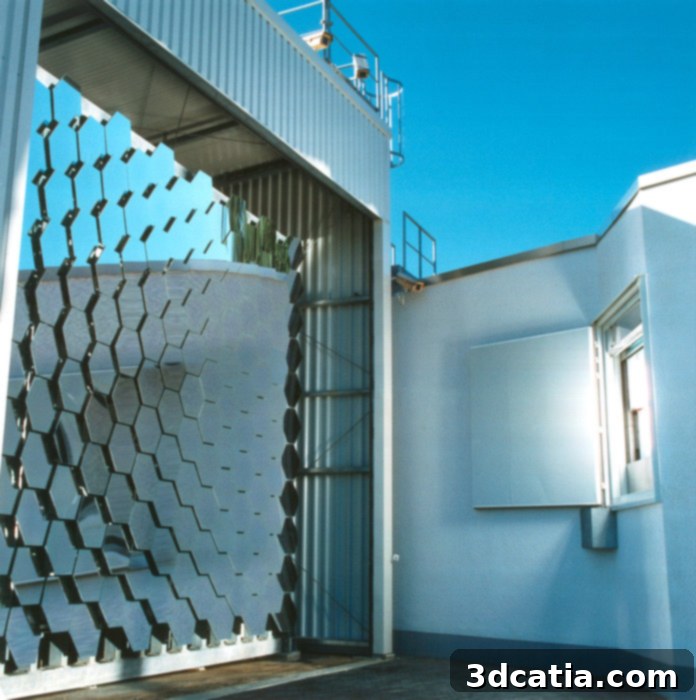
The solar furnace used, which is located at the German Aerospace Center in Cologne
Earthbound Applications and Sustainable Construction
While the initial and primary goal of developing these 3D printed lunar bricks was undeniably for extraterrestrial construction, the success of the project has illuminated potential applications here on Earth. Researchers are now exploring how this innovative solar-powered 3D printing system could be adapted for terrestrial use, particularly in scenarios where conventional construction methods are challenging or unsustainable. Tommaso Ghidini, the insightful head of the ESA’s Materials and Process division, emphasizes this dual potential, explaining that “3D printing civil structures using solar power and in-situ resources could support rapid construction of post-disaster emergency shelters, removing long, costly and often inefficient supply chains.” This vision highlights a profound societal benefit, moving beyond the space sector.
Consider regions affected by natural disasters such as earthquakes, tsunamis, or hurricanes. The logistical nightmare of transporting building materials, skilled labor, and heavy machinery to devastated areas often delays recovery efforts significantly, prolonging suffering. By deploying portable solar-powered 3D printers that can utilize locally sourced materials – such as sand, clay, or other readily available aggregates – emergency shelters and temporary housing could be constructed rapidly and efficiently. This localized approach drastically reduces reliance on vulnerable supply chains, which can be easily disrupted during crises. Furthermore, it promotes a more sustainable construction paradigm, minimizing waste and reducing the environmental impact associated with traditional building practices. This technology could empower communities to rebuild quickly and sustainably, transforming disaster relief and fostering resilience in vulnerable areas around the globe.
Material Strength and Future Refinements
Initial tests have shown that these innovative lunar bricks possess a strength comparable to gypsum, a common mineral extensively used in plaster and wallboards for terrestrial construction. This is a promising indicator of their structural viability, suggesting they could indeed serve as reliable building blocks for lunar habitats. However, the development journey is ongoing. Researchers are currently engaged in more detailed mechanical testing to thoroughly understand the material’s properties under various stresses and conditions that mimic the lunar environment. This comprehensive evaluation is crucial for ensuring the long-term durability and safety of structures built with these bricks on the Moon, where they would be subjected to extreme temperatures, vacuum, and radiation.
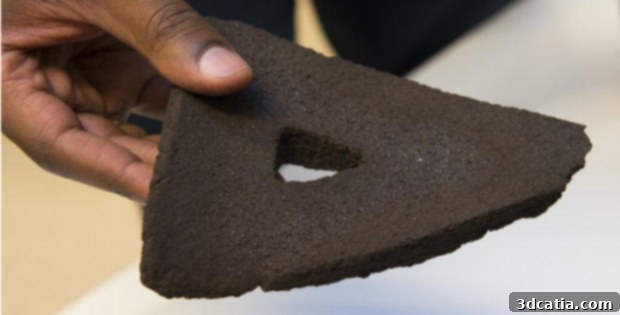
One specific area of ongoing refinement involves addressing the warped edges observed on some of the printed bricks. These irregularities are likely due to thermal stresses during the cooling process or variations in the melting and solidification of the lunar simulant. Overcoming this challenge is vital for ensuring precise construction and structural integrity. Researchers are exploring various parameters, including optimizing the heating and cooling cycles, adjusting the printing speed, and refining the optical system of the solar furnace. Beyond aesthetic considerations, uniformly shaped bricks are essential for constructing stable, sealed structures capable of maintaining internal atmospheric pressure and providing adequate shielding. Further research will also delve into other critical aspects such as the bricks’ resistance to micrometeoroid impacts, their thermal insulation properties to manage extreme lunar temperature swings, and their long-term stability when exposed to cosmic radiation. Successfully addressing these factors will pave the way for fully functional and safe lunar habitats.

The brick was created using moon dust and the sun
The Vision: A Self-Sufficient Lunar Future
Even though the 3D printed moon brick project is still in its conceptual and experimental phases, the dedicated team at the ESA firmly believes that these early results demonstrate a truly feasible and sustainable construction method for future lunar settlements. This breakthrough is more than just about making bricks; it’s about laying the groundwork for human self-sufficiency in space. By leveraging the Moon’s own resources and the ubiquitous energy of the sun, humanity can drastically reduce its dependence on Earth for critical supplies, making long-term lunar habitation economically viable and logistically simpler.
Imagine a future where astronauts landing on the Moon can immediately begin the process of building their protective habitats using automated 3D printers and the very ground beneath their feet. This ability to “live off the land” significantly cuts down the immense costs associated with launching tons of building materials from Earth – costs that currently run into tens of thousands of dollars per kilogram. Moreover, these locally sourced and printed structures offer superior protection against the unique hazards of the lunar environment, such as deadly cosmic radiation, micrometeoroid impacts, and extreme temperature fluctuations. The vision extends beyond simple shelters to comprehensive lunar bases, research stations, and even permanent “moon villages” where scientists, engineers, and perhaps even future settlers can live and work safely for extended periods. This innovative approach moves us closer to a future where humanity is not just visiting the Moon, but truly making it a second home, fostering a new era of space exploration and potential interplanetary living.
For those interested in witnessing this fascinating process firsthand, the ESA has released a video demonstrating the 3D printing of these revolutionary moon bricks. It provides a visual insight into how lunar dust can be transformed into robust building materials, showcasing the potential that this technology holds for the future of space exploration and habitation.
Check out the ESA’s video below to see the printing process:
For more in-depth information about this incredible project and other pioneering space engineering and technology initiatives, we encourage you to visit the official European Space Agency website. You can find detailed reports and updates here.
What are your thoughts on this incredible advancement in 3D printed moon bricks? Do you believe this technology will be the cornerstone for future human lunar living and pave the way for permanent off-world settlements? Share your insights and predictions in a comment below, or join the discussion on our Facebook and Twitter pages! We’d love to hear your perspective on humanity’s journey to becoming a multi-planetary species.