

Monad Studio: Revolutionizing Music with Visionary 3D Printed Instruments and Architectural Innovation
At the forefront of design and digital fabrication, Monad Studio stands out for its groundbreaking contributions to the world of music. We recently had the distinct pleasure of sitting down with the brilliant minds behind Monad Studio to delve into their latest advancements and profound philosophy. Renowned for crafting some of the most stunning and 3D printed instruments ever witnessed, their creations transcend traditional boundaries. From instruments utilized by the iconic Viktoria Modesta to unique violins, guitars, and even ambitious grand pianos, Monad Studio is redefining what’s possible. In our exclusive interview, we explored their journey into 3D printing, their sources of inspiration, and their exciting plans for the future of musical innovation.
Monad Studio: A Fusion of Architecture and Additive Manufacturing
Monad Studio was founded in New York by the visionary Argentine architects Veronica Zalcberg and Eric Goldemberg. Their collaboration began shortly after they completed their Advanced Master of Architecture at Columbia University in 2002. During this period, the architectural world was abuzz with digital tools that allowed for the visualization of incredibly innovative shapes and complex curvilinear surfaces within computer environments. However, a significant challenge remained: bridging the gap between these spectacular virtual designs and their tangible, material realization in the physical world. The transition from a digital blueprint on a screen to a concrete, three-dimensional object was often elusive.
The studio’s trajectory took a pivotal turn when Zalcberg and Goldemberg relocated to Miami in 2006. Eric Goldemberg accepted a directorship position in digital architecture at Florida International University, which provided them with invaluable access to advanced fabrication technologies. It was here that they began extensively utilizing 3D printers and CNC milling machines. These tools became instrumental in exploring the tangible form of their designs, allowing them to transform abstract digital concepts into physical realities. This hands-on experimentation facilitated a deep understanding of the possibilities and the practical limitations inherent in new materialities and digital fabrication processes. This phase enabled them to develop an extensive range of objects and installations, specifically scaled to the human body. Moving beyond purely virtual designs, this immersive experience with 1:1 scale prototyping allowed Monad Studio to focus primarily on projects deeply intertwined with the art world, where their unique architectural sensibility could find a new, resonant expression.

The Genesis of Futuristic Instruments and the Power of 3D Printing
Monad Studio’s foray into musical instrument design was a natural evolution stemming from their enduring fascination with the rhythmic aspects of architecture. This deep-seated obsession with rhythm in spatial design culminated in their influential book, “Pulsation in Architecture.” This publication meticulously traces the development of digital architecture, exploring how rhythmic groupings and tectonic expressions, arising from advanced digital practices, manifest as distinct sensations. Concurrently, the studio was immersed in its own hands-on experiments with 3D printers. They began constructing intricate objects, developing novel methods to materialize rhythmic effects through the aggregation of serial parts, pushing the boundaries of form and structure.
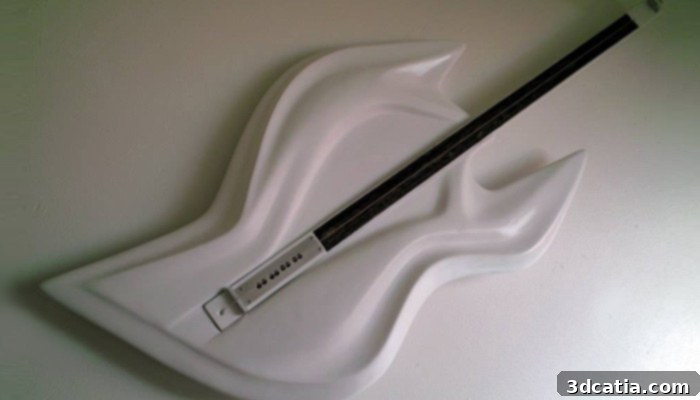
It was during this period of intense experimentation that a serendipitous encounter with a musician and luthier colleague, Scott F. Hall, occurred. Hall recognized the profound potential in Monad Studio’s architectural approach to rhythmic forms, suggesting that these concepts could translate into tangible sonic consequences. This pivotal insight sparked the idea of applying their design philosophy and fabrication expertise to create musical instruments. The team realized that 3D printing machines were not merely tools but essential instruments themselves, perfectly suited to realize their visionary forms. These designs often feature immense geometrical complexity and are engineered for an unprecedented anatomical adaptation between the musician’s body and the instrument. Such intricate interfaces, impossible to achieve with conventional manufacturing techniques, become fully attainable only through advanced 3D technology. Additive manufacturing offers the precision and freedom necessary to sculpt ergonomic shapes that seamlessly merge with the human form, enhancing both playability and expressiveness, thereby truly bringing Monad Studio’s unique vision to life.

The Meticulous Process of Crafting 3D Printed Instruments
The creation of each Monad Studio instrument is an elaborate and deeply iterative process that begins with a profound focus on the musician. Initially, the design team dedicates significant attention to understanding the postures, ergonomics, and dynamic friction points between the musician’s body and the instrument’s surfaces during performance. This intricate study involves detailed “mapping” of these dynamics, which are then translated into digital diagrams. These diagrams subsequently inform the generation of 3D forms and guiding lines for the instrument’s shape. This initial phase sets the stage for a continuous cycle of rigorous testing and calibration, essential for precisely defining the symbiotic relationship between the instrument’s body and the musician’s anatomy. The goal is to create an extension of the performer, where form and function are in perfect harmony.
The architectural essence of Monad Studio’s designs is vividly expressed through this process, as they meticulously portray the expressiveness of anatomical tension in their forms. During the development, numerous prototypes are 3D printed, generating a series of iterations. Each iteration allows the team to conduct in-depth analyses of both the formal aesthetics and the sonic capabilities of the instrument at a real scale. Crucially, this stage also incorporates invaluable feedback from musicians who test these prototypes. Their insights are instrumental in refining the design, ensuring that the instruments not only look revolutionary but also perform exceptionally. Typically, the intricate design phase alone can take approximately three months. Following design finalization, the actual 3D printing time varies depending on the instrument’s complexity and size, usually ranging from three to six days. It’s important to consider the practical limitations of printer bed sizes, often requiring larger instruments to be designed as multipart assemblies.
Once the structural components are 3D printed, the instrument enters a phase that marries cutting-edge technology with traditional craftsmanship. This involves the careful incorporation of essential elements such as strings, pickups, and tuning pegs. This stage demands a high degree of artisanal skill and precision, going beyond the automation of the digital printing process. The meticulous assembly and finishing ensure that each 3D printed masterpiece is not just an object of art but a fully functional, sonically rich musical instrument, ready to inspire and innovate.
The Indispensable Link Between Music and 3D Technologies
Monad Studio has successfully carved out a truly unique niche in the creative landscape, defined by its pioneering “sonic sculptures.” These instruments are unparalleled because they facilitate an extensive exploration of diverse sonic capacities. Their uniqueness stems not only from the intricate and often unconventional shapes of the instruments themselves but also from the precise control over material densities utilized in each 3D print. This granular control profoundly influences the acoustic behavior of the instrument’s surfaces and its overall built volume, allowing for unprecedented sound sculpting. For example, the studio had the extraordinary opportunity to print a violin using titanium, a material choice that imparted a truly distinct and resonant voice to the instrument. This remarkable feat was made possible through an innovative collaboration with a leading company in the aviation industry, a firm accustomed to 3D printing titanium components for high-performance aircraft engines. Such cross-industry partnerships exemplify the boundless possibilities that emerge when diverse technological expertise converges.
This application of advanced 3D printing technologies, coupled with other digital fabrication methods, positions Monad Studio as a pioneer in developing entirely new sonic palettes. Beyond traditional instrument design, the studio also integrates “transducers” into their artistic experiences. These devices, essentially speakers without their conventional cones, are applied directly to the surfaces of 3D printed structures. This creates a highly particular vibrational sound field, transforming sculptures into dynamic sound installations. The synergy of 3D modeling and 3D printing is immensely powerful in this context because it fosters an “imperative immediacy” within the experimental creative process. Designers can rapidly conceptualize, prototype, and refine forms and sonic properties, accelerating discovery and enabling bold explorations into uncharted auditory territories. This rapid iteration capability is vital for pushing the boundaries of sound design and creating truly immersive auditory experiences.
Monad Studio’s Ambitious Future Plans: A Grand Vision
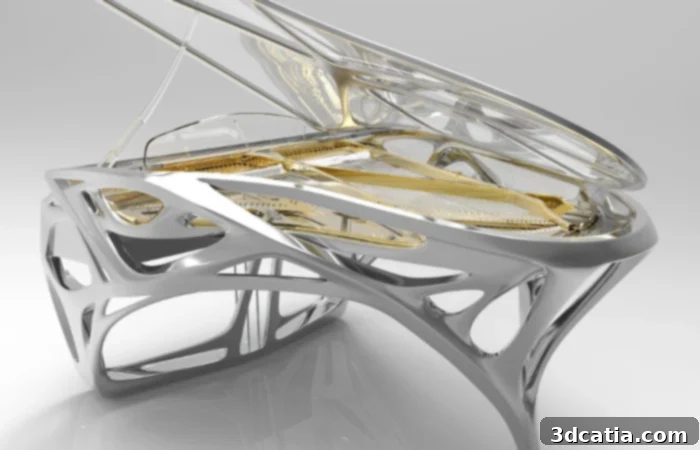
Looking ahead, Monad Studio is currently engrossed in its most significant and ambitious undertaking to date: the development of a revolutionary Grand Piano. This project is undeniably the most architectural of all their instruments, primarily due to its inherent structural system, which functions as an integral part of its sonic identity. Consequently, this unique grand piano, codenamed “EXO,” has been conceptualized and developed with an exposed structural aesthetic, as if featuring large windows that reveal its intricate interior sound percussion machinery. This monumental endeavor is a testament to collaborative innovation, being developed in partnership with Blüthner, a venerable and highly prestigious German piano firm renowned for its centuries of craftsmanship, and Lucid Pianos, an innovative Spanish firm. The convergence of Monad Studio’s avant-garde design philosophy with Blüthner’s acoustic mastery and Lucid Pianos’ fresh perspective promises an instrument that will redefine the grand piano as we know it.
The “EXO” model’s name is a direct reference to its exoskeletal system—a distinctive structural framework comprising curved components that both support and define the piano’s sound body. This external structure is not merely decorative but functionally essential, contributing to the instrument’s unique resonance and visual identity. The construction of the custom-designed “box” or main chassis for this magnificent piano is planned to take place in Portugal, leveraging advanced, large-scale 3D printing machines capable of handling its colossal dimensions. Subsequently, the intricate assembly of the piano’s delicate sound pieces and mechanisms will be meticulously carried out in Leipzig, Germany, at Blüthner’s headquarters. This distributed manufacturing approach, combining specialized digital fabrication with traditional acoustic craftsmanship, highlights the global and collaborative nature of this groundbreaking project, poised to deliver an instrument that harmonizes architectural vision with unparalleled musicality.
Innovative Guitars and Expansive Sonic Installations
Beyond the monumental grand piano, Monad Studio is concurrently developing a cutting-edge line of highly innovative electric guitars. These new instruments are designed to integrate all the pedals and peripheral effects typically connected externally from the ground directly within the instrument’s body, offering unprecedented portability and streamlined performance. This revolutionary approach aims to simplify the musician’s setup while expanding the sonic possibilities inherent in the guitar itself. Furthermore, Monad Studio continues to engage in large-scale architectural and artistic projects. A notable example is their impressive installation for the Jewish Museum of Florida in Miami. This striking piece featured a series of dynamically suspended panels, arranged to form abstract flocks of birds. Equipped with transducers, these panels vibrated with sonification, transforming the space into an interactive, auditory environment.
This particular project was a collaborative effort with the esteemed musical composer Jacob Sudol, marking another successful partnership between them. They had previously joined forces on the creation of a large 3D mural that also incorporated manual transducers for an interactive sound experience. Another recent and highly visible project involved a captivating collaboration with fashion and interactivity designer Anouk Wipprecht. Together, they conceived and created a mesmerizing sonic bustier for the internationally acclaimed bionic-pop artist, Viktoria Modesta. This project seamlessly blended haute couture, advanced technology, and performance art, showcasing Monad Studio’s versatility.
The creation of Viktoria Modesta’s sonic bustier mobilized a large, multidisciplinary team of collaborators. This diverse group included choreographers, musicians, set designers, and engineers, all working in concert to bring the vision to life. The project also garnered significant support from leading technology firms such as Intel and Autodesk, which provided crucial resources and expertise, enabling the team to push the boundaries of their technological and artistic inspiration. Viktoria Modesta subsequently delivered two memorable performances at Art Basel Miami, captivating audiences while accompanied by an ensemble of musicians playing Monad Studio’s unique 3D printed instruments. These collaborations underscore the studio’s commitment to interdisciplinary exploration and its capacity to create truly transformative artistic and musical experiences.
A Forward-Looking Perspective: The Infinite Possibilities of 3D Technology
As we concluded our insightful discussion, Veronica Zalcberg and Eric Goldemberg shared a profound belief that encapsulates Monad Studio’s ethos. They emphasized that there remain countless frontiers yet to be explored by seamlessly integrating advanced 3D technology with humanity’s visionary capacity. Their philosophy extends beyond individual innovation, highlighting the immense value of interdisciplinary collaboration. They passionately believe in partnering with other creators who share their spirit of provocation and boundless curiosity. This collaborative approach, uniting diverse talents and perspectives, is seen as the catalyst for unlocking entirely new realms of possibility across art, architecture, and music. Indeed, as they succinctly put it: Everything is possible!
Enjoyed this fascinating interview with Monad Studio? We’d love to hear your thoughts! Share your comments below or connect with us on our Facebook and Twitter pages. Don’t miss out on the latest advancements in additive manufacturing – sign up for our free weekly Newsletter to receive all the crucial news in 3D printing directly in your inbox!