

MobiPrint: The Autonomous Mobile 3D Printer Revolutionizing Accessibility and On-Demand Creation
For years, 3D printing has been confined by a fundamental limitation: immobility. Despite incredible advancements in various additive manufacturing technologies, every 3D printer, from a hobbyist’s desktop unit to an industrial behemoth, has required a fixed location for operation. While these machines can be physically moved from one place to another, such relocation always necessitated human intervention. The vision of a 3D printer that could independently navigate its environment, position itself, and commence printing without direct human guidance seemed like a distant dream. However, this paradigm is now shifting dramatically with the advent of MobiPrint, an groundbreaking innovation that promises to redefine the boundaries of what 3D printing can achieve.
A pioneering group of researchers at the University of Washington’s Paul G. Allen School of Computer Science & Engineering has successfully broken through these technological barriers, introducing an exceptionally innovative desktop-sized 3D printer dubbed MobiPrint. This remarkable device not only empowers users to fabricate objects within the comfort of their homes but also boasts autonomous movement capabilities. This means MobiPrint can independently travel to a predetermined location within a mapped space and initiate the printing process. Imagine a 3D printer that automatically assesses the dimensions of a room, intelligently maps its surroundings, and then prints objects directly onto the floor surface. This is precisely what MobiPrint accomplishes. The visionary team behind this project, prominently led by Daniel Campos Zamora, unveiled the MobiPrint at the highly esteemed ACM’s Symposium on User Interface Software and Technology (UIST) in Pittsburgh, generating significant excitement within the academic and technological communities. This ambitious project, underscoring its potential for transformative impact, received crucial funding and support from the National Science Foundation. The research also benefited significantly from the expertise of Liang He, an assistant professor at Purdue University and a former doctoral student at the Allen School, whose contributions were instrumental in bringing MobiPrint to fruition.
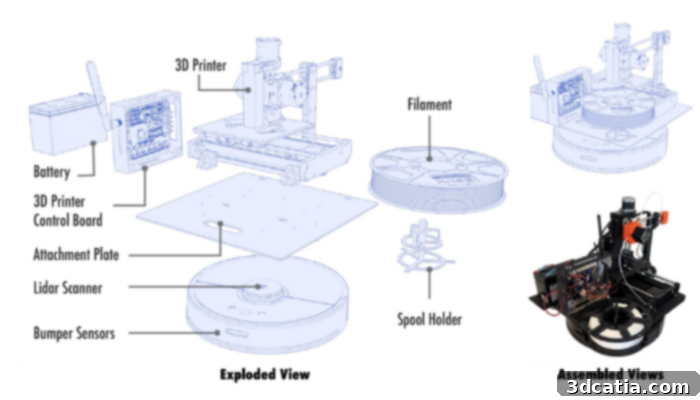
Structure of MobiPrint, highlighting its integrated components.
Unveiling MobiPrint’s Innovative Design and Functionality
So, what lies at the heart of MobiPrint’s revolutionary capabilities? The ingenuity of its design stems from a clever integration of existing, proven technologies. The core of the 3D printing mechanism consists of a modified Prusa Mini+ 3D printer, renowned for its reliability and print quality. This precise printing unit is robustly mounted onto a Roborock S5 robot vacuum cleaner, transforming a common household appliance into a mobile fabrication platform. This combination leverages the sophisticated navigation and mobility of the robot vacuum with the precision of a desktop 3D printer. The user experience is further enhanced by a custom-designed graphical user interface (GUI), meticulously crafted by the research team. This intuitive interface allows users to easily visualize and ‘draw’ objects directly within the digital map of their space, which is generated by the robot itself.
MobiPrint’s impressive spatial awareness and navigation capabilities are powered by the open-source Valetudo software. This software skillfully utilizes a Light Detection And Ranging (LiDAR) system, a technology commonly found in modern domestic robot vacuum cleaners that tirelessly map and clean our homes. The LiDAR system continuously scans the surrounding environment, creating highly accurate, real-time maps that enable MobiPrint to navigate intelligently and precisely locate desired printing areas. This sophisticated mapping capability allows MobiPrint to operate effectively on a variety of common household surfaces, including soft carpets, durable vinyl, and elegant hardwood floors. The printer is capable of producing objects with dimensions up to 180x180x65 mm, making it suitable for a wide array of functional prototypes, decorative items, and essential accessibility aids.
One of MobiPrint’s key advantages is its commitment to user privacy and control. The sophisticated software allows users to view, verify, and manage the robot’s intended path and print operations locally, entirely eliminating the need for cloud connectivity. This ensures that sensitive spatial data and design files remain within the user’s control. The workflow is streamlined and user-friendly: users can either select from a curated library of templates provided by MobiPrint or effortlessly upload their own custom 3D designs. Once a design is chosen, users simply pinpoint the desired print location on the interactive map and make any necessary adjustments to the design’s size and orientation. With a final confirmation, the robot autonomously maneuvers to the designated spot and commences printing the object directly onto the floor, bringing digital designs to life in the physical environment. The objects are printed using PLA (Polylactic Acid), a widely favored bioplastic known for its biodegradability, ease of use, and versatility. This innovative on-site printing capability opens up a world of possibilities, from creating customized home decorations and personalized artistic elements to fabricating highly practical structures for enhancing accessibility within a space, truly tailoring environments to individual needs.
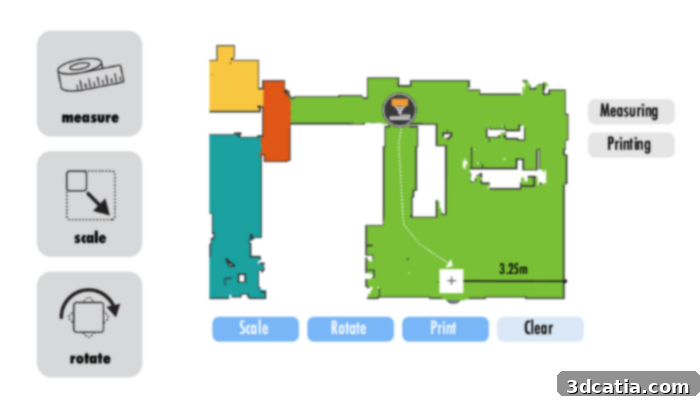
Mapping the route to independently reach the printing site.
While MobiPrint represents a monumental leap forward, the device currently operates primarily in a “park and print” mode. This means that once MobiPrint has successfully navigated to the chosen printing location on the map, it parks itself and remains completely stationary throughout the entire printing process. This current operational method, while effective for smaller objects, does impose a limitation on the size of designs that can be created, as larger prints would require continuous movement during fabrication. However, Daniel Campos Zamora and his team are not resting on their laurels. They are actively exploring and developing expanded capabilities that would allow MobiPrint to print much larger objects in a continuous, on-the-move mode, envisioning a future where the printer could create expansive floor patterns or integrated structures with seamless motion.
MobiPrint: A Powerful Tool for Enhancing Accessibility, Especially for People with Visual Impairments
The researchers at the University of Washington perceive MobiPrint as far more than a novel gadget for home customization or artistic expression. Their vision extends to a concrete and meaningful contribution towards greater social inclusion, particularly for individuals with visual impairments. The lab spearheaded by Campos Zamora is fundamentally dedicated to pioneering innovative tools and technologies designed to significantly improve the quality of life for people living with various visual challenges. MobiPrint aligns perfectly with this noble objective, offering tangible solutions for creating more accessible and navigable environments.
“One of the things that really inspired this project was looking at the tactile surface indicators that help blind and low vision users find their way around a space,” Campos Zamora passionately explained in an interview with IEEE Spectrum. He elaborated on the critical role these markers play in daily life, providing essential information such as directional cues for navigating complex environments like conference centers or crucial warnings about potential hazards, such as the presence of stairs or sudden drops. MobiPrint’s unique ability to print directly onto floor surfaces means it can custom-fabricate these tactile indicators exactly where they are needed, tailoring them precisely to specific layouts and user requirements. Furthermore, the printer could even be deployed to create small, localized ramps, effectively covering minor unevenness in floors or thresholds, thereby eliminating tripping hazards and improving mobility for wheelchair users or individuals with walking aids.
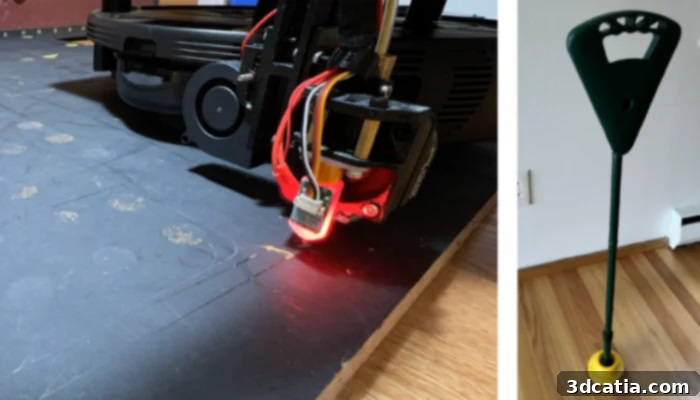
MobiPrint can print tactile surface markers to help blind and visually impaired people orient themselves within a room (left) and can create supports for their aids such as canes (right).
The potential impact of such technology resonated deeply with Jon E. Froehlich, a distinguished professor at the Allen School, who shared his personal connection to the project’s accessibility goals: “I think about kids out biking or my friends and family members who are in wheelchairs getting to the end of a sidewalk without a curb.” He emphasized the transformative nature of being able to instantly adapt environments. “It would be so great if in the future we could just send Daniel’s robot down the street and have it build a ramp, even if it was working just for a short period of time. That just shows you how reconfigurable environments can be.” This sentiment underscores the broader vision: to enable dynamic, on-demand modifications to physical spaces, making them instantly more inclusive and functional for everyone, regardless of their physical abilities.
Looking ahead, the research team is diligently working to expand MobiPrint’s capabilities even further. A significant area of focus is enabling the device to not only print objects but also to efficiently remove printed structures and, crucially, to recycle the plastic material. This closed-loop system would represent a major step towards sustainable and reconfigurable environments. Researchers are also actively investigating the feasibility of printing on a wider range of surfaces beyond floors, including tables or even walls, opening up new dimensions for on-demand customization and functional additions. Furthermore, exploration into outdoor printing environments and the use of diverse materials is underway. The ability to print with materials like concrete, for instance, is not yet possible but represents an exciting future frontier for large-scale, durable, and weather-resistant creations, broadening MobiPrint’s utility from interior design to architectural adaptation.
The ultimate aspiration driving the MobiPrint project is to continuously adapt and integrate technology more deeply with human needs, creating domestic and public environments that are inherently more inclusive and responsive. This project stands as a powerful testament to technological progress, not merely as an advancement in machinery, but as a tangible tool poised to significantly improve daily life, with a particular and profound focus on addressing the needs of people with visual impairments and mobility challenges. While the device is still in its developmental stages and currently subject to certain limitations, its immense potential applications are already paving the way for entirely new paradigms in making our physical environments more accessible, adaptable, and dynamically reconfigurable for every individual.
What are your thoughts on MobiPrint and its potential impact on accessibility and 3D printing? Let us know in a comment below or join the conversation on our LinkedIn, Facebook, and Twitter pages! Don’t forget to sign up for our free weekly Newsletter here to get the latest 3D printing news delivered straight to your inbox! You can also find all our compelling videos and demonstrations on our YouTube channel.
*All Photo Credits: Makeability lab.