
Revolutionizing 3D Printing: How MIT’s AI and Machine Learning Accelerate Material Discovery
The landscape of Artificial Intelligence (AI), particularly its powerful subset, machine learning, is increasingly transforming various sectors within the additive manufacturing industry. This exciting synergy is exemplified by groundbreaking research from MIT, where scientists have successfully harnessed the data-driven capabilities of machine learning to automate and significantly expedite the process of discovering novel 3D printing materials. By employing sophisticated algorithms, they were able to meticulously optimize critical material performance factors such as toughness, compression strength, and stiffness. This innovative approach quickly demonstrated its superiority over conventional, often laborious, methods of 3D printing material formulation. A significant outcome of this pivotal study is the creation of AutoOED, a free and open-source materials optimization platform, designed to empower other researchers and innovators to conduct their own advanced material optimization studies, fostering collaborative scientific progress.
One of the most remarkable aspects of this AI-driven methodology is its ability to propose unique chemical formulations that might otherwise remain unexplored by human researchers. Traditional materials development is inherently a time-consuming and manual endeavor, heavily reliant on a chemist’s intuition and hands-on experimentation. As Mike Foshey, co-lead author of the paper, mechanical engineer, and project manager in MIT’s Computational Design and Fabrication Group (CDFG) of the Computer Science and Artificial Intelligence Laboratory (CSAIL), eloquently explained: “Materials development is still very much a manual process. A chemist goes into a lab, mixes ingredients by hand, makes samples, tests them, and comes to a final formulation. But rather than having a chemist who can only do a couple of iterations over a span of days, our system can do hundreds of iterations over the same time span.” This stark comparison underscores the exponential leap in efficiency and discovery potential offered by machine learning, allowing for an unprecedented volume of experimentation and data generation within compressed timelines, ultimately accelerating the pace of material innovation for additive manufacturing.
Accelerating 3D Printing Materials Discovery with Automation
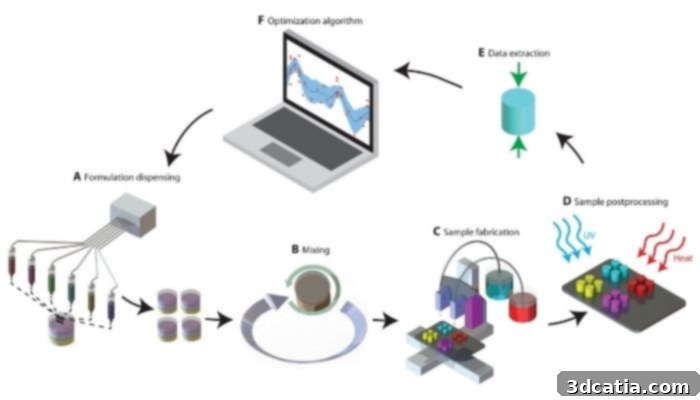
The research at MIT began by identifying a core set of six chemicals to serve as foundational components for various formulations. The primary objective of the machine learning algorithm was then meticulously configured to identify the best-performing material combinations, precisely controlled for desired properties like toughness, stiffness, and overall strength. This focus on specific mechanical attributes is crucial for tailoring materials to diverse 3D printing applications, from aerospace components requiring high strength-to-weight ratios to biomedical implants demanding specific biomechanical responses. The beauty of this methodology lies in its potential for complete automation across numerous stages of the materials discovery pipeline. The dispensing of raw chemicals, their precise mixing, the actual 3D printing of test samples, subsequent post-processing steps, and even the rigorous testing phases can be executed without direct human intervention. This end-to-end automation reduces human error, increases reproducibility, and dramatically speeds up the iterative design cycle.
While the initial phases of this automated system still require some manual labor for transferring materials between different stages of the sample fabrication pipeline, the researchers are already envisioning a fully autonomous future. Mike Foshey firmly believes that integrating advanced robotics into future iterations of the system could entirely eliminate the need for human input at these transfer points. This vision of a “lights-out” material discovery lab promises an even greater leap in efficiency and a significant reduction in operational costs, making the development of new 3D printing materials faster and more accessible than ever before. The study’s impressive results speak volumes: after rigorously testing 120 unique formulations, the algorithm successfully pinpointed 12 optimized formulations that met or exceeded the stringent performance criteria. This exceptional efficiency led the researchers to conclude that their innovative methodology is highly generalizable, meaning it can be adapted and applied to a wide array of other material design systems, thereby unlocking automated discovery potential across various material sciences and engineering disciplines.
The practical application of this groundbreaking research is embodied in the aforementioned AutoOED platform. This sophisticated software package, now available to the broader scientific community, encapsulates the advanced optimization algorithm developed in this pivotal study. Its open-source nature is a testament to MIT’s commitment to fostering innovation and collaboration, allowing researchers globally to leverage this powerful tool for their own material science explorations without proprietary barriers. The research itself received crucial backing and support from the German industrial giant BASF, recognized globally as the world’s largest chemical producer. This collaboration between leading academic research and industrial expertise highlights the significant real-world potential and commercial viability of such AI-driven advancements in material science. For those eager to delve deeper into the specifics of this transformative 3D printing materials study, comprehensive details and findings are available for review HERE. This access to detailed research ensures transparency and allows for replication and further development by other scientific bodies.

Photo Credit: ThisisEngineering / Unsplash
The implications of MIT’s ingenious application of artificial intelligence and machine learning extend far beyond the laboratory. This innovative approach promises to drastically cut down the time and cost associated with developing new materials, which has historically been a bottleneck in the widespread adoption of advanced additive manufacturing technologies. By making material discovery faster and more efficient, this research paves the way for a new era of customization and performance in 3D printed products across diverse industries, from automotive and aerospace to medical devices and consumer goods. Imagine bespoke materials precisely engineered for specific applications, achieving properties previously unattainable or too costly to produce. This isn’t just about faster research; it’s about unlocking entirely new possibilities for product design, functionality, and sustainability within additive manufacturing. The future of 3D printing will undoubtedly be shaped by these intelligent, automated material discovery systems.
What are your thoughts on MIT’s pioneering use of artificial intelligence to revolutionize 3D printing material discovery? We are keen to hear your perspectives on how these advancements might impact the future of additive manufacturing and material science. Share your insights and join the conversation in the comments section below, or connect with us on our social media channels: LinkedIn, Facebook, and Twitter. Don’t miss out on the latest breaking news and developments in the world of 3D printing; make sure to sign up for our free weekly Newsletter here, delivering the most important updates straight to your inbox. You can also explore a wealth of video content and interviews on our dedicated YouTube channel for more in-depth coverage.