
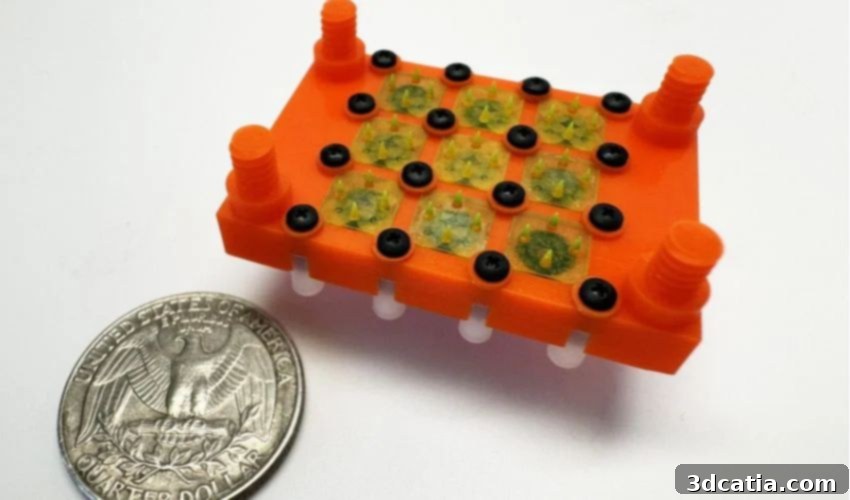
Revolutionizing Space Propulsion: MIT Pioneers 3D Printed Electrospray Engines for Efficient Satellite Thrust
The future of space exploration and satellite technology hinges on innovation in propulsion systems. Among the most promising advancements are electrospray engines, miniature motors designed to propel spacecraft with remarkable efficiency and precision. These cutting-edge propulsion systems operate by applying an electric field to a conductive liquid propellant, which then generates a high-speed jet of tiny, charged droplets. This stream of droplets, ejected at incredible velocities, creates the necessary thrust to propel a spacecraft through the vacuum of space. Their compact size and highly controlled operation make them particularly well-suited for small satellites, often referred to as CubeSats, which are increasingly vital for academic research, Earth observation, telecommunications, and deep-space missions. What sets electrospray engines apart is their ability to utilize fuel far more efficiently than traditional chemical rockets, a critical advantage for extended missions and precise orbital maneuvers where every gram of propellant counts. This superior fuel economy translates directly into longer mission durations, increased payload capacity, and unprecedented control over a satellite’s trajectory.
Despite their inherent advantages, the widespread adoption of electrospray engines has historically been hindered by significant manufacturing challenges. Traditionally, these sophisticated propulsion systems have been fabricated using semiconductor cleanroom techniques, a process notorious for being both prohibitively expensive and incredibly time-consuming. This reliance on specialized and high-cost manufacturing limits not only the range of potential applications but also the number of organizations capable of producing them. The intricate micro-scale components and high-precision requirements of electrospray engines typically demand a sterile environment and multi-step photolithography, etching, and deposition processes, which tie up significant capital and human resources. Recognizing these limitations as a major bottleneck, a team of pioneering engineers at MIT embarked on an ambitious project to revolutionize electrospray engine manufacturing. Their groundbreaking solution involved developing an electrospray motor made entirely using advanced 3D printing technologies, thereby circumventing the costly and restrictive traditional fabrication methods and opening new avenues for spacecraft propulsion.

3D CAD models of the electrospray thruster design explored in this study: a) exploded view of assembled thruster made of a manifold block, an array of emitter modules, and an extractor electrode (during the experiments, the central emitter module was replaced with a non-functional module to ensure uniform emitter operation across the other eight emitter modules); b) close-up of an emitter module composed of an array of four emitters, each fed by a long, narrow, and winding capillary.
The Science Behind Electrospray Propulsion: A Detailed Look
Understanding the intricate workings of electrospray engines reveals their remarkable elegance and efficiency. At their core, these devices feature a reservoir containing a liquid propellant, typically an ionic liquid known for its low vapor pressure and excellent conductivity. From this reservoir, the propellant is precisely channeled through a series of microfluidic pathways to an array of specialized emitters. These emitters, often microscopic in size, are designed with extremely fine tips where the magic of electrohydrodynamics truly begins. A crucial step involves applying a strong electrostatic field to the tip of each emitter. This field is created by maintaining a significant voltage difference between the emitter and a nearby extractor electrode. As the electric field intensifies, it exerts an electric stress on the conductive liquid’s surface, counteracting the liquid’s natural surface tension. This interplay of forces triggers an electrohydrodynamic effect, causing the liquid to deform into a characteristic cone shape, known as a Taylor cone, at the emitter’s apex.
From the very tip of this highly stable Taylor cone, a continuous stream of high-speed, charged droplets, or sometimes even individual ions, is ejected. This process is known as the cone-jet mode. The electrostatic field not only shapes the liquid but also accelerates these charged particles away from the emitter, generating momentum. According to Newton’s third law, for every action, there is an equal and opposite reaction. The expulsion of these charged droplets or ions at high velocity creates a reactive force, which is the thrust that propels the spacecraft. The beauty of electrospray propulsion lies in its ability to achieve a very high specific impulse—a measure of propellant efficiency—by accelerating a small mass of propellant to very high velocities. Furthermore, the precise control over the electric field allows for fine adjustments in thrust, enabling incredibly accurate spacecraft positioning and maneuvering. This level of precision is invaluable for tasks such as satellite constellation keeping, orbital adjustments, and scientific missions requiring delicate movements.
MIT’s 3D Printing Breakthrough: Blending Precision and Scale
To achieve their ambitious goal of 3D printing electrospray engines, the MIT researchers ingeniously leveraged two distinct yet complementary photopolymerization techniques. The critical components requiring ultra-high precision, specifically the emitter modules, were fabricated using two-photon polymerization (2PP). This advanced additive manufacturing method employs a highly focused femtosecond laser beam that selectively hardens liquid resin through a non-linear absorption process. The two-photon absorption occurs only at the focal point of the laser, enabling the creation of intricate three-dimensional structures with resolutions down to the sub-micron scale. This unparalleled precision was essential for producing the incredibly fine emitter tips—which dictate the efficiency and stability of the Taylor cone—and the uniform, narrow, and often winding capillaries that precisely control the propellant flow to each emitter. The ability of 2PP to create such complex geometries with high fidelity ensures consistent performance across the entire array of emitters, a vital factor for stable and reliable thrust generation.
While two-photon polymerization excels at producing minute, high-resolution features, its limited printing volume and relatively slower speed make it less efficient for larger structural components. For the main distributor block—a rectangular manifold responsible for securely housing the emitter modules and supplying them with propellant—the MIT team opted for an alternative, more scalable technique: Digital Light Processing (DLP). In DLP printing, a microscopic digital light projector is used to project entire layers of an image onto the photopolymer resin, curing an entire cross-section of the 3D structure simultaneously. This method significantly speeds up the production of larger components compared to point-by-point laser scanning techniques. The distributor block also integrates an extractor electrode, a critical component that, when a suitable voltage is applied, precisely controls the release of propellant from the emitter tips and accelerates the charged droplets. By combining 2PP for the intricate emitter modules with DLP for the bulkier, faster-to-produce distribution block, the researchers demonstrated a powerful hybrid manufacturing strategy. This synergistic approach effectively balances the need for extreme precision in functional micro-components with the requirement for efficient production of larger structural elements, creating a fully 3D printed electrospray engine that capitalizes on the strengths of both technologies.
Integration, Validation, and the Transformative Advantages of Additive Manufacturing
The development process for these innovative 3D printed electrospray engines extended beyond simply printing components. The MIT researchers meticulously conducted extensive experiments to ensure that the chosen 3D printing materials were not only structurally robust but also chemically compatible with the specialized liquid propellant. This compatibility is paramount, as any adverse reaction between the material and the propellant could degrade performance, compromise structural integrity, or lead to system failure in the harsh environment of space. Furthermore, a sophisticated method was developed to precisely connect the individual, multi-material components—the delicate emitter modules and the larger distributor block—and ensure perfect alignment. Any misalignment, even on a microscopic scale, could significantly affect the system’s performance by disrupting propellant flow, altering electric fields, or causing uneven thrust generation across the emitter array. This focus on seamless integration and material validation underscores the scientific rigor applied to the project.
The strategic decision to embrace 3D printing offered a multitude of compelling advantages that promise to revolutionize the design, manufacturing, and deployment of satellite propulsion systems. Foremost among these benefits is a substantial reduction in costs. By sidestepping the need for expensive cleanroom facilities and complex, multi-step semiconductor fabrication processes, 3D printing significantly lowers the barrier to entry for developing advanced propulsion. This cost-effectiveness is further enhanced by the ability to utilize readily available, commercially off-the-shelf materials and established manufacturing techniques, promoting greater accessibility and innovation. Beyond cost savings, 3D printing offers unparalleled design freedom, allowing engineers to create highly complex internal geometries and optimized fluidic pathways that would be impossible or exceedingly difficult with traditional methods. Perhaps the most visionary advantage is the potential for in-orbit manufacturing. Imagine a future where astronauts could produce propulsion systems for satellites directly in space. This capability would eliminate the immense logistical challenges and costs associated with launching components from Earth, enable on-demand repairs and upgrades, and foster true self-sufficiency for deep-space missions, freeing missions from the constraints of terrestrial supply chains.
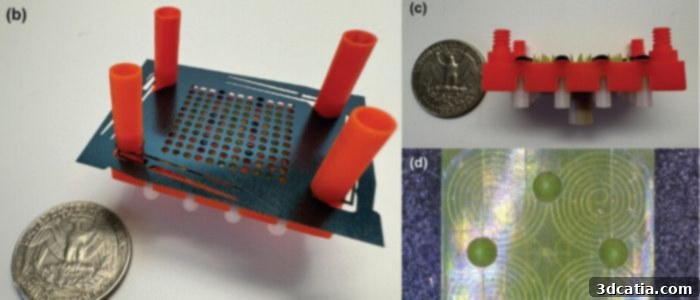
Images of a 3D-printed electrospray thruster: b) optical image of a fully assembled device next to a US quarter; c) optical image from the side of the device without the extractor electrode next to a US quarter; d) close-up optical image of an emitter module.
Exceptional Performance and Future Frontiers
The culmination of MIT’s research efforts was a highly successful demonstration of their 3D printed electrospray thruster prototype. This innovative device proved to be not only functional but also exceptionally efficient, generating thrust with a performance metric that surpassed even larger, more expensive conventional chemical rockets. More impressively, it significantly outperformed existing droplet electrospray engines, indicating a major leap forward in this propulsion technology. This superior performance is a testament to the precision afforded by the hybrid 3D printing approach and the careful optimization of the thruster’s design and materials. The successful validation of this prototype marks a pivotal moment, demonstrating the viability and immense potential of additive manufacturing for high-performance space applications.
Looking ahead, the MIT team is not resting on its laurels but is already charting the course for future advancements. Their ongoing research aims to further enhance the capabilities of these electrospray motors by exploring several promising avenues. One key area of focus is the creation of denser arrangements of emitter modules. By packing more emitters into a smaller footprint, they aim to increase the total thrust density, making the engines even more powerful and compact for increasingly small satellite platforms. Furthermore, the team plans to investigate the advantages of voltage modulation, which involves dynamically adjusting the electrostatic field to fine-tune thrust levels and potentially enable vectoring—the ability to steer the thrust direction without mechanical gimbals. The exploration of using multiple electrodes is another exciting prospect, potentially allowing for even greater control over the ion beam, improved efficiency, and enhanced diagnostic capabilities. These future developments promise to push the boundaries of electrospray propulsion, making it an even more indispensable technology for the next generation of space exploration, micro-satellite constellations, and precision orbital operations. To delve deeper into the specifics of this groundbreaking project and its scientific findings, you can find more information HERE.
What are your thoughts on the revolutionary 3D printed electrospray engine developed by MIT? We invite you to share your insights and comments below, or connect with us on our LinkedIn, Facebook, and Twitter pages! For those interested in more compelling content on 3D printing applications in the aerospace & defense sectors, be sure to explore our dedicated page HERE. Don’t miss out on the latest advancements in additive manufacturing—sign up for our free weekly Newsletter here to get cutting-edge 3D printing news delivered straight to your inbox! You can also discover all our insightful videos and in-depth analyses on our YouTube channel.
*All Image Credits: Hyeonseok Kim, Luis Fernando Velásquez-García (MIT)