
Revolutionizing Orthotics: How 3D Printed Mesh is Transforming Personalized Medical Supports
The landscape of medical device manufacturing, particularly in the realm of orthoses, has been significantly reshaped by the advent of 3D printing technologies. In previous discussions, we’ve highlighted various projects and products where additive manufacturing has introduced unparalleled levels of customization, moving beyond the traditional one-size-fits-all approach. This ability to tailor medical devices to the unique anatomical and functional needs of each patient is a cornerstone of personalized medicine and a primary driver for the widespread adoption of additive manufacturing in healthcare. However, the question remains: can we push the boundaries of personalization even further, especially when it comes to supporting the body’s most delicate structures?
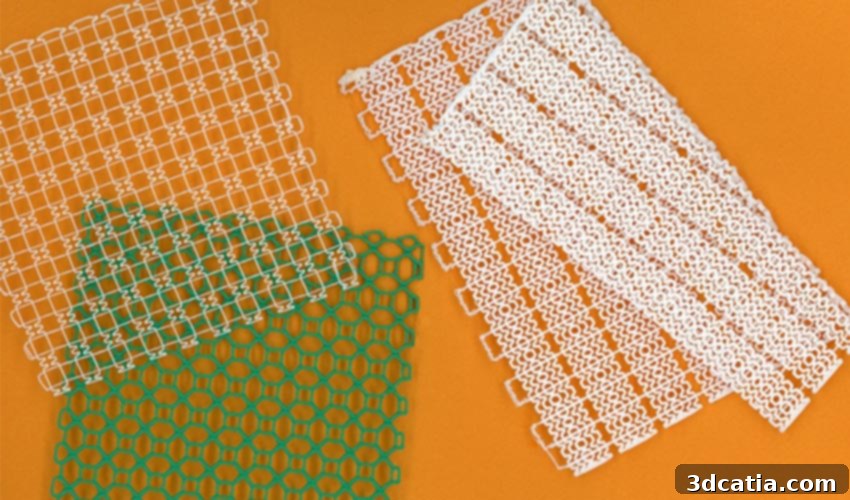
Groundbreaking research from engineers at MIT suggests a resounding “yes.” They have recently unveiled a novel approach to creating pliable, 3D printed mesh materials, meticulously engineered for their flexibility and toughness. Unlike conventional methods that typically rely on solid, relatively inflexible materials for support structures, this new technique is specifically designed to support softer tissues such as muscles and tendons. This innovation marks a significant leap forward, promising a new generation of medical devices that not only fit perfectly but also move harmoniously with the human body, enhancing comfort and therapeutic effectiveness.
The vision behind this advanced, fabric-like material is truly transformative. Imagine tough yet remarkably stretchy supports that can be custom-made for an individual’s specific requirements. These could manifest as personalized, wearable solutions like advanced ankle and knee braces, offering dynamic support without restricting natural movement. Beyond external devices, the potential extends to implantable medical devices, such as hernia meshes, which could be designed to better integrate with a person’s body, reducing the risk of discomfort or complications often associated with off-the-shelf options. Sebastian Pattinson, a leading researcher who conducted this pioneering work as a postdoc at MIT, emphasized the unique focus of their study: “This work is new in that it focuses on the mechanical properties and geometries required to support soft tissues.” This distinction is crucial, as it addresses a long-standing challenge in biomedical engineering – creating supports that are both strong enough to provide stability and flexible enough to accommodate the body’s intricate soft tissue mechanics.
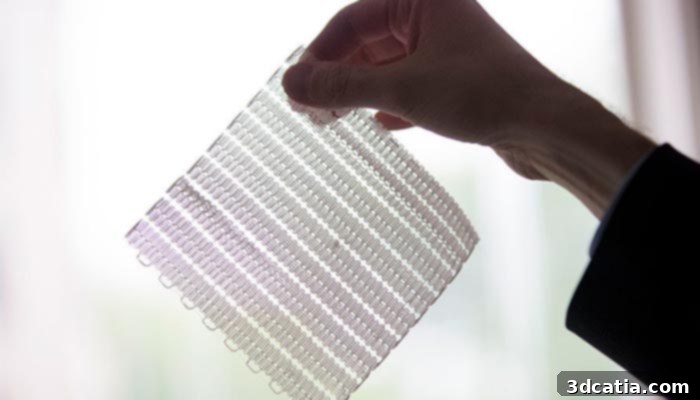
To illustrate the practical applications of their innovative 3D printed mesh, the researchers fabricated several prototypes. One notable design was a knee brace specifically engineered to conform seamlessly to the knee’s contours, even as the joint bends and extends. This dynamic adaptability is a significant improvement over rigid braces that can often feel cumbersome and restrict natural motion. Additionally, they developed a prototype glove featuring the 3D printed mesh strategically sewn into its top surface. This design allowed the glove to conform precisely to the wearer’s knuckles, offering support without impeding dexterity. Pattinson elaborated on the core motivation behind these designs: “3D printed clothing and devices tend to be very bulky. We were trying to think of how we can make 3D printed constructs more flexible and comfortable, like textiles and fabrics.” He further explained the fundamental principle they aimed to mimic: “One of the reasons textiles are so flexible is that the fibers are able to move relative to each other easily. We also wanted to mimic that capability in the 3D-printed parts.” This insight into the micro-mechanics of textiles was key to developing a 3D printing approach that could yield materials with comparable flexibility and drape, fundamentally changing how personalized supports are envisioned and manufactured.
Credits: M. Scott Brauer via MIT
Bio-Inspired Design: Collagen as the Blueprint for 3D Printed Mesh
The innovative design of this 3D printed mesh wasn’t born in a vacuum; it drew profound inspiration from nature itself. Pattinson revealed that his breakthrough stemmed from studying collagen, the most abundant structural protein in the human body. Collagen is a vital component of nearly all soft tissues, forming the foundational framework for ligaments, tendons, muscles, skin, and cartilage. Its unique molecular structure, characterized by its helical arrangement and ability to form strong yet flexible fibers, allows these tissues to withstand significant forces while maintaining elasticity and range of motion. By meticulously analyzing collagen’s hierarchical structure and mechanical properties, Pattinson was able to translate these biological principles into a printable design. He engineered intricate, wavy patterns that mimic the natural arrangement of collagen fibers, ensuring that the resulting material could provide robust support without sacrificing pliability. The chosen printing material, thermoplastic polyurethane (TPU), played a critical role in realizing this vision. TPU is an elastomeric polymer known for its excellent flexibility, durability, and biocompatibility, making it an ideal choice for medical applications requiring both strength and stretch. Through this bio-inspired design and material selection, Pattinson successfully created a mesh configuration that genuinely resembles a stretchy, tough, yet remarkably pliable fabric, capable of mimicking the dynamic behavior of human soft tissues.
Following the successful development of the collagen-inspired mesh, the MIT researchers proceeded to rigorously test its efficacy. They printed a long strip of the newly developed mesh and applied it as an experimental ankle support on several healthy volunteers. To objectively measure the mesh’s impact, they utilized an advanced robotic device called an Anklebot. This specialized machine is designed to precisely measure the force exerted by the ankle during various movements, allowing for a quantitative comparison of ankle mechanics both with and without the mesh support. The results were compelling and demonstrated the tailored functionality of the material. They found that the mesh significantly increased the ankle’s stiffness specifically during inversion – the motion where the sole of the foot turns inward. Crucially, the mesh did not appreciably affect the ankle’s movement or stiffness in other directions, such as eversion, dorsiflexion, or plantarflexion. This targeted support is a major advantage, as it indicates the material can provide stability where needed without hindering the full range of natural, healthy motion. Pattinson underscored the profound implications of this finding: “The beauty of this technique lies in its simplicity and versatility. Mesh can be made on a basic desktop 3D printer, and the mechanics can be tailored to precisely match those of soft tissue.” This emphasizes the potential for accessible, highly personalized medical solutions that can be produced even outside of highly specialized labs.
Further enhancing the utility and comfort of their innovation, the research team also pioneered two additional techniques aimed at imbuing the printed mesh with an even greater fabric-like quality. These advancements enable the material to conform effortlessly to the body’s contours, maintaining its supportive properties even when the body is in continuous motion. This constant adaptation is vital for long-term wearability and therapeutic effectiveness, as it minimizes discomfort and ensures consistent support throughout various activities. The detailed findings and methodologies of this groundbreaking research can be explored further HERE, providing an in-depth look into the scientific principles and engineering innovations that underpin this significant development.
The implications of MIT’s 3D printed mesh technology extend far beyond simple ankle and knee braces. This material opens doors to a vast array of advanced medical applications, including custom-fit spinal supports that can adapt to subtle bodily shifts, and even internal surgical meshes designed to promote better tissue integration and reduce post-operative complications. The ability to precisely tune the mechanical properties of these meshes to mimic different soft tissues could lead to superior outcomes for patients requiring long-term assistive devices or reconstructive surgeries. Moreover, the accessibility of this technique, allowing for production on “basic desktop 3D printers,” democratizes the creation of highly specialized medical tools. This could dramatically reduce costs and production times, making personalized care more attainable for a wider population. Imagine a future where physiotherapists or orthopedists could design and print custom supports for their patients directly in their clinics, offering immediate, highly tailored solutions. This also paves the way for integrating smart features into these meshes, such as embedded sensors that can monitor patient movement, tissue pressure, or even deliver localized therapies, ushering in an era of truly interactive and adaptive medical devices. This interdisciplinary research, blending materials science, biomechanics, and advanced manufacturing, is setting a new standard for patient-centric healthcare solutions, promising enhanced comfort, improved recovery, and a significant boost in quality of life.
*Cover Image Credits: Felice Frankel
What are your thoughts on 3D printed mesh as a groundbreaking new technique for personalized ankle and knee braces, and its broader potential in medical applications? We invite you to share your insights in a comment below, or join the conversation on our Facebook and Twitter pages! Stay informed about all the latest advancements in additive manufacturing by signing up for our free weekly Newsletter, delivered straight to your inbox.