

The Microscopic Louis Vuitton Handbag: MSCHF’s $63,000 3D Printed Masterpiece Redefining Art and Scale
Imagine owning a luxury item so exclusive, so unique, that it’s nearly invisible to the naked eye. This extraordinary concept became a tangible reality with the release of MSCHF’s “Microscopic Handbag,” an astonishing creation that pushes the boundaries of art, luxury, and advanced manufacturing. This minuscule accessory, directly inspired by the iconic Louis Vuitton OnTheGo tote, measures an unbelievable 657 by 222 by 700 microns – dimensions that make it smaller than a grain of sea salt and narrow enough to pass effortlessly through the eye of a needle. Far from a mere novelty, this minuscule marvel was meticulously crafted using state-of-the-art 3D printing technology and fetched an astounding price of over $63,000 at an online auction orchestrated by the multi-talented artist and entrepreneur, Pharrell Williams. The project, emblematic of MSCHF’s audacious approach, instantly sparked global conversation, forcing us to reconsider our perceptions of value, practicality, and the very essence of luxury branding.
The inception of this remarkable piece owes its existence to the revolutionary capabilities of additive manufacturing, a process that has continually redefined the limits of design and production. In this instance, 3D printing wasn’t merely a convenient method; it was the *only* viable technology capable of producing an object with such intricate detail at an unprecedented scale. This project serves as a compelling testament to the burgeoning potential of 3D printing, especially its prowess in microscale fabrication. While the “Microscopic Handbag” stands as a pure artistic endeavor, the underlying technology has profound implications for diverse industrial sectors. For example, industries such as electronics are consistently striving for component miniaturization, a challenge where micro-3D printing offers groundbreaking solutions. The creation of this bag highlights how artistic expression can not only benefit from these advanced manufacturing techniques but also showcase their immense capabilities to a broader audience, demonstrating what was once considered impossible is now within reach.
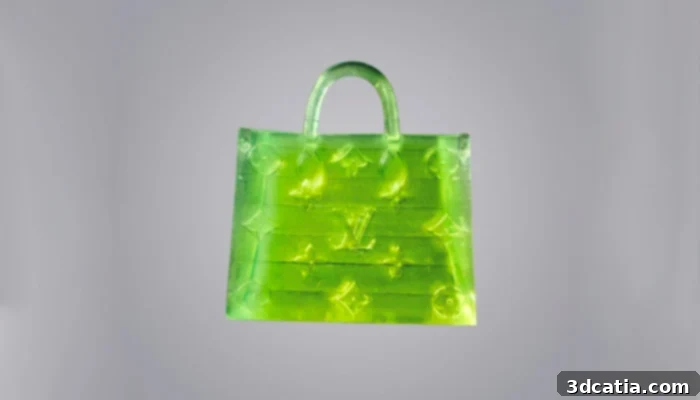
A close-up view of the microscopic 3D printed bag, revealing its intricate detail at an astonishing scale.
MSCHF’s Vision: Art at the Nanoscale
The masterminds behind this intriguing creation are MSCHF, a Brooklyn-based art collective renowned for their provocative, often satirical, projects that blur the lines between art, commerce, and pop culture. Their “Microscopic Handbag” is no exception. This unique piece, presented in a yellowish-green fluorescent color, is designed to be virtually imperceptible to the unaided human eye. Its deliberate design mimics the distinctive monogram pattern and silhouette of a popular Louis Vuitton handbag, yet it is crucial to emphasize that this is an independent artistic statement and not an official collaboration or product from the luxury fashion house. MSCHF consistently challenges consumer culture and brand worship, and this project brilliantly critiques the trend of ever-shrinking luxury bags, pushing the concept to its absurd yet technologically impressive extreme.
To achieve such an extraordinary level of miniaturization and detail, MSCHF employed a highly specialized 3D printing technique known as two-photon polymerization (2PP). This advanced microscale fabrication method works by precisely focusing ultra-short laser pulses into a photosensitive resin. Where the laser’s intensity is highest, the resin undergoes a two-photon absorption process, causing it to solidify at a highly localized point. By meticulously moving the laser focal spot, incredibly complex and precise three-dimensional structures can be built layer by layer, with resolutions down to the nanometer scale. This method is indispensable for creating micro-objects where conventional manufacturing techniques fall short due to limitations in resolution and material handling. Two-photon polymerization offers unparalleled accuracy, making it the ideal choice for rendering the intricate details of the Louis Vuitton monogram on a canvas smaller than a blood cell, demonstrating the cutting edge of what is possible in micro-manufacturing.
The Auction: Valuing the Invisible and the Unconventional
The auction of this groundbreaking microscopic artwork took place on Joopiter, an innovative auction house founded by the influential American musician, record producer, and designer, Pharrell Williams. Williams, known for his boundary-pushing creativity across various domains, provided the perfect platform for MSCHF’s unconventional piece. The “Microscopic Handbag” ultimately sold for a staggering sum exceeding $63,000, a price that far surpasses its material cost and speaks volumes about its conceptual and artistic value. What made this auction particularly compelling was that the winning bid didn’t just include the invisible bag itself; it also came with a high-powered microscope equipped with a built-in digital screen. This essential accessory ensured that the buyer could actually perceive and interact with their newly acquired microscale model, transforming the act of viewing into an integral part of the art experience.
The profound statement behind the piece was articulated in an official Instagram post by MSCHF, accompanying the auction: “Smaller than a grain of sea salt and narrow enough to pass through the eye of a needle, this is a purse so small you’ll need a microscope to see it. There are big handbags, normal handbags, and small handbags, but this is the final word in bag miniaturization. As a once-functional object like a handbag becomes smaller and smaller its object status becomes steadily more abstracted until it is purely a brand signifier.” This insightful commentary encapsulates MSCHF’s core message: challenging the intrinsic value of luxury goods beyond their functionality. It suggests that at a certain point, the object itself becomes secondary to the brand it represents. The price tag, for an item that is effectively non-functional and requires specialized equipment to even be seen, forces collectors and consumers alike to question what truly constitutes value in today’s art and luxury markets. It transforms a functional accessory into a purely symbolic entity, a testament to technological prowess and brand power.
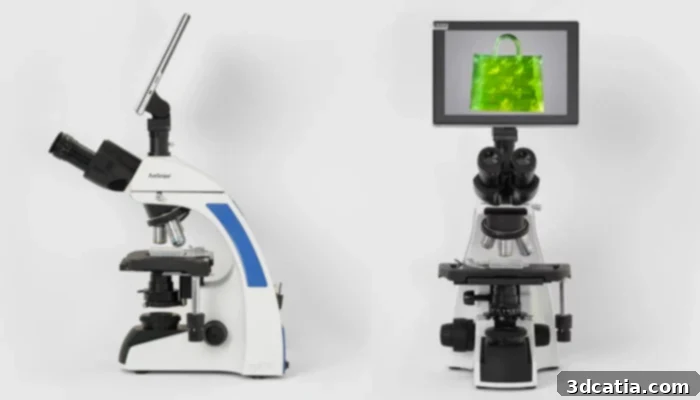
The microscopic bag was sold alongside a specialized microscope, essential for viewing the tiny artwork and enhancing its conceptual value.
Broader Implications: Art, Technology, and the Future of Design
The “Microscopic Handbag” is more than just a fleeting art stunt; it’s a significant cultural artifact that reflects several contemporary trends at the intersection of art, technology, and consumerism. Firstly, it showcases the incredible evolution of additive manufacturing, particularly in micro- and nanoscale applications. The ability to precisely create objects at such minute dimensions opens up new frontiers not only for artistic expression but also for critical industries. Imagine medical devices that are implantable and almost imperceptible, or electronic components that are exponentially smaller, leading to more powerful and compact gadgets. This artistic project acts as a powerful public demonstration of these cutting-edge capabilities, inspiring further innovation and application.
Secondly, MSCHF’s work consistently engages with the commercial landscape, often satirizing or critically engaging with consumer culture. By taking a globally recognized luxury symbol like a Louis Vuitton bag and stripping it of all practical utility, miniaturizing it to the point of invisibility, they force a re-evaluation of what gives luxury items their immense value. Is it craftsmanship, scarcity, brand heritage, or simply the intangible allure of exclusivity? When a bag becomes a mere “brand signifier,” as MSCHF suggests, its value shifts from functional utility to pure symbolic capital. This piece challenges the traditional notions of ownership and display, prompting questions about the very essence of luxury in an increasingly abstract and digitally-driven world. It explores how far a brand’s identity can be stretched and distorted while still retaining its perceived value, and how technology can be used to amplify these conceptual explorations.
Finally, the collaboration with Pharrell Williams and the use of the Joopiter platform further amplifies the project’s impact. Williams’ deep roots in both music and fashion provide a unique lens through which to present such an avant-garde piece. The auction itself became a performance, a public declaration of artistic intent and technological prowess. This microscopic bag stands as a powerful reminder that art continues to push boundaries, asking difficult questions and utilizing the latest technological advancements to provoke thought and inspire discussion. It’s a testament to human ingenuity – both in artistic conceptualization and scientific execution – demonstrating that the most profound statements can sometimes come in the smallest packages.
What are your thoughts on this revolutionary microscopic 3D printed handbag? Do you see it as a brilliant piece of art, a commentary on luxury, or a showcase of advanced manufacturing? We invite you to share your opinions in a comment below or join the conversation on ourLinkedIn,Facebook, andTwitter pages! Don’t forget to sign up for our free weeklyNewsletter here to get the latest 3D printing news delivered straight to your inbox! You can also find all our engaging videos and discussions on ourYouTube channel.