
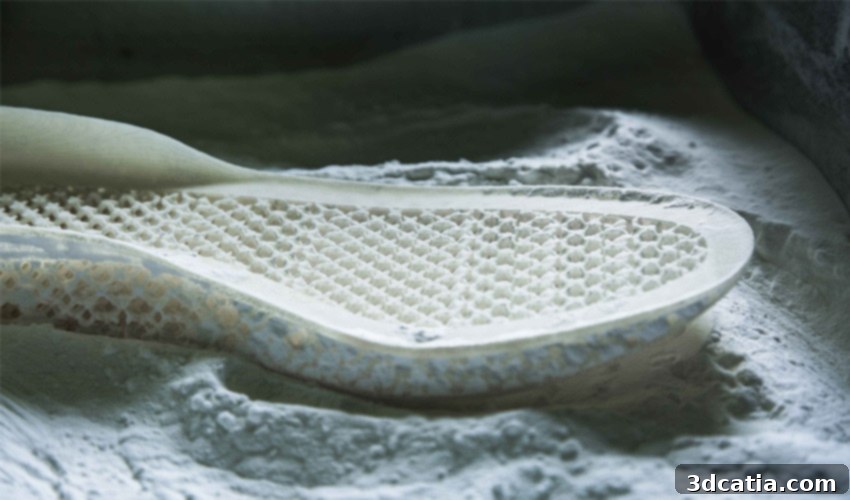
The Rise of 3D Printed Footwear: Personalization, Performance, and Market Growth
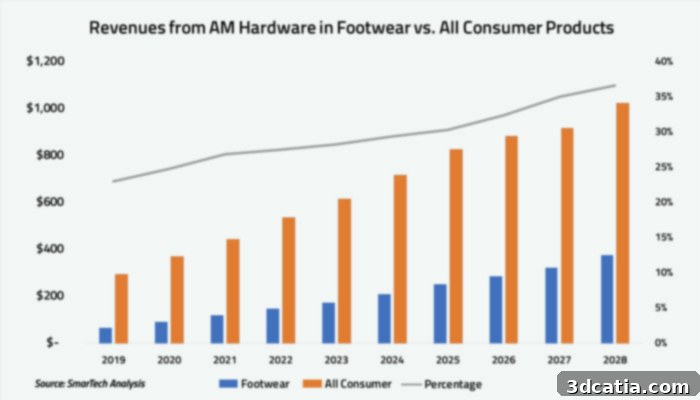
The footwear industry is currently experiencing a significant transformation, driven largely by the innovative integration of 3D printing technologies. A recent report by SmarTech Analysis, a prominent research firm specializing in additive manufacturing, sheds light on this exciting evolution. According to their latest findings, the adoption of 3D printing within the footwear sector is poised for explosive growth, with market revenues projected to exceed $6.5 billion by 2029. This impressive forecast represents an anticipated annual growth rate of 19.5%, underscoring the profound impact additive manufacturing is having on how shoes are designed, produced, and consumed.
The report further highlights the increasing value of specific 3D printed components for footwear. Elements such as soles, vamps (the upper part of the shoe), and midsoles are expected to generate substantial revenue, with projections indicating a market value of over $1 billion by 2023 for these parts alone. This robust financial outlook raises a crucial question: is 3D printed footwear not just a trend, but truly the inevitable future of this dynamic industry? The evidence strongly suggests that customized, high-performance shoes crafted with additive manufacturing are rapidly moving from niche innovation to mainstream necessity.
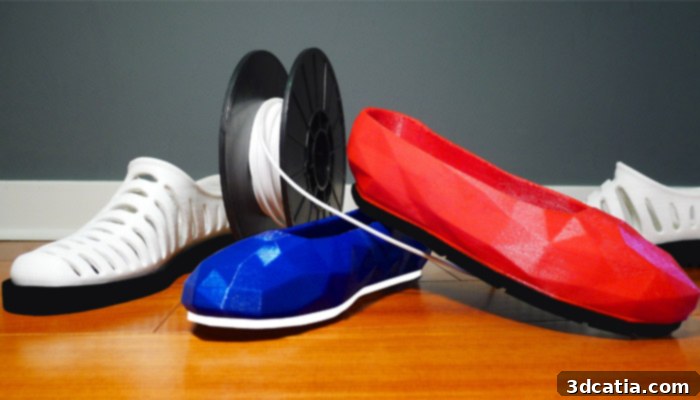
3D printing offers real opportunities in terms of personalisation, allowing for unique designs and optimal fit. | credits: Feetz
3D technologies are garnering escalating interest from the shoe industry primarily due to the unparalleled opportunities they present for personalization. In today’s consumer landscape, individuals are increasingly seeking products that are not only unique but also perfectly tailored to their specific needs. This desire extends far beyond aesthetics; consumers demand footwear that is adapted first and foremost to their individual foot morphology, providing superior comfort and support. Beyond fit, they also seek products that align with their distinct functional requirements, whether for athletic performance, daily wear, or specialized tasks, and, of course, their personal style.
Additive manufacturing stands out as an exceptionally efficient and flexible new production method to cater to this growing trend of hyper-personalization. The process often begins with advanced 3D scanning. Market innovators can digitally scan a consumer’s foot, capturing its exact dimensions and intricate anatomical specificities. This precise digital model then serves as the foundation for designing a truly bespoke product. Whether it’s a perfectly contoured sole that addresses individual gait patterns or an upper part of the shoe engineered for optimal pressure distribution, 3D printing can bring these designs to life. All of this can be achieved in remarkably short turnaround times, offering a rapid path from custom measurement to a finished, personalized product. Given these compelling advantages in meeting consumer demand, the projected annual industry growth of 19.5% is not merely surprising, but rather an expected trajectory for a sector embracing such transformative capabilities.
The rapid expansion of 3D printed footwear is being fueled by a diverse ecosystem of players, as highlighted by SmarTech Analysis. This ecosystem includes pioneering 3D machine manufacturers such as 3ntr, 3D Systems, and Carbon, who are at the forefront of developing the advanced hardware and software solutions necessary for intricate footwear production. Equally significant are major global brands in the sports sector, most notably Adidas and Nike, who have invested heavily in 3D printing to create revolutionary products like Adidas’s Futurecraft 4D series, showcasing personalized lattice structures for optimal cushioning. These giants are leveraging additive manufacturing for both performance enhancement and mass customization. Furthermore, a new wave of innovative startups, including companies like Scientifeet and Wiivv, have emerged, specializing in the intersection of footwear design and 3D printing, often focusing on custom orthotics, insoles, and personalized comfort solutions. This collaborative and competitive landscape ensures continuous innovation and accelerates the adoption of these technologies.
While 3D printed footwear currently represents a modest slice of the global shoe market, its trajectory is undeniable. According to the SmarTech report, revenues from 3D printed footwear, encompassing materials, software, prototypes, and tooling, account for approximately 0.3% of the overall global shoe market’s revenues today. However, this figure is predicted to grow significantly, reaching about 1.5% of total market revenue by 2029. This growth, while seemingly small percentage-wise, translates into billions of dollars in new market value and indicates a fundamental shift in production paradigms. When considering all 3D printed consumer goods, the footwear segment is projected to emerge as the most important category, closely followed by home products. This leadership position in consumer goods highlights a critical aspect: footwear is demonstrating a unique viability for mass production using additive manufacturing processes that have proven to be both effective and profitable. This success stems from the modular nature of shoe design, where components like midsoles and outsoles can be individually optimized and printed, offering advantages in terms of performance, customization, and supply chain efficiency.
The reason footwear is at the forefront of additive manufacturing adoption among consumer goods lies in several key factors. Unlike many other consumer products, shoes benefit immensely from intricate geometries and material properties that 3D printing excels at creating. For instance, lattice structures within midsoles can be precisely engineered to offer specific levels of cushioning, energy return, and stability, perfectly matched to a wearer’s biomechanics. This level of design freedom is virtually impossible with traditional manufacturing methods. Furthermore, the ability to produce on-demand and localize manufacturing reduces waste, minimizes inventory, and shortens supply chains, making the entire production process more agile and sustainable. The footwear industry is continuously pushing the boundaries of material science, developing new resins and powders that offer enhanced durability, flexibility, and comfort, directly addressing the demands of high-performance and everyday wear.
In terms of the specific technologies and materials driving this revolution, SmarTech’s analysis reveals that photopolymerization is currently the most widely adopted process for mass customization in footwear. This category includes technologies like Stereolithography (SLA), Digital Light Processing (DLP), and particularly, Carbon’s innovative Digital Light Synthesis (DLS) solution. Carbon’s DLS, for example, has garnered significant interest from leading sports equipment companies due to its remarkable printing speed and the exceptional level of detail and accuracy it can achieve. These attributes are crucial for producing complex lattice structures and perfectly fitting components. Beyond photopolymerization, Selective Laser Sintering (SLS) is also identified as another highly valued process within the shoe industry. SLS is particularly adept at producing strong, flexible, and durable parts from a range of powdered polymers, making it ideal for outsoles and other structural elements that require resilience.
The report further delves into the material landscape, projecting a substantial increase in demand. Overall demand for 3D printing materials in this sector is expected to reach 3,700 metric tons by 2029. Within this, powdered materials, often used in SLS processes, are projected to constitute the highest demand, accounting for approximately 1,850 metric tons, which is roughly 50% of the total material volume. This highlights the importance of materials like thermoplastic polyurethanes (TPUs) and nylons, which offer the necessary flexibility, durability, and shock absorption required for high-performance footwear. The continuous development of new, high-performance resins and powders that can withstand repeated stress, offer excellent rebound, and are comfortable against the skin is critical to the ongoing success and expansion of 3D printing in this industry.
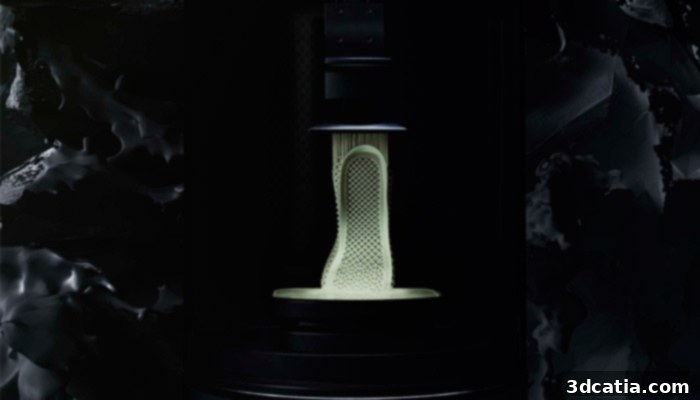
Photopolymerisation could very well become the most widely used 3D printing technology in the footwear sector, enabling intricate designs and rapid production. | Credits: Carbon
The implications of these figures and trends extend far beyond mere production methods. 3D printing in footwear represents a paradigm shift towards truly sustainable and responsive manufacturing. By enabling on-demand production, it drastically reduces waste associated with overproduction and unsold inventory. The ability to localize manufacturing can shorten supply chains, decreasing transportation emissions and fostering regional economic development. Furthermore, the potential to use recycled or bio-based materials in 3D printing opens new avenues for environmentally friendly footwear. As technology continues to advance, we can expect even greater material versatility, faster print speeds, and more accessible solutions, further solidifying 3D printing’s role as an indispensable tool in shaping the future of the shoe industry. The revolution is not just coming; it is already here, with companies constantly innovating to create lighter, stronger, more comfortable, and uniquely personalized shoes for everyone.
What are your thoughts on the groundbreaking figures revealed by SmarTech Analysis for the additive manufacturing segment of the footwear industry? We’d love to hear your insights and predictions for this transformative sector! Share your comments below or engage with us on our Facebook and Twitter pages. Don’t forget to sign up for our free weekly Newsletter to receive all the latest news, innovations, and developments in 3D printing sent directly to your inbox!