
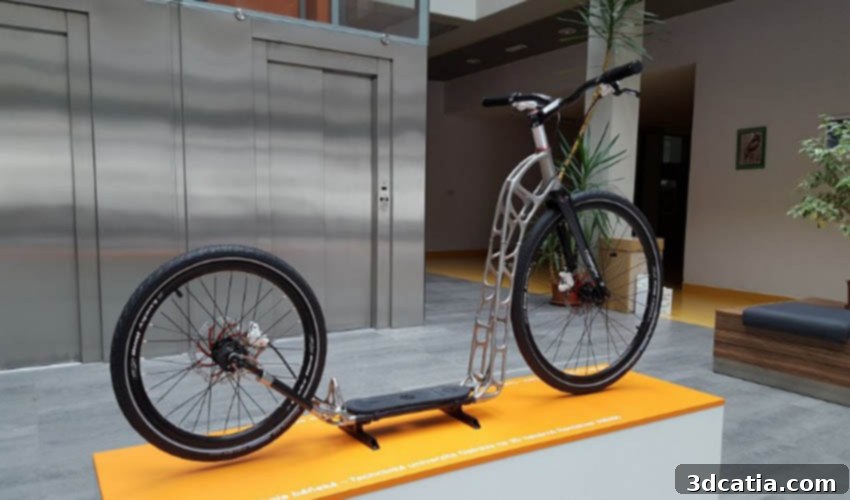
Revolutionizing Urban Mobility: The Rise of 3D Printed Scooters in the Automotive Industry
The automotive industry is undergoing a profound transformation, driven by a continuous quest for innovation in design, manufacturing, and performance. Within this landscape, 3D printing, also known as additive manufacturing, has emerged as a groundbreaking technology offering unparalleled potential. It provides cost-effective, eco-friendly, and significantly lightweight solutions, pushing the boundaries of what’s possible in vehicle production. While additively manufactured vehicles are not yet ubiquitous on our roads, the technology is evolving at an astonishing pace. Numerous projects and conceptual designs have already demonstrated the immense capabilities of 3D printing, signaling that it is only a matter of time before commercially widespread 3D printed vehicles become a common sight, reshaping personal and urban transportation.
One such pioneering endeavor perfectly illustrates this potential: a collaborative project between Renishaw, a leading UK-based 3D printer manufacturer renowned for its expertise in metal additive manufacturing, and visionary engineers from the Technical University of Ostrava (VŠB-TUO) in the Czech Republic. This partnership set out to produce a state-of-the-art 3D printed scooter, aiming to showcase the practical applications and tangible benefits of additive manufacturing in a consumer-ready product. This initiative represents a significant leap forward, moving beyond mere prototyping to functional, performance-driven vehicle components.
The core of this innovative scooter lies in its bionic frame, meticulously 3D printed from high-grade stainless steel. This complex structure was fabricated using a sophisticated Renishaw AM 400 3D printer. The choice of stainless steel, combined with the bionic design principles, allows for an optimal balance of strength, durability, and minimal weight, critical factors for a high-performance scooter. Renishaw’s AM 400, a metal powder bed fusion system, is particularly adept at creating intricate geometries and hollow structures, enabling the engineers to realize designs that would be impossible or prohibitively expensive with traditional manufacturing methods. In contrast to the metallic frame, the scooter’s plastic platform was produced on an EOS P 396 3D printer, a system known for its capabilities in polymer selective laser sintering (SLS). This dual-material approach highlights the versatility of additive manufacturing, allowing engineers to select the most appropriate material and printing technology for each specific component, optimizing for properties such as strength, flexibility, weight, and cost.
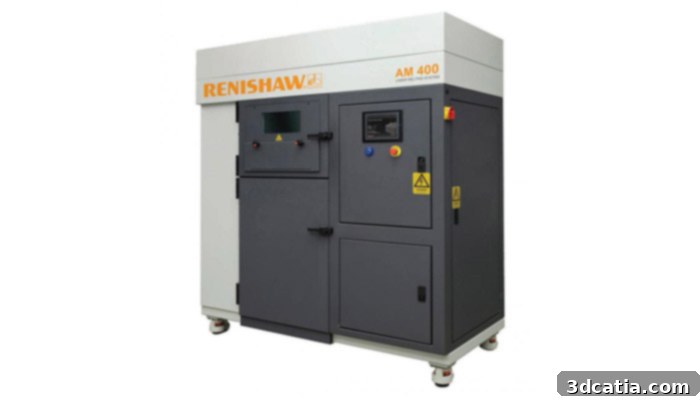
The AM 400 Printer from Renishaw, used to create the advanced scooter frame.
This ambitious partnership between Renishaw and VŠB-TUO extends beyond creating a single product; it seeks to lay the groundwork for a new paradigm in manufacturing, specifically targeting the commercialization of novel production methods for the future. The creation of this next-generation scooter serves as a tangible proof-of-concept, demonstrating the viability and inherent advantages of additive manufacturing in real-world applications. One of the most striking benefits immediately apparent in the prototype is its remarkably low weight. The scooter weighs approximately 3.2 Kg, a significant achievement primarily attributed to the innovative design of its frame, which incorporates hollow internal structures. This topology optimization, a hallmark of 3D printing capabilities, allows for material to be placed only where structurally necessary, dramatically reducing overall mass without compromising integrity.
Marek Pagác, the esteemed leader of the project and a distinguished professor in the Department of Machining, Assembly and Engineering Metrology at VŠB-TUO, eloquently articulated the project’s success: “Our prototype is about a quarter lighter than if it was made by the traditional method. Besides saving the material, we have made the parts lightweight and hollow. We also put the greatest emphasis on the attractive scooter design and its distinctive sporty look.” This statement underscores several key advantages. Firstly, the 25% weight reduction not only enhances the scooter’s performance and portability but also implies significant material savings during production, contributing to a more sustainable manufacturing process. Secondly, the ability to create complex internal geometries, such as hollow sections, is a direct outcome of 3D printing’s design freedom, something largely unattainable with conventional techniques like casting or machining. Finally, the emphasis on an “attractive scooter design and its distinctive sporty look” highlights how additive manufacturing empowers designers to move beyond the limitations of traditional methods, enabling the creation of aesthetically compelling and highly individualized products. This freedom allows for organic shapes and intricate details that can define a unique brand identity and appeal to a modern consumer base.
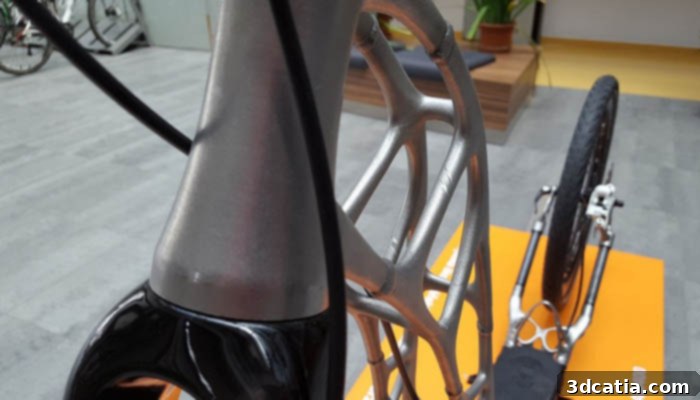
Close up of the intricately designed 3D printed frame showcasing its bionic structure | Photo Credits: VŠB -TUO
For the initial functional scooter frame, the manufacturing process involved producing the complex bionic structure in four distinct parts. These individual components were then meticulously welded together using traditional manufacturing methods to form the complete frame. While this multi-part approach allowed for the successful realization of the first prototype, the team from the Czech university is already looking ahead. Their next ambitious goal is to engineer and produce a second-generation version of their scooter, with a critical enhancement: creating the entire frame as a single, monolithic part. This would represent a significant advancement, eliminating the need for post-print welding and its associated complexities, potential weak points, and labor costs. A single-part frame promises enhanced structural integrity, reduced manufacturing time, and even greater design freedom, as designers would no longer be constrained by the need to divide the structure into weldable sections. The team anticipates having this innovative single-piece frame ready by August, with plans to proudly present it at the prestigious International Engineering Fair in Brno, Czech Republic, in October. This event will provide a vital platform to showcase their progress to a global audience of engineers, manufacturers, and potential investors.
However, the ultimate commercialization of this groundbreaking 3D printed scooter will hinge on a crucial factor: the team’s ability to find a truly cost-effective way of integrating the advanced 3D printing technology into a scalable production model. This involves addressing challenges such as material costs for metal powders, the initial capital expenditure for industrial-grade 3D printers, and the optimization of post-processing steps. While additive manufacturing offers undeniable advantages in terms of design freedom and weight reduction, achieving economic viability for mass-market consumer products requires careful consideration of the entire production lifecycle. This transition from prototype to widespread commercial product is often the most challenging phase for innovative technologies, demanding a delicate balance between performance benefits and production costs.
The motivation behind this project is deeply rooted in a desire for innovation and relevance, as explained by Petr Štefek, one of the dedicated engineers working on the project. “We wanted to go by something that has not yet been realised. Scooters are currently experiencing revival, many people are driving on them, which was also attractive to us.” This insight highlights the strategic alignment of the project with current market trends. Scooters are indeed enjoying a resurgence in popularity, particularly in urban environments, due to increasing congestion, environmental concerns, and the demand for efficient last-mile transportation solutions. The lightweight, customizable, and high-performance nature of a 3D printed scooter perfectly positions it to capitalize on this growing market. It offers not just a mode of transport, but a unique, personalized, and technologically advanced mobility experience, setting it apart from conventionally manufactured alternatives.
This project by Renishaw and VŠB-TUO is more than just a 3D printed scooter; it’s a powerful statement about the future of manufacturing and design in the automotive sector. It demonstrates how additive manufacturing can facilitate rapid innovation, enable the creation of previously impossible geometries, reduce material consumption, and ultimately lead to superior, more sustainable products. The exploration of bionic designs, the quest for single-part fabrication, and the strategic focus on urban mobility trends collectively paint a picture of a manufacturing landscape that is increasingly agile, environmentally conscious, and user-centric. As the technology continues to mature and become more accessible, we can expect to see 3D printing play an even more pivotal role, not just in concept vehicles and specialized components, but in mainstream consumer products that redefine our experience of personal transportation.
We encourage you to share your thoughts and insights on this groundbreaking project! Don’t hesitate to comment below or connect with us on our Facebook and Twitter pages. For all the latest news and developments in the world of 3D printing, remember to sign up for our free weekly Newsletter, delivered straight to your inbox!