
3D Printing Revolutionizes Trauma Care: BellaSeno’s Resorbable Bone Scaffold Heals Severe Gunshot Injury
The landscape of modern medicine is constantly evolving, with 3D printing technology emerging as a pivotal force driving innovation. Its applications in the medical field are not just growing; they are expanding at an unprecedented rate, pushing the boundaries of what’s possible in patient care. Beyond established uses like surgical planning and creating custom prosthetics, additive manufacturing is increasingly being leveraged for highly specialized and complex procedures, particularly in the realm of implants and the healing of traumatic injuries. A remarkable recent case from the Hannover Medical School, Clinic for Trauma Surgery, exemplifies this progression. Here, a patient suffering from a devastating third-degree open infected fracture, sustained from a gunshot wound, received groundbreaking treatment using a customized, resorbable 3D-printed bone replacement scaffold. This innovative scaffold, developed by the pioneering medical device company BellaSeno, represents a significant leap forward in regenerative trauma surgery, offering a beacon of hope for patients facing severe musculoskeletal damage.
Prior to this landmark case, BellaSeno, a company distinguished by its ISO 13485 certification and its focus on clinical-stage medical devices, was primarily recognized for its advanced regenerative implants. The company garnered particular acclaim for its work in creating sophisticated breast implants for women who had undergone mastectomies due to breast cancer. Their commitment to improving patient quality of life through custom-engineered, biocompatible solutions positioned them at the forefront of regenerative medicine. With its headquarters in Germany and a robust subsidiary in Brisbane, Australia, BellaSeno has consistently demonstrated its capability to translate cutting-edge research into tangible medical benefits. This latest achievement, venturing into the complex and demanding fields of trauma and orthopedics, underscores the versatility of their technology and their unwavering dedication to addressing critical unmet medical needs. It signals a strategic expansion for the company, showcasing how its foundational expertise in regenerative implant design can be adapted to solve some of the most challenging clinical scenarios in reconstructive surgery.
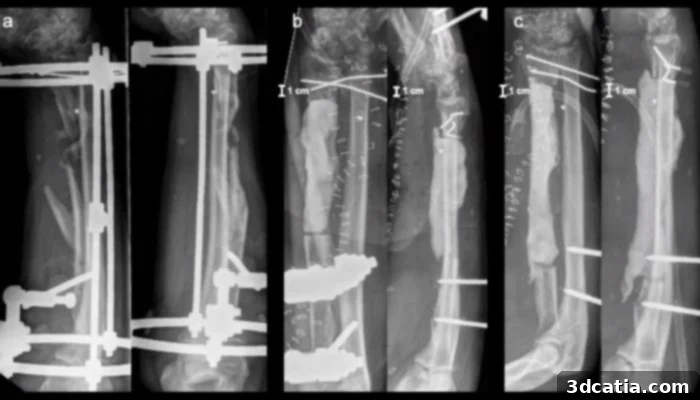
X-ray images (AP and lateral view) of the right forearm: (a) at the time of admission; (b) after 1st operation; and (c) before bone reconstructive surgery
The Complex Challenge: Reconstructing a Severe Bone Defect
The procedure, which took place in October 2023, was an arduous undertaking focused on reconstructing a massive 14 cm segmented bone defect within the radial shaft of the patient’s forearm. This particular section of bone is critical, extending from the neck to the radial tuberosity, and constitutes a significant structural component of the arm. The patient’s journey to this advanced treatment at Hannover Medical School was long and fraught with difficulties. Prior to their arrival, they had already endured eleven separate surgical interventions, all aimed at closing the severe wound. Despite these extensive efforts, the underlying fracture had only been provisionally stabilized by an external ring fixator. The sheer magnitude and complexity of the injury presented an insurmountable challenge for conventional reconstructive techniques, leaving a significant void where vital bone tissue should have been. This persistent problem underscored the urgent need for a more innovative and effective solution to not only bridge the gap but also facilitate genuine bone regeneration. The ultimate goal of the procedure was the precise integration of BellaSeno’s revolutionary bone replacement scaffold, meticulously designed to be bioresorbable, meaning it would gradually dissolve and be absorbed by the body as new, healthy bone tissue regenerated in its place.
A Novel Surgical Technique: Integrating the 3D-Printed Scaffold
Prof. Dr. med. Philipp Mommsen, the Managing Senior Physician at the Clinic for Trauma Surgery at Hannover Medical School and the lead author of the compelling paper detailing this case, eloquently articulated the critical need for such advanced solutions. He explained, “As the example of the 46-year-old patient demonstrates, sophisticated solutions to treat large bone defects are scarce. Traditional methods often fall short when confronted with defects of this scale, particularly those complicated by infection and extensive tissue loss. BellaSeno’s scaffold enabled us to conduct a truly novel surgical technique for graft vascularization by embedding a vascular muscle arcade directly into a patient-specific, 3D-printed bioresorbable scaffold. This innovative approach addresses one of the most significant challenges in reconstructive surgery: ensuring adequate blood supply to promote healing and integration of the graft.” This method, by directly integrating a vascularized tissue component into the scaffold, dramatically improves the chances of successful bone regeneration. Prof. Mommsen further emphasized, “This surgical procedure represents an innovative and promising approach for the restoration of extensive bone defects. As we see an increasing number of such catastrophic and very difficult to treat defects – often resulting from high-energy trauma like gunshot injuries or severe accidents – we are facing a rapidly growing medical need to reconstruct such injuries efficiently and effectively.” The procedure not only provided a structural framework but also actively promoted the biological processes essential for healing, setting a new benchmark for complex trauma reconstruction.
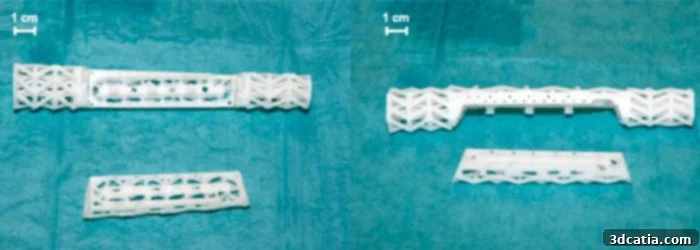
The 3D printed bone scaffold
Precision Engineering: The Science Behind the Custom Scaffold
The inherent strength of 3D printing in medical applications lies in its unparalleled ability to create highly customized, patient-specific devices. In this particular case, the benefit of 3D printing was strikingly evident as the scaffold could be precisely tailored to the patient’s unique anatomy, offering a level of fit and functional integration impossible with off-the-shelf solutions. To achieve this remarkable precision, BellaSeno leveraged its cutting-edge AI-driven additive manufacturing facilities. This advanced technological infrastructure allowed them to meticulously design and fabricate a 3D-printed “cage” that perfectly matched the contours of the patient’s bone defect. The design was crucial not only for structural support but also to ensure a secure and stable hold for the autologous bone graft. This graft, a critical component of the reconstructive process, was carefully harvested from the medullary cavity of the patient’s own femoral bone, ensuring biocompatibility and reducing the risk of rejection. The custom-designed scaffold effectively filled the large void, providing an optimal environment for regeneration.
The material choice for the scaffold was equally significant. It was fabricated using Resomer®, a state-of-the-art biodegradable polymer platform developed by Evonik, a leader in specialty chemicals. Resomer® polymers are renowned for their excellent biocompatibility and their predictable degradation profiles, allowing the scaffold to resorb at a controlled rate as new bone tissue forms. Beyond the material, the intricate design of the part was meticulously engineered to facilitate proper internal vascularization. This critical feature was achieved by strategically positioning an arterio-venous loop within the scaffold’s structure. Indeed, the scaffold cage featured both an inner and outer support frame, which integrated a vascular pedicle carefully placed on the outer cage frame. This sophisticated architecture ensures not only mechanical stability but also promotes the rapid ingrowth of blood vessels, essential for nutrient supply and waste removal, which are vital for bone healing and overall tissue regeneration. Furthermore, the innovative design and material properties mean the cage is expected to be not just totally bioresorbable but also possesses osteoconductive properties, meaning it actively encourages bone cell growth and new bone formation. This potent combination of reconstructing an extensive radial shaft bone injury while simultaneously ensuring immediate and robust vascularization was identified as a paramount factor in the successful outcome of this complex and challenging treatment.
Promising Outcomes: Patient Recovery and Future Outlook
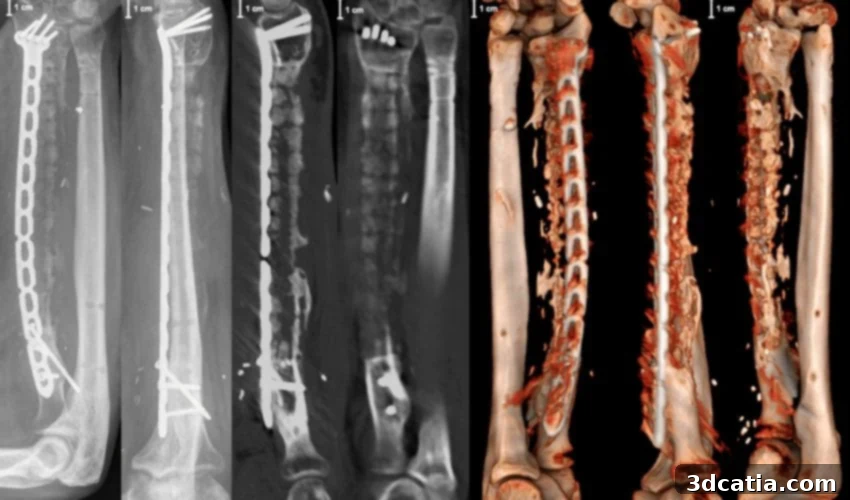
The most encouraging aspect of this pioneering procedure is its undeniable success, as highlighted in a recent press release from BellaSeno. The careful planning, advanced 3D printing technology, and meticulous surgical execution have yielded exceptional results for the patient. A mere three months post-surgery, the patient has exhibited clear and positive signs of timely bony integration, indicating that the new bone tissue is successfully merging with the existing skeletal structure. Moreover, and perhaps most critically for their quality of life, the patient has regained adequate elbow function, demonstrating the functional restoration of the affected limb. Crucially, there have been no signs of wound healing disorder or infection, which is a significant achievement given the initial severity and infected nature of the gunshot injury. This rapid and complete recovery underscores the transformative potential of personalized 3D-printed scaffolds in managing highly complex traumatic bone defects.
Dr. Mohit Chhaya, the astute CEO of BellaSeno, offered a compelling conclusion regarding the broader implications of this success. He stated, “This case study once again underlines the unparalleled versatility and adaptability of our proprietary technology. Almost any intricate design request by a medical team can be fulfilled with extraordinary precision to optimize the patient’s treatment plan. The intelligently designed open structure of our scaffold is a key innovation, as it actively enables and promotes vascularization, which is absolutely crucial not only for proper bone healing and integration but also to allow essential access for immune cells and targeted anti-microbial drugs. This direct access helps effectively prevent surgical site infections, a common and severe complication in trauma cases.” Dr. Chhaya also provided a glimpse into the future of BellaSeno’s research and development, revealing, “We are currently working diligently on next-generation bone scaffolds. These advanced scaffolds are being developed as a composite of PCL (polycaprolactone) and bio-active glass, specifically engineered to incorporate inherent anti-infective properties.” This continuous innovation promises even more robust solutions for patients facing similar complex injuries. Detailed insights into this groundbreaking procedure are readily available in the comprehensive case study, which was published in the esteemed Journal of Personalized Medicine, and can be accessed HERE for those interested in the scientific specifics.

The arm after surgery
This monumental achievement by Hannover Medical School and BellaSeno represents a significant milestone in the ongoing integration of 3D printing in healthcare, particularly in the challenging domain of trauma surgery. The successful treatment of a severe gunshot injury with a customized, bioresorbable bone scaffold not only validates the potential of additive manufacturing but also opens new avenues for personalized medicine and regenerative strategies. What are your thoughts on this incredible use of a 3D-printed scaffold to treat extensive bone defects caused by such a catastrophic injury? Where do you anticipate we will witness the next significant innovations and breakthroughs in 3D printing within the medical sector? We invite you to share your perspectives and insights in a comment below or join the conversation on our LinkedIn, Facebook, and Twitter pages! Don’t miss out on the latest advancements and news in the additive manufacturing world. Make sure to sign up for our free weekly newsletter here, delivering the freshest 3D printing news straight to your inbox! Additionally, you can explore all our engaging video content and interviews on our dedicated YouTube channel.
*All Photo Credits: Hannover Medical School and BellaSeno