
Pioneering 3D Printed Orthopedic Footwear: An Interview with Footwear Engineer Daniel Petcu
The world of footwear manufacturing has been profoundly transformed by additive manufacturing, particularly 3D printing. This innovative technology is increasingly adopted across various sectors, ranging from consumer goods, where we’ve witnessed the emergence of strikingly fashionable examples, to specialized sports shoes engineered to deliver superior athletic performance. However, one of the most significant and impactful applications of 3D printing lies within the orthopedic shoe industry. Here, the primary objective transcends mere aesthetics or peak performance; it centers on creating footwear that makes a tangible contribution to the health and overall well-being of its wearers, addressing specific medical conditions and significantly enhancing their quality of life. Daniel Petcu, a distinguished footwear engineer, has dedicated his career to advancing this specialized field. His extensive work has culminated in groundbreaking achievements, notably the design of the first complete 3D-printed orthopedic shoe, which he presented as a pivotal case study at OTWorld 2024 in Leipzig. At this prestigious event, Petcu personally showcased the innovation by wearing a pair of custom-designed 3D printed footwear, embodying the practical benefits of his pioneering efforts. We engaged with him in an insightful interview, delving into the intricacies of his role as a footwear engineer and exploring the daily challenges he confronts in this rapidly evolving and highly specialized domain.
Meet Daniel Petcu: A Visionary in Medical Footwear Engineering
3DN: Could you introduce yourself and elaborate on your unique journey into medical footwear?
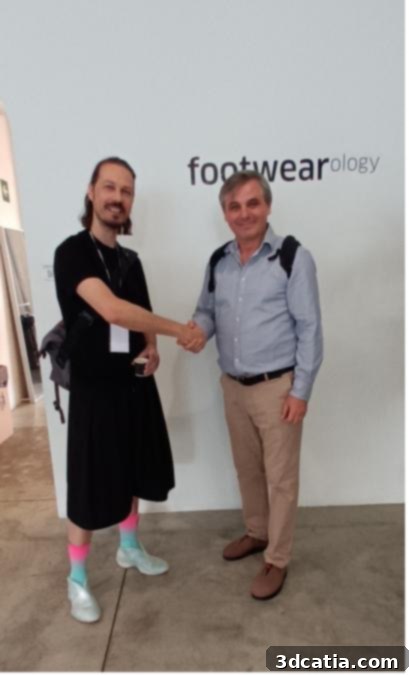
Petcu (right) meeting Philippe Holthuizen, founder of Fused Footwear, at Footwearology’s event in Barcelona.
I am a footwear engineer by profession, holding a Ph.D. awarded for a thesis that meticulously explored foot orthoses specifically tailored for diabetic feet. My profound interest lies in the specialized domain of medical footwear, which broadly encompasses various types of foot orthoses. This particular area often falls outside the traditional scope of practice for many footwear engineers. Consequently, my engagement with medical footwear necessitated an extensive and dedicated process of self-education, allowing me to acquire comprehensive knowledge in the Pedorthics field. This intensive learning journey inspired me to conceptualize and develop Pedorthic Information Modeling (PIM). I define PIM as an advanced digital environment designed for the precise representation of the aesthetic, physical, and functional characteristics that define the information model of medical footwear. It represents a holistic approach to digitizing and optimizing the design process for therapeutic foot solutions.
The theoretical foundation of the Pedorthic Information Modeling concept has been successfully translated into practical application through the development of a sophisticated Grasshopper visual programming code. This code has enabled the precise 3D printing of both highly customized foot orthoses and complete orthopedic footwear. The PIM concept and its accompanying Grasshopper code are not static; they are subjects of continuous development, rigorous testing, and iterative refinement to ensure their practical validity and efficacy in clinical settings. My innovative work has garnered significant international recognition, leading to numerous presentations at prominent global events. These include OTWorld in Leipzig, Germany, in both 2022 and 2024, where I shared the latest advancements; IVO-OST in Koln, Germany, in 2022; FootPRINT3D in Barcelona, Spain, in 2023; the International Rhino User Meeting in Wroclaw, Poland, in 2024; and the Pedorthic Association of Australia Conference, also in 2024. These platforms have been instrumental in fostering dialogue, gathering feedback, and validating my methodologies within the broader pedorthic and additive manufacturing communities.
3DN: How did you first encounter additive manufacturing, and what were the key factors that drew you to this technology?
It’s somewhat ironic, but I’ve always considered myself an ‘all-thumbs’ engineer – not particularly inclined towards hands-on tasks like car repairs or intricate technical installations. Manual dexterity was never my forte, which posed a significant challenge in the field of custom-made medical footwear, an industry traditionally defined by a meticulous ‘handmade’ workflow that imbues products with a distinct artisanal character. However, a few years ago, an incredibly inspiring interview published in MAEKAN featuring Philippe Holthuizen from Fused Footwear completely transformed my perspective. It illuminated the remarkable potential of fully 3D printing footwear. This revelation was truly transformative for me. 3D printing perfectly aligned with my inherent desire for independence in my work, offering a pathway to bring complex product designs to fruition without the lifelong dedication typically required to develop extensive manual skills. In that moment, a realization dawned on me, much like hearing Frank Sinatra’s iconic declaration: ‘This is my way!’
Beyond the immediate practical advantages, the ability to utilize additive manufacturing to conceptualize and precisely engineer specific (meta)materials for distinct therapeutic purposes is profoundly captivating. I have meticulously implemented and tested various lattice structures within my programming code. Initially, the prohibitive costs and limited accessibility of manufacturing and testing these complex structures led me to concentrate on more affordable FDM (Fused Deposition Modeling) printing. To further enhance the capabilities of FDM, I developed an advanced Grasshopper code for Gradient Stiffness G-Code post-processing. This innovative solution allows me to dynamically vary material stiffness across a product’s structure, significantly expanding its application beyond just insoles and foot orthoses to include midsoles and even fully 3D printed footwear components, each with tailored mechanical properties.
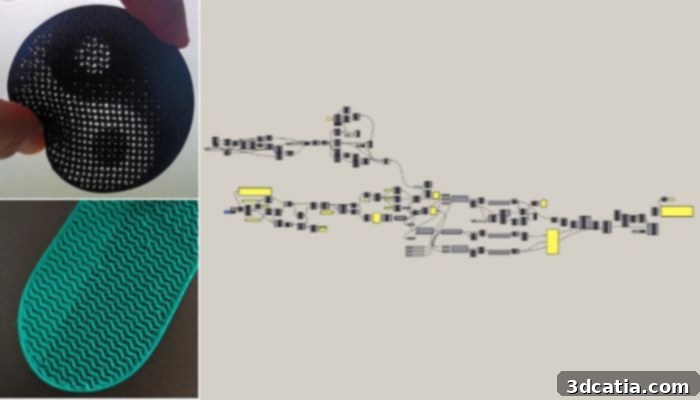
Grasshopper code for Gradient Stiffness G-Code post-processing
The ultimate impetus behind my decision to commit exclusively to additive manufacturing stemmed from a particularly challenging medical footwear case. It involved a young lady suffering from a permanent medical condition that rendered her unable to stand or walk without specialized shoes. Eight years prior, during my tenure at a previous employer, I had successfully designed a unique solution for her using traditional design and manufacturing methods. However, when she needed a replication of this solution, she found herself in an incredibly difficult predicament: she could not find anyone willing to even attempt to recreate the complex, custom footwear I had previously developed. This critical experience starkly underscored the inherent limitations and rigidities of the traditional, hand-made driven workflow.
It’s intriguing to consider that in nations with a deeply ingrained tradition of exceptional craftsmanship, she might have more readily found a suitable solution. This observation highlights a significant issue prevalent in countries that have established highly functional traditional manufacturing systems: once these systems become deeply entrenched, initiating change or fostering innovation by thinking ‘outside the box’ becomes remarkably challenging. Furthermore, educational frameworks that do not adequately emphasize parametric thinking and design inadvertently impede the cultivation of innovative approaches and discourage a mindset geared towards continuous improvement. The lack of foundational knowledge in these modern design methodologies acts as a barrier to progress and adaptability within the industry.
In stark contrast, fields such as AEC (architecture-engineering-construction) are celebrated for their high degree of innovation, primarily because parametric thinking and design are foundational to their methodologies. We frequently observe numerous architects and computational/product designers actively engaged in developing fully 3D printed footwear solutions. However, a noticeable void exists in their involvement with medical footwear. The reason for this gap is fundamental: these professionals typically lack the essential medical knowledge, encompassing functional anatomy, biomechanics, pathomechanics, and related disciplines, which is crucial for accurately evaluating complex clinical cases and subsequently designing appropriate, therapeutically effective medical footwear. This interdisciplinary knowledge gap is precisely where my unique expertise provides a distinct advantage, bridging the divide between advanced computational design and critical medical understanding.
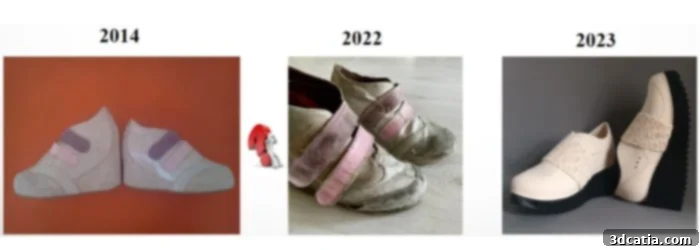
The road from traditional orthopedic footwear to the first fully 3D Printed one.
My blend of medical, technical, and computational knowledge proved to be my distinct advantage—I understood precisely what was required to effectively design and manufacture a medical shoe. Using the young lady’s challenging case as a fundamental reference point, I embarked on the development of the Pedorthic Information Modeling (PIM) concept. This involved ingeniously adapting the principles of Building Information Modeling (BIM) from the AEC sector to the highly specialized domain of Pedorthics. Initially, my development trajectory followed the traditional design workflow. However, a pivotal turning point occurred when I decided to invest in my own 3D printer. The significant affordability of owning a printer, compared to the recurring costs of external printing services, was a key factor. More crucially, witnessing firsthand my ability to materialize complex design ideas that my manual skills alone could never achieve solidified my conviction. Following this realization, I decisively ceased all work associated with traditional workflows and made the strategic decision to fully commit to the transformative potential of 3D printing.
In 2022, the lady graciously sought my assistance once more to resolve her ongoing shoe problem. It became unequivocally clear that the most effective and entirely independent pathway to a solution was through 3D printing. This experience served as an exceptionally powerful catalyst, not only propelling me to exclusively pursue additive manufacturing but also affording me the unique opportunity to be the first to design and manufacture fully 3D printed footwear that a patient/customer could wear daily. This personal success story powerfully illustrates the immense potential of 3D printing to deliver highly customized, genuinely effective, and life-changing solutions, particularly in the most challenging and complex medical scenarios.
Furthermore, additive manufacturing fosters exciting opportunities for creative and interdisciplinary collaboration. It empowers designers like myself to independently conceive and create entirely new types of footwear designs or to engage in innovative partnerships with other digital and computational designers. This collaborative spirit was vividly demonstrated in my work with Oran Sheinman, where we collectively pushed the boundaries of both aesthetic form and functional utility. The technology also facilitates unique collaborations with local artists, forging a fascinating synergy between traditional craftsmanship and advanced digital workflows. A notable example is my project with Corina Coroi, where the shoe sole and custom foot orthoses were precisely 3D printed, while the leather uppers were meticulously crafted using traditional methods and then seamlessly integrated onto the sole using a custom 3D printed sealing system. This hybrid approach beautifully showcases the versatility and complementary nature of additive manufacturing within the broader footwear industry.
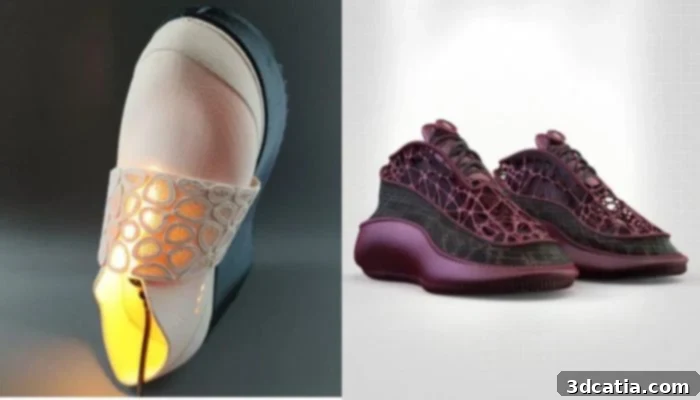
Left: Petcu’s fully 3D Printed shoe; Right: Collaboration with computational designer Oran Sheinman.
3DN: Can you describe your current professional roles and what a typical day involves for you?
My professional life is effectively divided into two distinct, yet inherently interconnected, roles. My primary role, which provides crucial financial sustenance, involves conducting comprehensive foot biomechanical evaluations for a Podiatry clinic. This work is absolutely essential for gaining a deep understanding of individual patient needs and forms the foundational basis for developing effective and personalized interventions. My second role is what I often refer to as the ‘one-man orchestra.’ This encompasses the continuous and iterative development and refinement of the Pedorthic Information Modeling (PIM) concept. The overarching objective here is to advance PIM to a stage where I can seamlessly integrate the products—specifically, the 3D printed medical devices designed and manufactured based on this concept—into my daily clinical practice, all while ensuring full adherence to pertinent regulatory standards. This dual responsibility necessitates a dynamic daily cycle that combines intensive learning, rigorous testing, and constant development. The PIM concept and the Grasshopper code, which serve as my primary developmental tools, are in a symbiotic relationship, continuously informing and evolving each other. It’s an ongoing process of innovation where theoretical advancements directly inform practical applications, and real-world testing provides critical feedback that refines the theoretical framework, thereby continuously expanding the boundaries of what is achievable in custom medical footwear.
3DN: What specific qualifications and experiences do you believe are essential for a footwear engineer aspiring to work with 3D printing in this field?
My formal technical college education dates back three decades, a time when basic programming was the extent of computer-related subjects. Unsurprisingly, this foundational knowledge had no direct link to shoe design. However, I was incredibly fortunate to have a mentor who generously invested countless unpaid hours teaching me a crucial problem-solving methodology: primarily designing the underlying algorithm before attempting to write any code. This fundamental principle of algorithmic thinking remains central to my approach today, though it is now greatly amplified and made more versatile by the capabilities of the Grasshopper visual programming language. It’s about structuring logical solutions, a skill far more valuable than simply memorizing specific software commands or functionalities.
From my observations, many footwear engineering schools predominantly focus on instructing students in the usage of existing, often expensive, proprietary footwear design software solutions that are already deeply entrenched in the market. While this approach equips students with practical operational skills, it unfortunately tends to position these institutions more as ‘schools of users’ rather than ‘schools of thinkers’ – a critical distinction for a university-level education aiming to foster genuine innovation. This helps explain why, when examining the pioneers in 3D printed footwear, you predominantly find architects or computational designers. These individuals are rigorously trained to think parametrically, to develop and adapt code to solve unique design challenges, rather than being confined to the predefined functionalities of existing software. They are, at their core, problem-solvers who are capable of creating their own tools when necessary, pushing the boundaries of what is conventionally possible.
Given that 3D printing footwear is still a relatively nascent field, extensive direct experience is continuously being accumulated. However, the foundational knowledge requirements are increasingly clear: a robust understanding of computational, algorithmic, and parametric thinking and design; proficiency in visual programming; and a deep comprehension of 3D printing technologies, materials, and metamaterials. For those interested in specializing in medical footwear, and if their formal education does not provide specific medical knowledge, a substantial commitment to self-study is absolutely indispensable. This includes delving into complex subjects such as biomechanics, pathomechanics, functional anatomy, and meticulously understanding the intricate landscape of medical device regulations. The interdisciplinary nature of this field demands continuous learning and a highly proactive approach to acquiring diverse and specialized expertise.
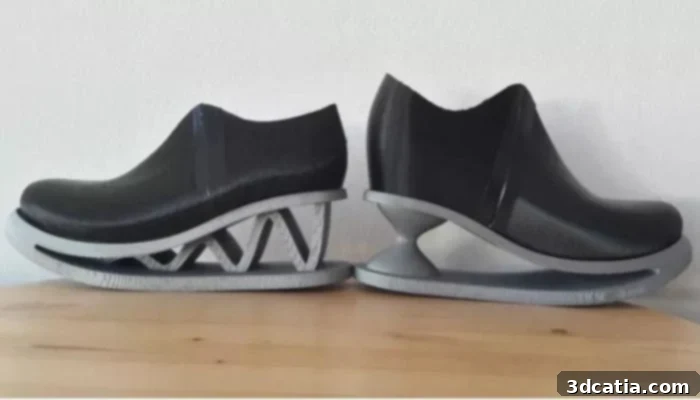
Petcu’s first exercise with shoes 3D printing based on the Grasshopper code.
3DN: What are the biggest challenges you currently face in your pioneering work with 3D printed orthopedic footwear?
Now that the Pedorthic Information Modeling (PIM) project has reached a significant level of maturity and sophistication, my paramount challenge is the successful integration of products designed based on this innovative concept into my daily clinical practice. This transition involves not only rigorous validation of their functional efficacy but also the intricate process of navigating regulatory compliance for medical devices. A critical objective is to unequivocally demonstrate that fully 3D printed medical footwear is not merely suitable, but superior, for managing even the most complex and difficult cases, such as those associated with Charcot-Marie-Tooth disease. This condition, characterized by its unique and severe foot deformities, serves as a crucial benchmark for illustrating the ultimate capabilities and therapeutic potential of additive manufacturing in orthotics.
From a technical standpoint, I firmly believe that the 3D printing of shoe uppers represents the greatest and most complex challenge. This endeavor extends far beyond simply achieving a functional or aesthetically pleasing shape; it demands the satisfaction of stringent requirements across multiple critical domains. These include physico-mechanical properties, ensuring optimal durability, flexibility, and anatomical support; hygienic properties, such as superior breathability, effective moisture management, and excellent skin compatibility; and, of course, compelling aesthetic properties. Patient adherence to wearing therapeutic footwear is profoundly influenced by their perception of its visual appeal and the tactile qualities of the materials used. There will always be an inherent comparison with traditional materials, particularly leather, which is widely recognized and trusted for its safety, comfort, and premium aesthetic for feet. Replicating or, ideally, surpassing these established qualities with 3D printed materials for uppers, while simultaneously maintaining the benefits of bespoke customization and therapeutic effectiveness, remains a formidable hurdle that requires significant advancements in material science and innovative design.
3DN: What advice would you offer to someone hoping to embark on a career as a footwear engineer utilizing additive manufacturing?
For anyone aspiring to become a footwear engineer leveraging additive manufacturing, my foremost advice is to diligently cultivate a robust foundation in parametric thinking. This naturally leads to proficient parametric design through visual programming. The Rhinoceros-Grasshopper environment stands out as an exceptional platform for developing these skills, supported by a vast and vibrant community where you can readily find answers to your questions and engage in collaborative learning. Once you’ve established this foundational knowledge, prioritize focusing on affordable and reliable 3D printing methods. This strategic approach enables you to test your innovative ideas frequently and iteratively without incurring significant financial strain. If financially feasible, investing in your own 3D printer can be a transformative step, offering unparalleled freedom for experimentation, rapid prototyping, and continuous learning.
Beyond acquiring technical skills, actively seek out and follow creative individuals and pioneers who are forging their own unique paths within the 3D printing landscape. Their insights, experiences, and open-source contributions are an invaluable resource for both information and inspiration. Never hesitate to ask for assistance when you encounter challenges; dispel any apprehension that your questions might seem ‘stupid’ or embarrassing. Generally, individuals within this innovative community are eager to share their knowledge and expertise. Even when a problem appears insurmountable, numerous resources and supportive communities exist to guide you toward a solution. Embracing this collaborative spirit is absolutely critical for personal growth and collective progress.
Make a concerted effort to seek out and actively participate in major events and conferences focused on additive manufacturing. These gatherings offer far more than just opportunities to connect with the people whose work you admire; they provide an indispensable chance to physically see, touch, and interact with similar 3D printed products firsthand – an immersive experience that is absolutely mandatory for truly grasping the nuances and potential of the technology. Don’t be hesitant; proudly wear your own 3D printed shoes to these events, even if you perceive them as not perfectly stylish. It serves as a powerful testament to your belief in the technology and an open invitation for engaging discussions. Finally, trust your instincts, hone your observational skills, and cultivate patience. 3D printing processes inherently require time, but this ‘downtime’ presents a unique and valuable opportunity to further refine your ideas, acquire new skills, and meticulously develop your concepts for the next iteration. It is a continuous, rewarding journey of learning, creation, and innovation.
You can discover more about Daniel Petcu and his pioneering work at Pedorthic Art. What are your thoughts on the evolving and impactful role of a footwear engineer harnessing additive manufacturing? We invite you to share your valuable perspective in a comment below or connect with us on our social media channels: LinkedIn, Facebook, and Twitter! For the very latest updates and news in 3D printing delivered directly to your inbox, don’t forget to sign up for our free weekly newsletter here. Additionally, you can explore all our insightful videos and content on our dedicated YouTube channel.
*All Photo Credits: Daniel Petcu