
Microlight3D’s Micro 3D Printing: Crafting the World’s Smallest Champagne Pyramid and Pushing Fabrication Boundaries
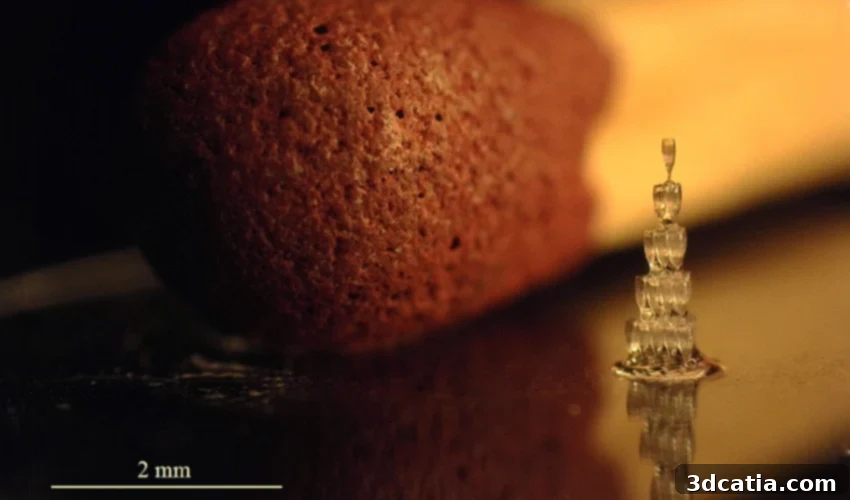
In a remarkable demonstration of its cutting-edge microfabrication 3D printing technology, Microlight3D, a trailblazing French company, has successfully created the world’s smallest champagne pyramid. This intricate marvel stands at a mere 2 millimeters in height and comprises 35 perfectly formed micro glasses, each a testament to the unparalleled precision achievable with their advanced systems. This achievement not only highlights Microlight3D’s extensive experience in the highly specialized field of microprinting but also sets a new benchmark for miniature fabrication.
Philippe Paliard, co-founder of Microlight3D, shed light on the astonishing scale of this creation. “Each miniature flute measures just 0.4 millimeters tall and is capable of holding precisely 1 nanoliter of genuine Champion Ouy champagne,” he explained. To put this into perspective, Mr. Paliard added, “A standard bottle of champagne, typically 750 milliliters, possesses enough volume to fill an astounding 750 million of these incredibly tiny flutes.” This captivating project serves as a playful yet powerful showcase of the company’s capabilities, illustrating the microscopic dimensions they can consistently achieve.
As its name profoundly suggests, microfabrication is a sophisticated engineering discipline focused on creating miniature parts and components. These structures often operate at the micrometer scale, which is one-millionth of a meter, or even further down to the nanometer scale, an astounding one-billionth of a meter. Microlight3D stands as an acknowledged expert in this highly specialized domain. The company previously garnered significant attention when its revolutionary technology was employed to 3D print intricate miniatures from the iconic Star Wars universe, some measuring an astonishing 0.01 millimeters long, a feat that captivated audiences and demonstrated the versatility of their systems.
These meticulously designed micro-structures, including both the Star Wars figures and the components of the champagne pyramid, were all brought to life using Microlight3D’s flagship µFAB-3D machine. This ultra-high-resolution 3D printing system operates on a sophisticated technology known as multiphoton lithography (MPL), which is more widely recognized in the scientific community as two-photon polymerization (2PP). This innovative process utilizes a highly focused laser beam to selectively solidify photopolymerizable materials, allowing for the creation of incredibly solid, miniature, and complex three-dimensional structures with unprecedented detail and accuracy at scales previously thought impossible.
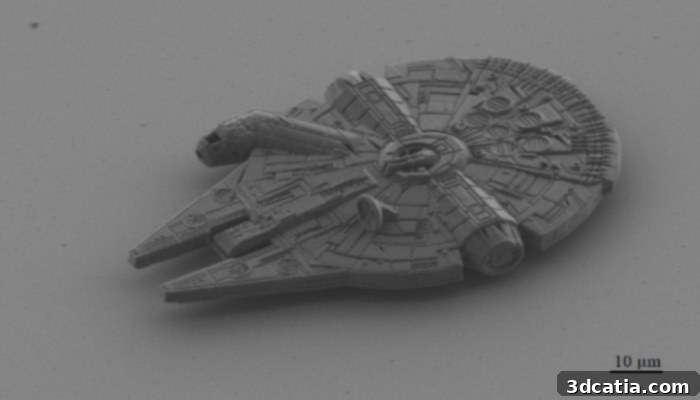
Star Wars figure measuring 0.1 millimeter long designed with the µFAB-3D printer | Photo Credits: Microlight3D
A Millimeter-Sized Design: The Material Behind the Marvel
The success of creating such incredibly small and functional objects is not solely dependent on the printing technology; the choice of material plays an equally critical role. The micro flutes for the champagne pyramid were fabricated using OrmoGreen, a specially developed polymer filled with nanoparticles. This innovative material offers mechanical and thermal properties that are far superior to those found in conventional, off-the-shelf polymers, making it ideally suited for demanding micro-scale applications.
Mr. Paliard elaborated on the unique characteristics of OrmoGreen: “It is a proprietary material specifically developed by Microlight3D to meet the rigorous demands of microfabrication. This polymer is ingeniously filled with silica particles, which are the fundamental components of glass. This unique composition imbues OrmoGreen with properties remarkably similar to those of actual glass, particularly in terms of rigidity, transparency, and thermal resistance. Given these exceptional qualities, it was unequivocally the optimal material choice for crafting the champagne flutes, ensuring both their structural integrity and their aesthetic appeal at a minuscule scale.” The development of such specialized materials underscores Microlight3D’s comprehensive approach to pushing the boundaries of micro 3D printing, addressing both hardware and material science challenges simultaneously.
While Microlight3D possessed the in-house expertise to flawlessly design and print the miniature flutes, the task of filling them with a nanoliter of champagne presented a distinct challenge that required specialized assistance. The company strategically leveraged external expertise for this delicate process, showcasing the collaborative spirit often necessary in advanced scientific endeavors. “The exceptionally precise deposition of champagne into each flute was the culmination of a productive collaboration between Microlight3D and Pierre-Luc Piveteau, a distinguished researcher at the renowned Swiss Federal Institute of Technology in Lausanne,” Mr. Paliard revealed. This partnership underscores the intricate nature of working at such minuscule scales, where even liquid handling demands state-of-the-art techniques and interdisciplinary knowledge.
This captivating achievement, while seemingly whimsical, serves a far greater purpose than mere novelty. With the creation of the world’s smallest champagne pyramid, Microlight3D is strategically showcasing the full extent of its advanced microfabrication technology and the latest, most exciting advances in the broader field of microprinting. This “fun and accessible way” to present complex technological capabilities makes the often abstract world of micro-scale engineering tangible and understandable to a wider audience. More critically, it acts as a highly effective proof-of-concept, demonstrating the reliability and precision of their systems for potential industrial applications.
Furthermore, the champagne pyramid project was also a strategic opportunity to unveil a critical new functionality that is soon to be integrated into Microlight3D’s commercial machines. “It is also a way to present a new functionality that will appear on our machines and that allows us to make high structures,” Mr. Paliard stated. He added with a hint of irony, “It can seem ridiculous, but before today, our systems were primarily optimized for horizontal resolution, meaning they could not reliably produce structures more than one millimeter high.” This limitation, while acceptable for many micro-components, restricted certain applications. The ability to print vertically with precision opens up an entirely new realm of possibilities.
The co-founder then offered an exciting glimpse into the immediate future: “A new development will make it possible to make objects up to 10 millimeters high, a tenfold increase in vertical printing capability.” He concluded with anticipation, “We will announce this significant new development in the next few weeks.” This enhancement is far from trivial; in the world of microfabrication, a 10-millimeter print height represents a monumental leap, enabling the creation of more complex, macro-scale integrated micro-devices, deeper structures, and multi-layered components, broadening the addressable market for Microlight3D’s technology significantly. This is indeed just the beginning of what appears to be a rapid evolution in micro-scale additive manufacturing.
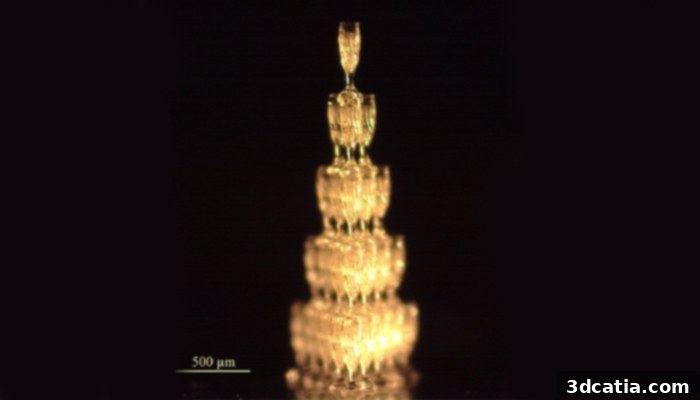
The pyramid of flutes | Photo Credits: Microlight3D
The Broader Impact of Micro 3D Printing and Microlight3D’s Vision
The creation of the champagne pyramid, along with the development of materials like OrmoGreen and the enhancement of vertical printing capabilities, positions Microlight3D at the forefront of a rapidly expanding industry. Micro 3D printing is not just about creating novelties; it holds immense potential to revolutionize various sectors. In medicine, it can enable the fabrication of micro-implants, advanced drug delivery systems, and sophisticated biomedical sensors. For the electronics industry, it opens doors to manufacturing high-density integrated circuits, micro-electromechanical systems (MEMS), and customized micro-optics. Research and development also stand to benefit immensely, as scientists can now design and test complex micro-structures with unprecedented ease and speed. Microlight3D’s focus on robust, high-resolution systems ensures that these intricate components are not only accurately printed but also possess the necessary mechanical and thermal stability for real-world applications.
The strategic demonstration of the champagne pyramid serves as a clear indicator of Microlight3D’s vision: to make microfabrication technology more accessible and versatile, empowering innovators across diverse fields. By continuously refining their two-photon polymerization process and developing advanced materials, they are not only solving existing manufacturing challenges but also inspiring entirely new applications that were previously unfeasible. The ability to create functional, robust objects at the micro- and nano-scale with increasing design freedom and structural height represents a paradigm shift in how we approach miniaturization and precision engineering.
What are your thoughts on Microlight3D’s incredible micro-printed champagne flutes and their pioneering work in the microfabrication space? We invite you to share your perspectives in a comment below or join the conversation on our Facebook and Twitter pages! Don’t miss out on the latest advancements and breaking news in 3D printing; sign up for our free weekly Newsletter and have all the crucial updates delivered directly to your inbox!