
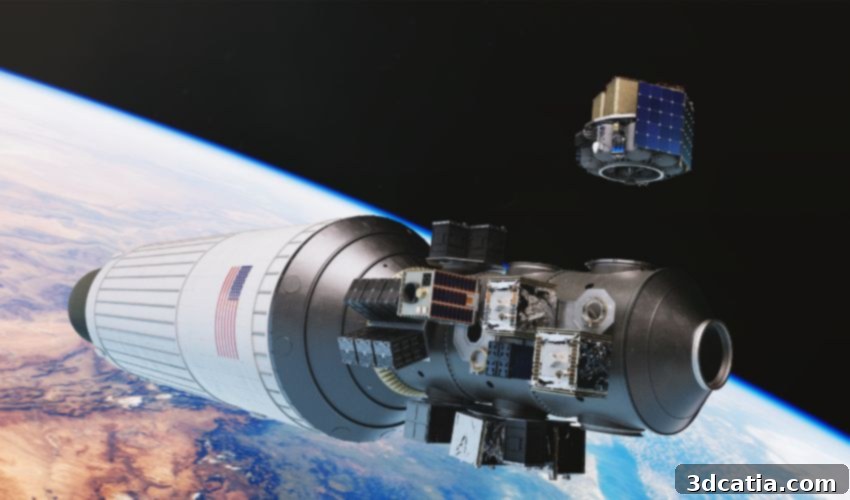
Revolutionizing Small Satellite Launches: Launcher’s E-2 Engine Powered by Velo3D’s Advanced Metal 3D Printing
In an era defined by rapid technological advancement, satellites have become indispensable pillars of our modern world. Far beyond their critical role in providing invaluable data about Earth’s dynamic clouds, vast oceans, diverse landmasses, and atmospheric conditions—information essential for scientists to accurately predict weather patterns and understand long-term climate trends—they are also the backbone of daily communications, navigation, and countless other applications. Interestingly, a significant transformation is underway within the satellite industry itself: satellites are progressively shrinking in size. This reduction in mass translates directly into lower production costs and, crucially, dramatically reduced launch expenses. As a direct consequence of this paradigm shift, a new breed of companies is emerging, dedicated to designing and manufacturing smaller, more cost-effective rockets specifically tailored to deploy these miniaturized satellites. Among the most innovative and promising players in this burgeoning market is Launcher.
Established in 2017, the Californian startup Launcher was founded with a clear vision: to strategically address the escalating demand for satellite launches, a demand that is currently outpacing the available supply within the rapidly expanding satellite launch market. This sector, projected to soar from an estimated $8 billion to a staggering $38 billion by 2030, represents a monumental opportunity. Launcher’s innovative approach lies in its seamless integration of advanced liquid propulsion technology with state-of-the-art metal 3D printing techniques. This powerful combination enables them to develop highly efficient rockets and orbital transfer vehicles specifically engineered to precisely deliver small satellites into their designated orbits. At the heart of their offering is the remarkably low-cost Launcher Engine-2 (E2) rocket engine, a marvel of engineering optimized for efficient mass production. The E2 is designed to be the highest-performance liquid rocket engine in its class, destined to serve as the primary thrust component for Launcher’s flagship Light rocket. To bring this ambitious and innovative design to fruition, Launcher strategically partnered with Stratasys Direct Manufacturing, leveraging Velo3D’s groundbreaking metal additive manufacturing (AM) technology.
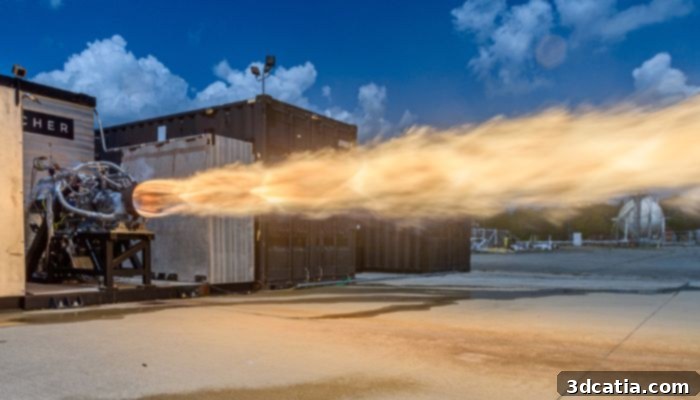
Testing the engine (photo credits: Launcher/John Kraus Photography)
Unveiling the Launcher E-2 Liquid Rocket Engine: A Deep Dive into Performance
As previously highlighted, the Launcher E-2 liquid rocket engine is meticulously engineered to be an integral part of Launcher’s next-generation, high-performance rockets. This powerhouse engine generates an impressive 22,000 lbf (pound-force) of thrust, fueled by a propellent combination of LOX (liquid oxygen) and RP-1 (kerosene). Its exceptional design and capabilities position it as the world’s highest-performing engine specifically developed for small launch vehicles. Fabricated with a specialized copper alloy, renowned for its excellent thermal conductivity and strength at high temperatures, the E2 boasts an outstanding 98% Combustion Efficiency and a remarkable specific impulse (Isp) of 365 seconds. The high specific impulse indicates a very efficient conversion of propellant mass into thrust, which is crucial for achieving orbit with minimal fuel. Furthermore, the engine’s LOX pump features an exquisitely balanced impeller, a critical component capable of spinning at an astonishing 30,000 revolutions per minute (rpms) even under the most extreme cryogenic conditions, all while precisely transporting liquid oxygen to the combustion chamber. This level of precision and performance in such a demanding environment is a testament to advanced engineering and manufacturing.
However, the innovative and high-performance nature of the E-2 rocket engine presents significant manufacturing challenges. Among its components, the turbopump, particularly its precision-engineered impeller, stands out as exceptionally difficult to produce. Max Haot, Founder and CEO of Launcher, eloquently articulated the project’s inherent difficulties, stating, “If we look at any liquid rocket engine that can reach orbit, the turbopump is one of the most challenging parts of the project… or at the very least, half of the challenge. And if you’re talking about a turbopump for a stage combustion closed cycle, that level of challenge increases.” This highlights the extreme complexity involved in creating a component that must operate flawlessly under immense stresses and temperatures.
While metal additive manufacturing was identified as the optimal approach for this ambitious project, the stakes were incredibly high – there was simply no room for error, given the engine’s critical role in high-performance space launches. Haot further emphasized the gravity of the situation, explaining, “I want to point out how significant this is. We’re dealing with liquid oxygen and an impeller spinning at 30,000 rpm to produce about one megawatt of power from the Turbine. In this type of environment, at four thousand psi of discharge pressure, any anomaly, any rubbing between the rotor and the stator, can result in an immediate, rapid, unplanned disassembly.” This vivid description underscores the dire consequences of even the slightest imperfection. Therefore, harnessing truly innovative technologies capable of delivering unprecedented precision and reliability was not merely an option, but an absolute necessity for Launcher.
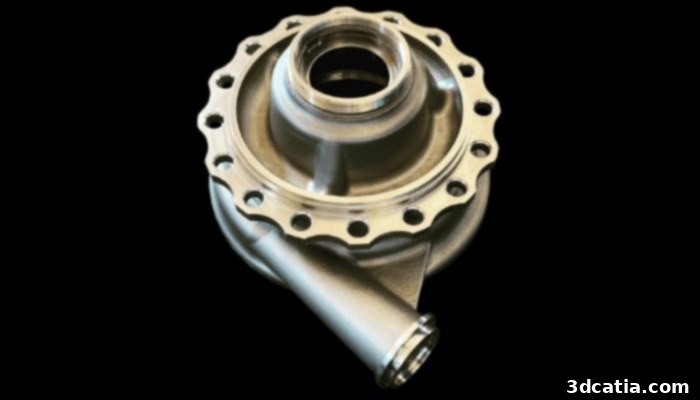
Volute section of the liquid oxygen pump feeding the E-2 engine (photo credits: Launcher)
In pursuit of this exacting precision, Launcher turned to Stratasys Direct Manufacturing, a leader in advanced additive manufacturing solutions. Stratasys Direct, in turn, utilized Velo3D’s groundbreaking Sapphire® solution to meticulously create the critical, well-balanced inducer impeller. This highly complex component plays a pivotal role in the E-2 engine’s performance, accelerating and efficiently driving the liquid oxygen (LOX) directly into the combustion chamber. This process generates a significantly greater fluid flow, which directly translates into more powerful thrust for the rocket. More specifically, the E-2’s impeller was ingeniously designed by integrating what would typically be two separate 3D printed parts – an inducer and an impeller – into a single, cohesive, and highly efficient component. The material chosen for this crucial part was INCONEL 718, a nickel-chromium superalloy renowned for its exceptional corrosion resistance, good compatibility with liquid oxygen, and its outstanding mechanical strength and stability across an extreme range of temperatures, including cryogenic conditions.
Why Metal Additive Manufacturing and Velo3D’s Unique Solution?
Given the multitude of manufacturing technologies available, the strategic decision by Launcher to embrace metal additive manufacturing, and more specifically Velo3D’s Sapphire® solution, warrants a closer examination. Metal AM offers a host of compelling advantages, particularly in the aerospace sector, where precision, performance, and cost-efficiency are paramount. These benefits include unparalleled design freedom, enabling the creation of intricate geometries and internal channels that are impossible with traditional manufacturing methods. This freedom allows for part consolidation, reducing the overall number of components, and significant weight reduction, directly impacting launch costs. However, for a component as critical and sensitive as the E-2 engine’s impeller, not just any AM solution would suffice. The primary constraint was that to achieve the necessary functional properties and extreme balance for a high-speed rotating part, the component could not be manufactured with internal supports or by being tilted during the printing process. This specific requirement led Stratasys Direct to unequivocally choose the Velo3D Sapphire® system, celebrated for its unique ability to print complex metal parts entirely without supports in critical internal cavities.
Crucially, the ability to print the impeller completely flat was a non-negotiable requirement for the engineering team. Tilting the part during the additive manufacturing process would inevitably compromise its perfect symmetry and mass distribution, thereby preventing the creation of a precisely balanced spinning component essential for its high-RPM operation. This capability, however, is not readily available with most other metal 3D printing solutions. Typically, to avoid the challenges and post-processing complexities associated with internal supports – which are often necessary for many complex geometries in conventional metal AM – users are compelled to tilt the part at an angle. This tilting, while sometimes resolving support issues, introduces its own set of problems, particularly for dynamically balanced parts. The Sapphire® system, in contrast, uniquely overcomes this limitation, offering unprecedented freedom.
As we have previously highlighted, Velo3D’s solution stands apart in the additive manufacturing landscape due to its unparalleled design freedom, a philosophy perfectly encapsulated by the company’s motto: “Print the part you want and need – without compromise.” This extraordinary freedom is the culmination of several sophisticated factors. Velo3D offers an advanced, fully integrated metal AM solution that encompasses not only its cutting-edge hardware but also its powerful Flow™ print preparation software and the robust Assure™ software for real-time quality validation. Flow™ enables precise build preparation and simulation, while Assure™ provides in-situ monitoring to ensure consistency and prevent defects. Furthermore, the Sapphire® system is uniquely capable of printing extremely low angles, down to zero degrees. This specific capability was profoundly important for Launcher, as it directly translated into the ability to print the critical impeller component perfectly flat on the build plate, maintaining its essential rotational symmetry and balance.
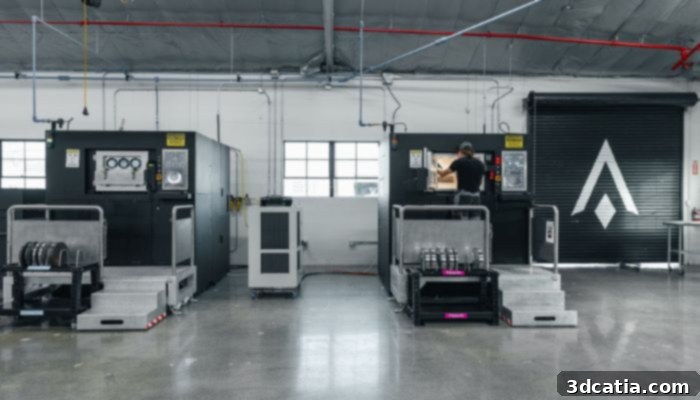
Launchers’ two Sapphire printers (photo credits: Launcher)
Indeed, the necessity of tilting the part would have severely compromised its overall quality. Tilting leads to uneven stress accumulation during the build process, which is detrimental for any precision component, especially one designed for high-speed rotation. This stress, combined with potential distortions, would have prevented the creation of a perfectly balanced spinning component. According to Stratasys Direct, the Velo3D system provided the ideal solution, making it possible to print impellers in their most optimal orientation – perfectly flat – while simultaneously eliminating the need for internal supports. These internal supports, if required, would not only necessitate complex and potentially damaging post-processing removal steps but could also inadvertently impair the delicate internal geometries and the structural integrity of the final part. Andre Ivankovic, Mechanical Engineer for Launcher, further elaborated on this critical advantage, stating, “By printing the part flat, we got a nice symmetric mass distribution of the part relative to that central rotational axis.” This symmetry is fundamental for preventing vibrations and ensuring efficient operation at extreme RPMs.
Achieving Success: The Results of Advanced Additive Manufacturing
The journey to finalize the E-2 engine’s critical components involved a comprehensive suite of customized post-processing operations and rigorous validation steps. To ensure the highest quality and performance, Stratasys Direct meticulously performed partial machining on the component. This initial machining phase was crucial for precisely removing all residual powder from the intricate internal channels, a step essential for maintaining clean fluid flow and preventing contamination. Following this, the components underwent certified heat treatments, a vital process designed to relieve internal stresses induced during the printing process and to optimize the material’s metallurgical properties, enhancing its strength and durability. The next critical step involved stringent checks to confirm that the impeller rigorously met all specified material density and integrity requirements before any thermal processes were fully completed, ensuring any potential defects were identified early.
The synergistic combination of Stratasys Direct’s profound expertise in additive manufacturing and its meticulous secondary post-processing techniques, coupled with Velo33D’s unique capability to print highly complex geometries without the need for internal supports, culminated in the successful fabrication of an exceptionally intricate and functional part. The rigorous testing conducted thus far has been overwhelmingly positive. Most notably, Launcher recently achieved a significant milestone by successfully testing the E-2 Engine Turbopump for the U.S. Space Force during an intensive campaign conducted at the prestigious NASA Stennis Space Center. Over the course of 11 demanding tests, the dedicated E-2 Test team not only met but frequently exceeded all specified goals for power output, input and output pressure, overall efficiency, and vibration control. This resounding success unequivocally validates the innovative design and advanced manufacturing approach. For those interested in a more in-depth understanding of how the E-2 was brought to life using Velo3D’s Sapphire® solution, further details can be found HERE.
What are your thoughts on the groundbreaking E-2 Liquid Rocket Engine from Launcher and its innovative manufacturing process? We encourage you to share your insights and comments below, or engage with us on our LinkedIn, Facebook, and Twitter pages! Don’t miss out on the latest advancements in 3D printing; remember to sign up for our free weekly Newsletter here to receive all the breaking news directly in your inbox! Additionally, you can explore all our compelling videos on our YouTube channel.
*Cover Photo Credits: Launcher