
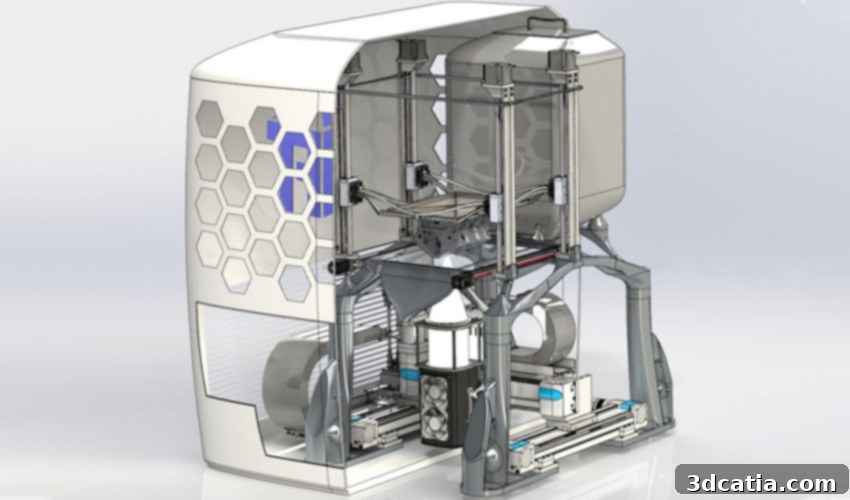
SLEDM: Revolutionizing Metal 3D Printing with High-Power LED Technology for Faster, More Efficient Production
The landscape of additive manufacturing is continuously evolving, pushing the boundaries of what’s possible in industrial production. Amidst the global shifts, including the recent remote work mandates, innovation at institutions like Graz University of Technology has not slowed. Indeed, the research department of this esteemed Austrian university has proudly unveiled a groundbreaking powder bed process for the additive production of metal parts. This new methodology challenges conventional approaches, offering significant advancements in speed, efficiency, and cost.
Traditionally, metal additive manufacturing relies on intense heat sources like lasers or electron beams to selectively melt successive layers of metal powder. These established techniques are widely recognized as Selective Laser Melting (SLM) and Electron Beam Melting (EBM), respectively. While highly effective, they come with certain limitations regarding processing speed, material compatibility, and post-processing requirements. The pioneering system from Graz University of Technology introduces a paradigm shift by replacing these conventional energy sources with a high-power LED array for melting individual layers of metal powder. This innovative approach has given rise to the process’s name: Selective LED based Melting, or SLEDM. Developed over the past few months by the Institute of Production Engineering under the expert direction of Franz Haas, this technology represents a significant leap forward, with a patent application already filed to protect its unique methodology.
Understanding SLEDM: A Departure from Traditional Metal AM
The SLEDM process distinguishes itself from existing metal 3D printing techniques through several key innovations, primarily centered around its unique light source and printing orientation. Unlike laser or electron beam systems, which often require precise control over highly focused, narrow energy beams, SLEDM leverages the power and versatility of high-performance LEDs. These LEDs are coupled with a sophisticated optical system that allows for unprecedented control over the light beam. This complex lens system enables the focus diameter of the LED beam to be variably adjusted across a remarkable range, currently spanning from a precise 0.05 mm up to a broad 20 mm. This adaptability is a game-changer, addressing one of the core challenges in scaling additive manufacturing for larger parts while maintaining intricate detail.
This extensive range in focus diameter offers a significant advantage: the ability to rapidly process large-volume areas or components. By widening the beam, SLEDM can cover much larger cross-sectional areas with each pass, drastically reducing the time needed to scan and solidify layers. This translates into construction times that can be up to 20 times faster for substantial components compared to traditional methods. While accelerating production for large features, the system simultaneously retains the capability for fine detail, ensuring that delicate internal structures and intricate geometries, often critical in advanced engineering applications, are not compromised. This dual capability – speed for bulk and precision for detail – positions SLEDM as a highly versatile and economically attractive solution for a wide range of industrial applications. In contrast, existing laser-based systems typically offer a much narrower variable focus diameter, usually between 0.07 mm and 0.5 mm, highlighting the significant leap in flexibility offered by SLEDM.
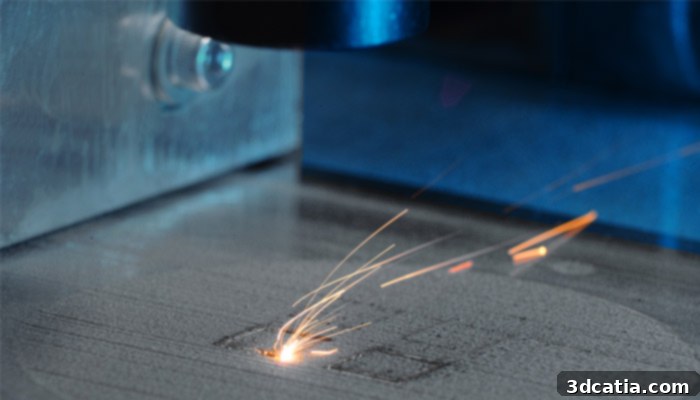
Thanks to the variable diameter of the LED beam, large areas can be produced faster. On the other hand, laser-based systems currently offer a focus diameter between 0.07 and 0.5 mm | Credits: Fraunhofer ILT
Beyond Speed: Efficiency in Printing Direction and Post-Processing
Another fundamental difference distinguishing the Graz University of Technology’s SLEDM system lies in its unique printing direction. Unlike most powder bed fusion processes where a new layer of powder is spread over the solidified part and then selectively melted, SLEDM prints the component from top to bottom. In this innovative approach, the component is “exposed” rather than being built up from a powder bed, meaning it is not constantly submerged or covered in loose powder. This inversion of the traditional build process has profound implications for material usage and post-processing.
By printing downwards and exposing the component, the SLEDM process is designed to significantly reduce the overall amount of metal powder required. In conventional methods, a substantial volume of powder often surrounds the printed part, acting as support and thermal mass. While much of this un-melted powder can be recycled, the initial material investment and the complexity of powder management can be considerable. SLEDM’s top-down approach inherently minimizes the volume of powder actively engaged in the build chamber, leading to more efficient material consumption and potentially lower operational costs. Furthermore, this method dramatically simplifies – and in many cases, eliminates – the laborious and time-consuming post-processing steps typically associated with metal additive manufacturing.
Conventional metal 3D printing often produces parts with rough surface finishes and necessitates the use of extensive support structures to prevent warping and ensure geometric accuracy during the build process. Removing these supports and achieving the desired surface quality typically involves manual labor, grinding, machining, or chemical treatments, all of which add significant time, cost, and complexity to the overall production workflow. Institute Director Franz Haas emphasizes this critical advantage: “The time-consuming, usually manual post-processing, which is necessary with current methods, for example to smooth rough surfaces and remove supporting structures, is no longer necessary and saves further valuable time.” This elimination of complex post-processing not only accelerates the production cycle but also significantly lowers the total manufacturing cost per part, making SLEDM an incredibly appealing solution for industrial adoption.
Economic Advantages and Targeted Applications
Beyond operational efficiencies, the SLEDM machine developed by TU Graz is also projected to offer significant advantages in terms of equipment costs. While more detailed information on pricing has yet to be officially published, the inherent nature of LED technology suggests a potentially lower initial investment compared to the highly specialized and powerful laser or electron beam sources required for conventional metal AM systems. This cost-effectiveness, combined with reduced material consumption and streamlined post-processing, positions SLEDM as a potentially more accessible and financially viable option for businesses looking to adopt metal additive manufacturing, thereby broadening its market appeal and accelerating its industrial integration.
Currently, the SLEDM process is strategically focused on two primary, high-impact sectors: the mobility industry and the medical implants sector. In the medical field, the research team envisions transformative applications, particularly in the production of bioresorbable metal implants. A compelling example is the manufacturing of screws made from magnesium alloys. These implants can be precisely adapted to the individual patient’s anatomy and medical needs, offering a revolutionary benefit: they gradually dissolve within the body once the fracture has healed. This eliminates the need for a second surgical procedure to remove the implant, significantly improving patient comfort, reducing healthcare costs, and lowering surgical risks. The potential to manufacture these personalized implants directly in an operating theatre setting, or at point-of-care facilities, promises to revolutionize personalized medicine by providing on-demand, patient-specific solutions with unprecedented speed and precision. This brings the vision of custom medical devices closer to reality, tailored to each individual’s unique biological requirements.
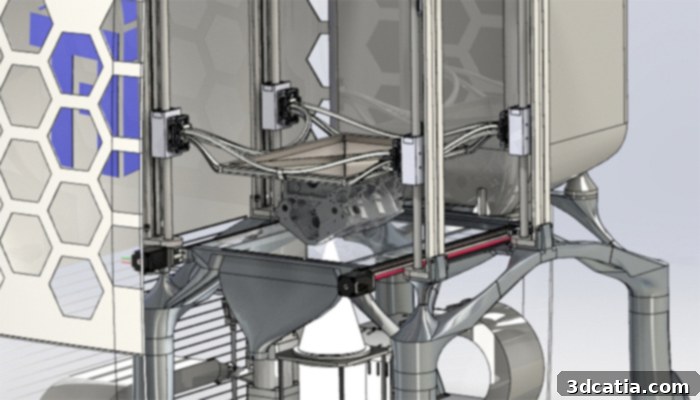
In the SLEDM process, the component is printed from top to bottom
For the mobility sector, particularly in the realm of sustainable solutions for future transportation, the SLEDM system holds immense promise for producing advanced components for battery systems. As electric vehicles (EVs) and other forms of e-mobility continue to expand, the demand for high-performance, lightweight, and efficiently cooled battery components is soaring. Additive manufacturing, with its ability to create complex internal geometries and optimize designs for thermal management and weight reduction, is ideally suited to address these challenges. SLEDM’s speed and cost-effectiveness could make it a vital tool for manufacturing intricate cooling channels, optimized housings, and lightweight structural elements for EV batteries, contributing to improved range, performance, and overall efficiency. Institute Director Franz Haas reaffirms this strategic focus: “We want to make additive manufacturing using SLEDM economically viable for e-mobility and position SLEDM in this field of research at an early stage.” The next crucial step in the development of this pioneering technology is the production of a marketable prototype by TU Graz, which will pave the way for its wider commercial adoption and integration into industrial workflows. Further comprehensive information regarding this breakthrough can be accessed HERE.
The Future of Metal Additive Manufacturing with SLEDM
The introduction of Selective LED based Melting (SLEDM) by Graz University of Technology marks a significant milestone in the journey of metal additive manufacturing. By leveraging high-power LEDs and a unique top-down printing approach, SLEDM addresses several critical limitations of existing technologies, offering a powerful combination of increased speed, reduced material waste, eliminated post-processing, and potentially lower equipment costs. Its targeted applications in high-growth sectors like medical implants and e-mobility underscore its potential to drive transformative changes in how complex metal components are designed and produced. As the technology moves from prototype to widespread commercialization, SLEDM is poised to make metal 3D printing more accessible, efficient, and sustainable, paving the way for a new era of industrial innovation and product development.
What are your thoughts on this innovative LED metal 3D printer and its potential impact on the industry? We invite you to share your insights in a comment below or join the conversation on our Facebook and Twitter pages! To stay updated with all the latest advancements and news in the dynamic world of 3D printing, remember to sign up for our free weekly Newsletter, delivered straight to your inbox!