

MechStyle: AI-Powered 3D Printing System Creates Functional and Personalized Designs
Have you ever encountered challenges when attempting to 3D print an AI-generated 3D model? Issues like undesirable “AI bumps” (minor imperfections or protrusions), details that surpass your 3D printer’s capabilities, and crucially, mechanical stability problems can hinder the process. The integration of artificial intelligence (AI) into 3D printing is rapidly evolving, offering exciting possibilities for creating complex and customized objects. However, ensuring these AI-generated designs are not only aesthetically pleasing but also structurally sound and printable remains a significant hurdle. This is where innovative systems like MechStyle come into play, bridging the gap between AI’s creative potential and the practical requirements of 3D printing.
The promise of AI-generated models suitable for 3D printing has generated considerable excitement. Companies like Backflip, developed by the creators of Markforged, aim to provide AI 3D model generation specifically tailored for 3D printing. Additionally, MeshyAI recently introduced Creative Lab, a platform designed for generating 3D-printable models. Now, researchers at the Massachusetts Institute of Technology (MIT) Computer Science and Artificial Intelligence Laboratory (CSAIL), in collaboration with researchers from Google, Stability AI, and Northeastern University, have unveiled “MechStyle.” This system aims to leverage AI to create real-world objects that are not only functional but also reflect the user’s desired appearance and texture, pushing the boundaries of what’s achievable with AI and 3D printing.
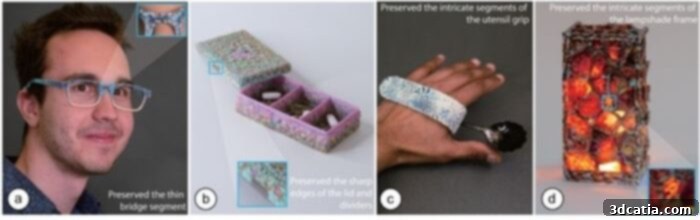
Parts adapted with the MechStyle system (Image credit: Faruqi et al.)
How MechStyle Ensures Functionality in AI-Generated 3D Prints
MechStyle’s approach distinguishes itself from other AI 3D model generators through its unique workflow. Unlike systems that begin with text, image, or video prompts, MechStyle starts with a pre-existing 3D model. Users can either upload their own models or select from a library of preset assets, such as vases or hooks. Once a base model is chosen, users can then provide text or image prompts to guide the creation of a personalized design. The generative AI model modifies the geometry based on these prompts, while MechStyle simultaneously simulates the impact of these changes on the structural integrity of the parts. This process ensures that vulnerable areas remain structurally sound, resulting in an AI-enhanced blueprint ready for 3D printing and real-world use.
In an article published by MIT, the MechStyle system was illustrated with the example of a 3D-printed wall hook. A user could upload a 3D model of a standard wall hook, specify the printing material, and then prompt the system to generate a custom version, such as “generate a cactus-like hook.” The AI model, working in conjunction with the simulation module, would then produce a 3D model that resembles a cactus while retaining the structural properties necessary for a functional hook. This highlights the collaborative nature of the system, where the stylization process, guided by the understanding of the text prompt, is constantly informed by feedback from the simulation module. The system learns to balance aesthetics with structural integrity, delivering designs that are both visually appealing and practically usable.
“We want to use AI to create models that you can actually fabricate and use in the real world,” said Faraz Faruqi, MIT Department of Electrical Engineering and Computer Science (EECS) PhD student and CSAIL engineer. “So MechStyle actually simulates how GenAI-based changes will impact a structure. Our system allows you to personalize the tactile experience for your item, incorporating your personal style into it while ensuring the object can sustain everyday use.” This quote encapsulates the core vision behind MechStyle: to empower users to create personalized and functional 3D-printed objects using the power of AI.
The Role of Finite Element Analysis (FEA) in Ensuring Structural Integrity
A crucial aspect of the MechStyle project is the integration of finite element analysis (FEA). FEA is a powerful physics simulation method that generates a “heat map” indicating the structural viability of different regions under realistic weight conditions. This simulation identifies areas that are structurally sound and those that are vulnerable. As the AI refines the model, the FEA simulation identifies weakening points and prevents further modifications that could compromise the structure. This iterative process ensures that the final design meets the required structural standards, making it suitable for real-world applications.
Performing FEA simulations for every AI iteration can significantly slow down the design process. To address this, MechStyle incorporates an intelligent scheduling strategy that determines when and where additional structural analyses are needed. “MechStyle’s adaptive scheduling strategy keeps track of what changes are happening in specific points in the model,” Faruqi explained. “When the genAI system makes tweaks that endanger certain regions of the model, our approach simulates the physics of the design again. MechStyle will make subsequent modifications to make sure the model doesn’t break after fabrication.” By selectively running FEA simulations only when necessary, MechStyle optimizes the design process without sacrificing structural integrity.
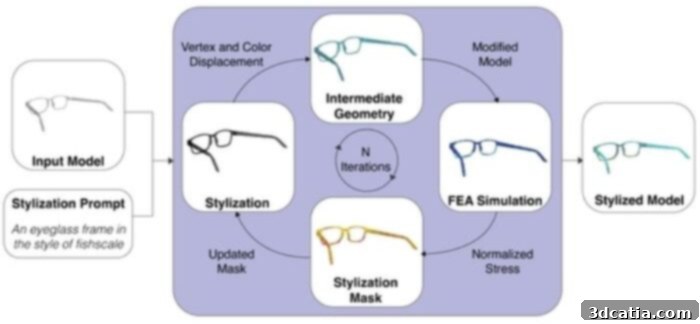
The MechStyle iterative workflow (Credit: Faruqi et al.)
Through the combined power of FEA and adaptive scheduling, MechStyle can generate objects with high structural viability, often reaching 100%. The research team tested 30 models with styles resembling bricks, stones, and cacti. Their findings revealed that the most effective approach for creating structurally sound objects involved dynamically identifying weak regions and adjusting the generative AI process accordingly. They discovered that stylization could be completely stopped when a specific stress threshold was reached, or gradually refined to prevent at-risk areas from reaching that threshold. This adaptability is key to MechStyle’s success in creating complex, stylized designs that are also structurally robust.
Areas for Future Improvement in MechStyle
The CSAIL researchers acknowledge that the MechStyle system, while effective in maintaining the structural integrity of a user’s model, is currently unable to improve the viability of 3D models that are inherently flawed. If a user uploads a model that is already structurally unsound, MechStyle will return an error message. One of the team’s future goals is to enhance MechStyle’s capabilities to improve the durability of these faulty models, expanding its usefulness to a wider range of users and designs. This enhancement would make the system more versatile and allow it to address a broader set of 3D printing challenges.
Another area for improvement lies in the initial design stage. Currently, MechStyle requires users to upload a 3D model or select a preset design. The researchers aspire to integrate generative AI into this initial stage, enabling the platform to create 3D models from scratch based on user prompts. This would eliminate the reliance on pre-made designs and unlock even greater creative possibilities. By allowing users to generate both the form and the style of their 3D-printed objects with AI, MechStyle could become a comprehensive design tool for personalized manufacturing.
To delve deeper into MechStyle and explore five example applications, refer to the research paper published about the project here. This paper provides a comprehensive overview of the system’s architecture, algorithms, and experimental results.
What are your thoughts on MechStyle? Share your opinions in the comments below or connect with us on our LinkedIn or Facebook pages! Don’t forget to subscribe to our free weekly Newsletter here for the latest 3D printing news delivered directly to your inbox! You can also find our videos on our YouTube channel.
*Cover Image Credit: MIT News