
The Future of Making: Key 3D Printing Trends Shaping Additive Manufacturing in 2021 and Beyond
As we step into what marks the fourth decade of additive manufacturing, the landscape of 3D printing is continuously evolving, driven by innovation, necessity, and a growing understanding of its unique capabilities. Following a year that saw the industry adapt and respond to unprecedented challenges, 2021 is poised to be a pivotal period where foundational trends will mature and manifest into transformative solutions. Industry leaders like Materialise have keenly observed these shifts, identifying critical directions that will steer the sector’s trajectory. They highlight three primary areas of focus: a fundamental re-evaluation of traditional manufacturing paradigms, an expansion of personalization beyond mere products to encompass the 3D printers themselves, and a renewed emphasis on developing novel solutions with speed and efficiency.
The global crisis of recent times undeniably underscored the profound potential of additive manufacturing (AM) to offer practical and impactful solutions to emergent challenges. From rapidly producing personal protective equipment (PPE) to fabricating critical medical device components, AM demonstrated unparalleled agility. However, these urgent applications, while vital, often only scratched the surface of AM’s true power. The core value proposition of additive manufacturing lies in its ability to create geometries and functionalities that are simply unattainable through conventional manufacturing methods. Its inherent strengths—such as enabling intricate customization, facilitating part consolidation to reduce component count, and significantly minimizing material waste—position AM as a cornerstone for developing flexible, sustainable, and highly optimized solutions. For the industry to build a lasting legacy, the imperative is to persistently identify and cultivate applications that fully harness these distinctive qualities, simultaneously fostering a broader awareness of the comprehensive benefits AM brings to the table.
Fried Vancraen, CEO and Founder of Materialise, eloquently captures this sentiment, stating, “As companies realize that they need to do things differently, AM empowers them to make a difference.” This insight speaks to a broader industrial awakening, where businesses are actively seeking methodologies that transcend traditional limitations and enable genuine innovation, efficiency, and resilience. This shift in mindset is propelling additive manufacturing from a niche prototyping tool to a robust, indispensable method for industrial-scale production across diverse sectors, including healthcare, aerospace, and consumer goods, among others.
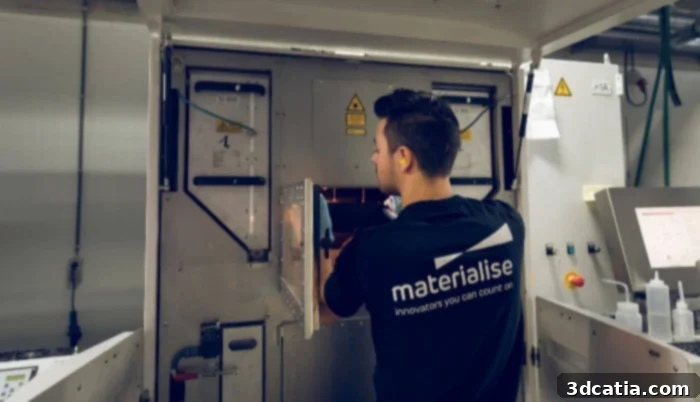
Image via Materialise, depicting innovative 3D printed components and their application potential.
Rethinking Manufacturing: A Paradigm Shift for the Modern Era
The recent global disruptions have served as a stark catalyst, compelling industries worldwide to fundamentally reassess their operational blueprints and supply chain vulnerabilities. We have extensively discussed how additive manufacturing can play a transformative role in strengthening fractured supply chains, injecting much-needed agility, and fostering unprecedented levels of innovation throughout the entire production cycle. Traditional linear supply chains proved fragile under pressure, highlighting the urgent need for more robust, localized, and adaptable manufacturing strategies. AM offers a compelling alternative, enabling on-demand production closer to the point of use, thereby reducing reliance on distant suppliers and minimizing logistics complexities and lead times.
A compelling illustration of this paradigm shift comes from the aerospace industry, with Airbus revealing ambitious plans to accelerate the development of hydrogen-powered commercial jets, entirely bypassing hybrid engine development. This audacious leap aims to bring the world’s first zero-emission, climate-neutral aircraft into service by 2035. Achieving such an monumental goal necessitates radical innovation in design, materials, and manufacturing processes. Technologies like additive manufacturing are absolutely crucial in realizing these visionary concepts. AM facilitates the creation of lightweight, complex components optimized for performance, crucial for systems such as advanced hydrogen storage, fuel cell integration, and propulsion nozzles. It allows for rapid iteration of designs, reducing development cycles and accelerating time-to-market for revolutionary products that adhere to strict aerospace standards.
Bart Van der Schueren, CTO of Materialise, underscores this transformative potential: “AM frees designers from the constraints and limitations of traditional manufacturing technologies. As a result, AM allows us to create performance, weight-saving, time and cost advantages.” This design freedom translates into unparalleled opportunities for engineers to optimize parts for functionality, integrate multiple components into single, complex structures, and reduce overall material consumption. For instance, lattice structures—impossible to create with conventional methods—can significantly reduce weight while maintaining or even enhancing mechanical properties, making them ideal for aerospace applications where every gram counts towards fuel efficiency and performance. Furthermore, AM can produce highly complex internal channels for fluid flow or heat exchange, critical for advanced thermal management systems in next-generation aircraft.
Beyond aerospace, industries like automotive, medical, and consumer goods are also undergoing significant re-evaluation. Automotive manufacturers are utilizing AM for lighter components, complex tooling, and personalized interior parts, pushing the boundaries of vehicle efficiency and aesthetic customization. The medical sector leverages AM for patient-specific implants, surgical guides, and prosthetic devices that perfectly match individual anatomies, leading to better outcomes, reduced surgical times, and shorter recovery periods. This pervasive rethinking of manufacturing processes signals a clear move towards a more flexible, resilient, and technologically advanced industrial future, with additive manufacturing at its core, enabling unprecedented levels of product innovation and operational efficiency.
Embracing Customization and Personalization at Scale
The unparalleled capacity of additive manufacturing to deliver customization at scale has long been a subject of considerable discussion within the industry, and we are witnessing an accelerated convergence towards this reality. It is now widely acknowledged that a defining characteristic of 3D printing is its ability to substantially reduce the economic barriers associated with personalizing products. Unlike traditional mass production, where customization incurs significant retooling costs and economies of scale favor uniformity, AM allows for unique variations without prohibitive cost penalties. This capability has already revolutionized sectors such as healthcare, where patient-specific surgical instruments, custom prosthetics, and personalized orthotics are becoming standard practice, dramatically improving patient care and rehabilitation outcomes. In consumer goods, bespoke footwear and eyewear are emerging, offering consumers products perfectly tailored to their individual needs and preferences.
However, as Executive Chairman Peter Leys points out, there’s a crucial, often overlooked dimension to this trend: “What is less known and often overlooked is the importance of empowering engineers and operators to also personalize and optimize the printing process as such.” This emphasizes a deeper level of customization—not just of the final product, but of the entire manufacturing workflow itself. For optimal results, each specific application often demands a uniquely tailored 3D printing process. This involves fine-tuning a myriad of parameters, including material properties, print speed, layer thickness, build orientation, support structure design, laser power, powder bed temperature, and even subsequent post-processing techniques like surface finishing or heat treatment.
Achieving this level of process personalization requires sophisticated software tools, advanced simulation capabilities, and a deep understanding of material science and machine mechanics. For instance, printing a high-performance medical implant might require extremely tight tolerances, biocompatible materials, specific surface finishes for osseointegration, and rigorous quality control, necessitating a distinct set of process parameters compared to, say, printing a prototype automotive component or a decorative consumer item. By empowering engineers to customize the process itself, companies can unlock maximum efficiency, improve part quality, reduce material waste, and significantly enhance overall cost and speed reductions. This proactive approach to process optimization ensures that the full advantages of additive manufacturing are realized, moving beyond generic settings to highly specific, application-driven workflows that maximize performance and resource utilization.
Materialise posits that 2021 could very well mark the genesis of this crucial movement towards widespread process personalization. This shift will be driven by increasingly intelligent software platforms that integrate AI and machine learning for predictive modeling, enhanced sensor technology within printers for real-time monitoring and feedback, and a growing pool of skilled additive manufacturing professionals capable of navigating these complex optimizations. As AM becomes more integral to mainstream manufacturing, the ability to fine-tune every aspect of the printing process will become a key differentiator for companies seeking to gain a competitive edge in product performance, production efficiency, and overall manufacturing excellence.
Accelerated Adoption of Additive Manufacturing: Bridging the Gap
While some pioneering companies embarked on their additive manufacturing adoption journey over a decade ago, meticulously integrating the technology into their operations, a significant portion of the industrial world is still relatively new to AM. These early adopters are now strategically positioned to implement even more profound shifts, leveraging their accumulated knowledge, robust infrastructure, and established workflows. However, for businesses newly exploring additive manufacturing, significant barriers to entry persist. The substantial initial investment required for high-end industrial 3D printers, coupled with the steep learning curve associated with mastering the technology, developing specialized workflows, and managing complex post-processing, often acts as a deterrent.
Beyond capital expenditure, a lack of comprehensive knowledge about AM’s true capabilities, the nuances of material science, crucial design for additive manufacturing (DfAM) principles, and rigorous quality assurance protocols can intimidate and discourage businesses from making substantial investments in 3D printing. This is where the burgeoning ecosystem of service providers and AM bureaus plays a critical role. These services effectively democratize access to additive manufacturing, allowing companies to test the waters, produce prototypes, and even undertake short-run production or bridge manufacturing without the necessity of immediate, heavy capital investment. They provide a vital gateway for businesses to experience the benefits of AM firsthand, mitigating financial risk and accelerating the exploration and validation phase of the technology.
Looking ahead, Materialise strongly advocates that specialized consultancy services will become absolutely instrumental in guiding companies through the intricate process of adopting and seamlessly integrating additive manufacturing technology. Such expert guidance is crucial for several reasons: it can significantly minimize the financial and operational risks associated with substantial investments in AM infrastructure; it can dramatically accelerate implementation timelines by leveraging extensive expert knowledge regarding the technology’s true potential, current limitations, and future roadmap; and it ensures that the most appropriate manufacturing method is selected for each unique application, optimizing for cost, speed, and performance. Consultants can help navigate complex decisions related to material selection, optimize designs for AM, establish robust quality control frameworks, and develop scalable strategies for industrializing additive processes, from initial concept to full-scale production.
This expert consultation extends to training internal teams, developing bespoke AM strategies aligned with overarching business objectives, and staying abreast of rapidly evolving materials, machine technologies, and software solutions. By providing tailored insights and hands-on support, these services empower companies to overcome the initial hurdles, capitalize on AM’s distinctive advantages, and build long-term capabilities that foster innovation and competitive advantage. The accelerated adoption of additive manufacturing is not just about acquiring machines; it’s about building an intelligent, integrated ecosystem of knowledge, optimized processes, and skilled personnel that can fully leverage this transformative technology for sustainable growth, resilience, and unparalleled product development in the years to come.
The future of manufacturing is undeniably being shaped by these powerful trends in 3D printing. As we move further into this new decade, the evolution of additive manufacturing promises to deliver unprecedented levels of innovation, efficiency, and sustainability across industries. What are your thoughts on the most impactful trends in the 3D printing industry that will define the next few years? Share your insights and join the conversation by leaving a comment below or engaging with us on our Facebook and Twitter pages! Don’t miss out on the latest advancements and news – sign up for our free weekly Newsletter to get all the essential updates on 3D printing delivered straight to your inbox.