
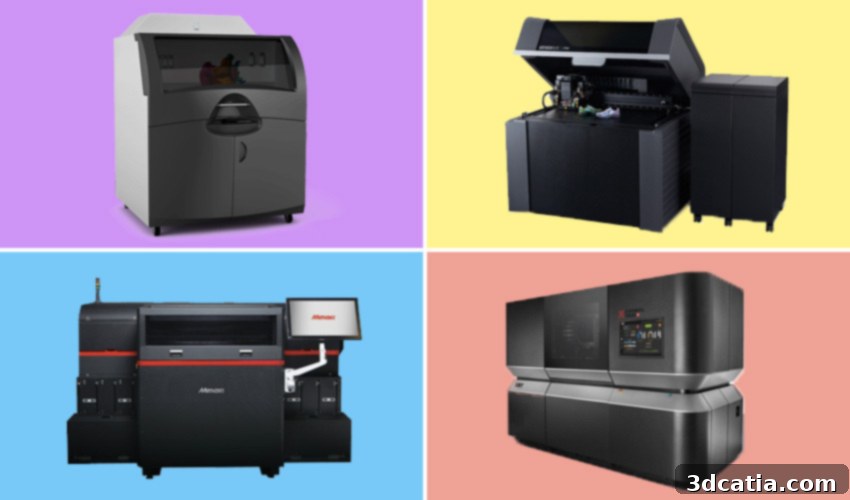
Unlocking Precision: A Comprehensive Guide to Material Jetting 3D Printers
Material Jetting stands as one of the seven foundational families of additive manufacturing processes, offering a unique approach to creating intricate three-dimensional objects. As its name suggests, this innovative technology operates by precisely depositing material onto a build platform, layer by layer, in a manner reminiscent of a conventional 2D inkjet printer laying down ink on paper. However, the sophistication of Material Jetting extends far beyond simple ink drops. Here, specialized print heads project numerous, often larger, droplets of material. These materials typically consist of photopolymers, which are then instantaneously cured and solidified by exposure to ultraviolet (UV) light. The versatility of Material Jetting is remarkable, as it can also accommodate a range of other materials, including metals, ceramics, and even waxes, expanding its application across diverse industries.
This broad material compatibility has led to the classification of Material Jetting into three primary subgroups: Material Jetting (commonly known through the patented PolyJet technology), NanoParticle Jetting (NPJ), and Drop on Demand (DOD). Irrespective of the specific process employed, users consistently achieve exceptionally high-precision, highly detailed parts. A significant advantage of Material Jetting processes is their unparalleled ability to produce full-color components and integrate multiple materials within a single print, opening up new possibilities for functional prototyping, realistic models, and advanced manufacturing. To assist you in navigating this dynamic field and making an informed choice, we have curated a selection of leading 3D printers for each technology subgroup, highlighting their unique features and applications.
Material Jetting (PolyJet Technology)
The Material Jetting subgroup is perhaps best recognized through the proprietary PolyJet technology, pioneered and perfected by Stratasys. This process represents the pinnacle of multi-material and multi-color 3D printing, enabling the creation of complex geometries with varying material properties within a single build. PolyJet works by jetting minute droplets of liquid photopolymer onto the build tray, which are then immediately cured by UV light. This precise control over material deposition allows for the simultaneous printing of different photopolymers, leading to parts that can exhibit diverse textures, colors, and mechanical characteristics.
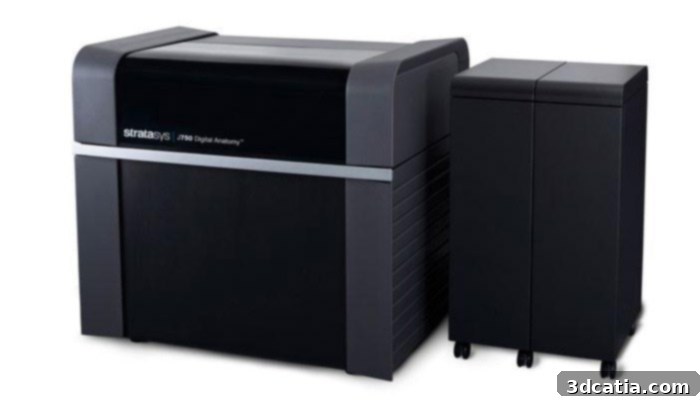
Stratasys – J750 Digital Anatomy
Stratasys has long been a dominant force in material jet 3D printing, solidifying its position through its 2012 merger with Objet Ltd., the original patent holder of the PolyJet process. Today, Stratasys offers an extensive portfolio of PolyJet 3D printers, renowned for their capacity to produce multi-material, multi-color, and even transparent parts. Among their impressive lineup, the J750 Digital Anatomy stands out as a groundbreaking solution, primarily engineered for the demanding requirements of the medical sector. This printer boasts a generous build volume of 490 x 390 x 200 mm, but its true innovation lies in its ability to meticulously recreate the tactile behavior and mechanical properties of human tissues on anatomical models. This advanced capability provides healthcare professionals with an unprecedented level of realism, allowing them to gain a genuine “feel” for surgical procedures, enhance their training, and meticulously plan complex operations. By simulating various tissue types, from bone to soft tissue, the J750 Digital Anatomy significantly improves medical education and pre-surgical preparation, ultimately contributing to better patient outcomes.
Mimaki 3DUJ-553 Printer
In 2017, the Japanese manufacturer Mimaki, a company with a rich history and established expertise in 2D printing technologies, made a significant entry into the additive manufacturing space with the unveiling of its 3DUJ-553 industrial 3D printer. This machine operates on a UV LED process, similar to PolyJet, where light plays a crucial role in curing successively applied layers of material. With a substantial print volume of 508 x 508 x 305 mm, the 3DUJ-553 is capable of depositing incredibly fine droplets of colored, white, or black inks onto the printing tray, incrementally building up the final part. A standout feature for professionals is its ability to render an astonishing 10 million colors, providing unparalleled color accuracy and vibrancy for prototypes, models, and end-use parts. Furthermore, the printer offers the flexibility to incorporate transparency through translucent ink, adding another dimension of design freedom. Mimaki enhances the user experience with integrated simulation software, allowing for a highly precise visual preview of the part’s shape and colors before the printing process even begins, thus minimizing errors and material waste. For convenience and quality assurance, the 3DUJ-553 includes a surveillance camera, enabling users to monitor the printing process remotely. Another significant advantage is the machine’s use of a water-soluble support structure. This innovation ensures that supports can be easily and thoroughly removed post-printing, leading to accurate, neat models without any risk of damaging delicate features, a common challenge with mechanical support removal methods.
NanoParticle Jetting (NPJ)
NanoParticle Jetting (NPJ) represents a sophisticated evolution within Material Jetting, specifically designed to address the challenges of 3D printing high-performance metals and ceramics. Unlike photopolymer-based systems, NPJ employs a unique approach where a liquid suspension containing tiny nanoparticles of the desired material (either metal or ceramic) is jetted from the print heads. These nanoparticles are encased in a proprietary fluid that also acts as a carrier and a binder. After deposition, the high temperatures within the build chamber or post-processing steps evaporate the carrier fluid, leaving behind densely packed nanoparticles that are then sintered into a fully dense, high-quality part. This process bypasses the need for extensive post-processing steps like de-binding and sintering often required by other metal 3D printing technologies, leading to parts with superior surface finish, fine detail, and excellent material properties.
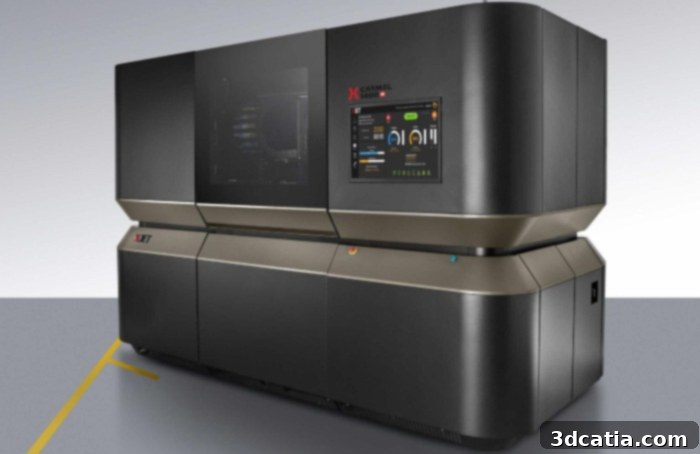
XJet Carmel 1400M
The XJET Carmel line of additive manufacturing systems is built upon the company’s patented NanoParticle Jetting (NPJ) technology, a revolutionary process for 3D printing high-quality metal and ceramic parts. NPJ constructs parts by precisely jetting a liquid laden with nanoparticles of either metal or ceramic material in suspension. XJET provides systems tailored for both metal and ceramic applications. Their metal NPJ systems are available in two sizes: the XJet Carmel 700M, featuring a build plate of 700 cm2, and the larger XJet Carmel 1400M, which boasts an impressive 1,400 cm2 build plate—making it one of the largest build trays available in the industry for such precision. The XJet Carmel 1400M is engineered to deliver exceptional quality, accuracy, and reliability, coupled with high levels of productivity, allowing for the creation of intricate metal components with extremely fine details and superior surface finishes. Both sizes of the metal systems are compatible with industry-standard software packages, including Autodesk and Netfabb, ensuring seamless integration into existing workflows. Additionally, the XJet Carmel 1400M offers the convenience of compatibility with a dedicated mobile application, allowing users to monitor and manage print jobs remotely.
XJet Carmel 1400C
Mirroring its metal counterparts, XJET’s ceramic additive manufacturing systems also come in two distinct sizes, leveraging the same advanced NanoParticle Jetting technology. These include the XJet Carmel 700C, equipped with a 700 cm2 build plate, and the XJet Carmel 1400C, featuring a larger 1,400 cm2 build plate. Both ceramic systems offer compatibility with leading design and manufacturing software such as Autodesk and Netfabb, facilitating smooth integration for engineers and designers. As with the metal series, only the larger Carmel 1400C printer benefits from mobile app compatibility, enhancing remote monitoring and control. The XJet Carmel 1400C shares the same maximum build height of 200mm as its metal equivalent. Thanks to its proprietary NanoParticle Jetting Technology, XJet’s ceramic systems are capable of producing parts of the utmost quality, characterized by impressive levels of detail, an excellent surface finish, and exceptional accuracy. This precision makes them ideal for applications requiring complex geometries and high material integrity, such as specialized tooling, medical devices, and high-temperature components. Crucially, as with XJet’s Metal systems, these benefits are delivered without compromising throughput or build time, making them a highly efficient solution for advanced ceramic additive manufacturing.
Drop On Demand (DOD)
Drop On Demand (DOD) is another significant branch of Material Jetting, characterized by its ability to precisely deposit individual droplets of material only when and where they are needed. This contrasts with continuous jetting systems. DOD technology is highly versatile, finding specialized applications ranging from creating intricate wax patterns for investment casting to pioneering the additive manufacturing of electronic circuitry. The primary advantage of DOD lies in its precise control over material deposition, allowing for the use of a wide array of materials, including waxes, polymers, and even conductive inks, with minimal waste and high accuracy. This makes it particularly suitable for applications demanding extreme detail and specific material properties, often in niche but high-value industries.
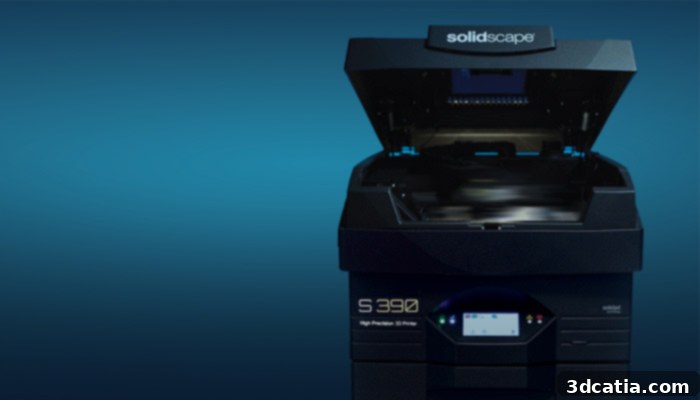
Solidscape – S390
Solidscape, a distinguished member of the Prodways group, has carved a strong niche in the 3D printing market by developing a specialized range of DOD printers dedicated primarily to the jewelry sector. Among its offerings, the S390 stands out as a high-precision solution for crafting intricate wax patterns. This machine is equipped with two independent printing heads: one for depositing proprietary wax materials and another for applying a soluble support material. This dual-head system enables the design and production of highly precise molds, critical for various applications such as injection molding, lost-wax casting, and other advanced manufacturing processes. The S390 offers a practical printing volume of 52 x 152 x 101 mm and supports a wide selection of compatible wax materials, each engineered for specific casting requirements. A key benefit of the S390 is its ability to automatically generate print media that strategically supports and protects the most fragile and intricate parts of the model during the printing process. Following printing, these support structures can be dissolved completely in water, leaving behind flawlessly smooth and durable wax models that are ready for immediate use in casting, without any risk of damage from manual support removal.
DragonFly LDM®
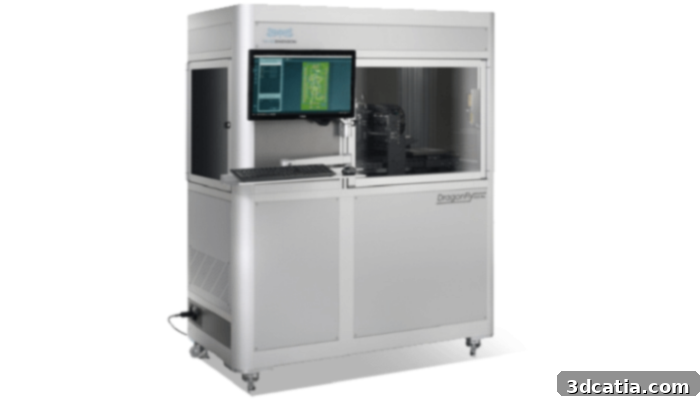
The DragonFly LDM® (Lights-Out Digital Manufacturing) system, developed by Nano Dimension, is a truly unique and groundbreaking platform within the additive manufacturing landscape. It distinguishes itself as the industry’s only comprehensive additive manufacturing solution specifically designed for the continuous, around-the-clock 3D printing of electronic circuitry. Powered by Nano Dimension’s state-of-the-art LDM technology, the DragonFly LDM® is engineered for unattended operation, boasting advanced self-maintenance features. This minimizes human intervention, with typically just one weekly maintenance operation required, thanks to significant improvements such as a new advanced print head design, sophisticated software management algorithms, and an automatic self-cleaning mechanism for the print heads that activates every few hours. Physically substantial, approximately the size of two refrigerators, the DragonFly has machine dimensions of 1400mm x 800mm x 1800mm (approximately 4’7” x 2’7.5” x 5’11”) and a precise build volume of 160mm x 160mm x 3mm (6.5” x 6.5” x 0.125”). It operates as a highly accurate inkjet deposition printer utilizing dedicated nano-inks, featuring two specialized printheads: one for nano-Silver conductive ink and the other for dielectric polymer ink. This dual-head configuration allows the DragonFly to concurrently print using simultaneous multi-material additive manufacturing, enabling the creation of complex functional electronic components in a single process. It achieves a minimum trace layer thickness of 17 microns and a minimum dielectric layer thickness of 35 microns, with a technical accuracy of 0.01mm or 1 micron. Nano Dimension proudly asserts that the DragonFly LDM® system is establishing new benchmarks for precision in 3D printed electronics. Its capabilities make the DragonFly LDM® invaluable across a diverse range of industries, including aerospace, defense, automotive, medical, and general electronics, facilitating rapid prototyping and production of advanced electronic devices.
Other Material Jetting Technologies
Beyond the primary subgroups, the innovation in Material Jetting continues to evolve, leading to hybrid technologies and specialized systems that push the boundaries of what’s possible in 3D printing. These advancements often integrate elements from other additive manufacturing processes or introduce novel ways to deposit and cure materials, expanding the versatility and application range of material jetting even further. These printers are designed to meet specific market needs, offering unique combinations of features like full-color capabilities, material flexibility, and enhanced efficiency.
XYZPrinting da Vinci Color
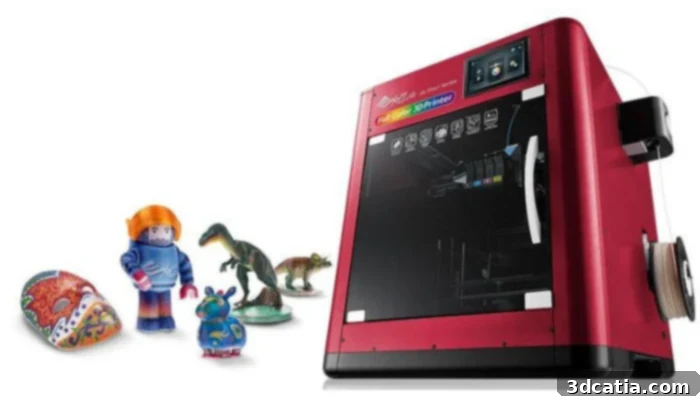
The da Vinci Color from the Chinese manufacturer XYZprinting represents a truly unique fusion of additive manufacturing technologies. It combines the widely popular Fused Filament Fabrication (FFF) process with advanced inkjet technology, creating a versatile 3D printer capable of producing full-color prints. The integrated inkjet technology employs CMYK (Cyan, Magenta, Yellow, Black) cartridges, allowing for the precise deposition of individual ink droplets that merge to create millions of vibrant color combinations. This innovative approach means that parts can be printed with the da Vinci Color in virtually any desired color, making it exceptionally well-suited for creative projects, educational applications, and producing realistic prototypes where visual accuracy is paramount. The machine offers broad material compatibility with various standard and special PLA and PETG filaments. Furthermore, with a specialized extruder, it can also print XYZ carbon fiber material, expanding its utility for more robust applications. It provides a maximum print range of 200 x 200 x 150 mm and can achieve a layer resolution ranging from 100 to 400 micrometers. The printing speed typically falls between 30 to 60 mm per second. For enhanced user experience, the da Vinci Color is equipped with an integrated touch screen, a convenient removable printing plate, and offers wireless connectivity to a home or office network, providing flexibility and ease of use.
ProJet CJP 860Pro from 3D Systems: (ColorJet Printing)
No comprehensive overview of 3D printers would be complete without acknowledging the pioneering contributions of 3D Systems, a giant in the additive manufacturing industry. Their ProJet CJP 860Pro color printer stands as a testament to their innovation, capable of creating a truly realistic color experience through its advanced five print heads. What sets this 3D printer apart is its reliance on ColorJet Printing (CJP) technology. CJP is a binder jetting process that involves depositing a liquid binder and colorants onto a bed of powder material, layer by layer, to build the part. A significant advantage of CJP, as demonstrated by the ProJet CJP 860Pro, is its exceptional cost-effectiveness, enabling the production of parts that can be up to 7 times cheaper than those produced by other technologies. This efficiency is further enhanced by its ability to eliminate waste through optimized material usage. Another key benefit of CJP is the inherent lack of need for dedicated support structures, as the unfused powder surrounding the part acts as a natural support. This drastically reduces post-processing time and labor, streamlining the entire workflow. The ProJet CJP 860Pro also impresses with its remarkable printing speed, operating 5 to 10 times faster than many other systems. This accelerated production capability allows for the creation of large-format models in just a few hours, making it ideal for rapid prototyping, architectural models, and vibrant conceptual designs. Clearly, this printer is an all-rounder: while delivering significant savings in both time and money, it offers an incredible spectrum of color choices, a substantial build space capacity of 508 x 381 x 229 mm, and a strong commitment to sustainable operation through efficient material utilization.
Material Jetting continues to be a frontier of innovation in additive manufacturing, offering unparalleled precision, multi-color capabilities, and the ability to combine various materials into single, complex parts. From mimicking human tissues with PolyJet to creating functional electronic circuits with Drop on Demand, and producing high-performance metal and ceramic components via NanoParticle Jetting, this technology is driving advancements across medical, jewelry, aerospace, and general manufacturing sectors. The range of printers highlighted here demonstrates the incredible versatility and ongoing evolution of Material Jetting, providing solutions for diverse and demanding applications.
What are your thoughts on these advanced material jetting 3D printers and their potential impact on future manufacturing? Let us know in a comment below or join the conversation on our Facebook, Twitter andLinkedIn pages! Don’t miss out on the latest advancements and news in 3D printing – sign up for our free weekly newsletter here, delivering all the essential updates straight to your inbox!