
The Future is Polymer: Unpacking the $21 Billion Polymer 3D Printing Market Growth
The journey of additive manufacturing began with a foundational process that, from its inception, positioned plastics at the forefront of innovation: stereolithography (SLA). Invented in the 1980s, SLA revolutionized manufacturing by using a laser to selectively harden a photosensitive polymer resin, layer by layer, to create intricate three-dimensional objects. This pioneering method laid the groundwork for what has become a thriving industry, one where plastics and polymers continue to play an indispensable role. This enduring relevance is more pronounced than ever today, with the polymer 3D printing sector projected to reach an astounding $21 billion by 2033, according to a comprehensive study by IDTechEx titled “Polymer Additive Manufacturing 2023-2033: Technology and Market Outlook.”
To truly grasp the magnitude of this predicted growth, it’s not enough to simply acknowledge the historical presence of polymers in 3D printing. Instead, one must delve into the myriad innovations that have emerged in recent years, transforming the capabilities and applications of these versatile materials. The market is witnessing an influx of new players offering advanced forms of materials, extending far beyond conventional plastics to include high-performance foams, sophisticated composites, and viscous thermosets designed for specific industrial requirements. Parallel to this material revolution, groundbreaking printing technologies are also pushing the boundaries of what’s possible, with volumetric 3D printing being a prime example of such a disruptive advancement. But what are the underlying forces propelling the rapid expansion of the plastics printing market? And what significant challenges or obstacles still lie on the path to its full potential?
The IDTechEx report meticulously segments the polymer additive manufacturing market, offering a detailed breakdown by both technology and material. This intricate segmentation reveals a landscape rich with diverse printing processes, which in turn leads to a proliferation of material offerings tailored to various applications. From traditional filaments and liquid resins to fine powders and cost-effective pellets, the spectrum of polymer forms compatible with 3D printing is continuously expanding. A particularly notable finding from the report highlights the anticipated rapid growth of polymer powders over the analysis period. This surge is largely attributable to the exceptional properties these plastics provide. Often categorized as “technical polymers,” these materials are engineered for demanding industrial applications, offering superior mechanical, thermal, and chemical resistance compared to general-purpose plastics.
Indeed, the IDTechEx report underscores a significant shift in user focus, with a growing emphasis on final part production rather than merely rapid prototyping. While rapid prototyping remains a crucial application, the industry’s evolution towards end-use parts signifies a maturation of the technology. Users across various sectors now possess a more sophisticated understanding of additive manufacturing technologies, enabling them to leverage these processes for high value-added applications. This includes the efficient manufacture of custom-made parts, complex functional components, and even low-to-medium volume production runs. This growing expertise allows industries like aerospace, medical, and automotive to integrate polymer 3D printing into their core manufacturing workflows, creating components that were previously impossible or cost-prohibitive to produce with traditional methods. Despite this powerful trend towards final production, the ability of polymer 3D printing to quickly and affordably create prototypes continues to be a cornerstone application, facilitating design iteration and accelerating product development cycles.
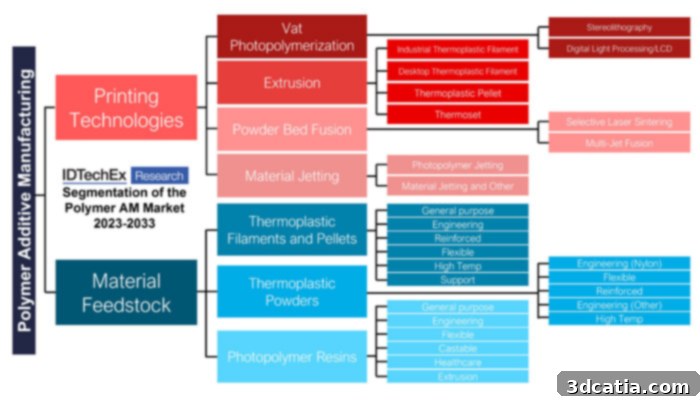
Photo Credits: IDTechEx
Technological Innovations Driving Polymer Additive Manufacturing Forward
A compelling aspect revealed in the IDTechEx study is the increasingly prominent role that startups are assuming within the polymer 3D printing landscape. While established, historical players such as 3D Systems and Stratasys steadfastly pursue their innovation strategies, a vibrant ecosystem of new ventures is constantly emerging. These startups are often agile, unburdened by legacy systems, and singularly focused on developing cutting-edge solutions, whether through novel materials or significantly faster and more efficient printing processes. The overarching objective for these innovators is to unlock the full potential of polymer additive manufacturing by meticulously improving every segment of the value chain. This includes advancements in sophisticated software for design and simulation, more capable and intelligent machines, a wider array of high-performance materials, and streamlined post-processing techniques.
The study specifically identified nine such “innovators” across these diverse segments, illustrating how their groundbreaking advances could substantially contribute to the market’s continued expansion. While these are indeed projections, the evolution of these startups and their actual impact on polymer additive manufacturing will be a fascinating narrative to observe over the coming years. Their contributions are vital for pushing the boundaries of speed, accuracy, material compatibility, and economic viability, ultimately broadening the adoption of 3D printing across industries.
One particularly noteworthy startup highlighted is Evolve Additive Solutions, which has pioneered a revolutionary process known as STEP, an acronym for Selective Electrophotographic Thermoplastic Process. This innovative method is executed in three distinct stages: imaging, alignment, and fusion. In the initial imaging step, the machine leverages a high-resolution 2D electrophotographic engine, similar to technology found in advanced laser printers, to precisely define each layer. Evolve Additive Solutions has ingeniously combined elements from sheet lamination, traditional 3D printing, and powder bed fusion techniques to achieve manufacturing speeds that are truly remarkable. This hybrid approach enables the STEP process to rival the production rates of conventional injection molding, a critical benchmark for enabling high-volume manufacturing with additive techniques. The ability to quickly produce higher volumes of parts is, without doubt, a compelling proposition that will significantly broaden market interest and adoption, especially in sectors requiring scalability.
Continuing with technological advancements, the report also brings to light startups like Readily3D and Xolo, which are at the forefront of developing and commercializing volumetric printing methods. In stark contrast to traditional layer-by-layer additive manufacturing, volumetric 3D printing creates an entire part in a single, rapid step. This groundbreaking approach involves using light to solidify a volume of photosensitive resin almost simultaneously, rather than meticulously tracing individual layers. This fundamentally bypasses the inherent challenges associated with printing speed, particularly prevalent in many resin-based processes, while simultaneously maintaining an exceptionally high level of detail and resolution. Such a paradigm shift holds immense promise for applications demanding ultra-fast production of intricate components, potentially transforming fields such as micro-fabrication, medical device manufacturing, and the creation of complex optical elements.
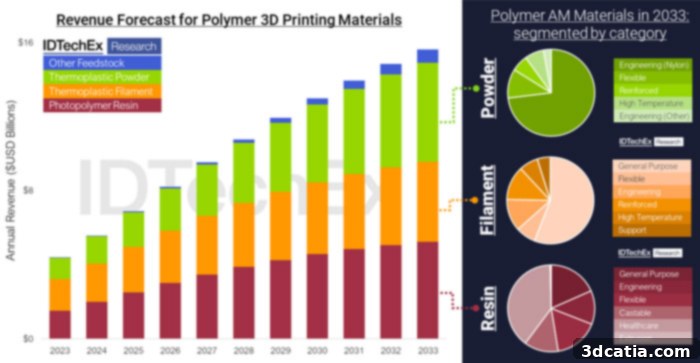
Market revenue by material category (photo credits: IDTechEx)
Polymer 3D Printing Market: A Future Shaped by Materials
The IDTechEx study places a strong emphasis on the critical role of polymer materials within the additive manufacturing market, projecting that their revenue will significantly outpace that of hardware sales. By 2033, the market for polymer 3D printing materials alone is forecast to reach an impressive $15 billion. This highlights the recurring, consumable nature of materials as a primary driver of long-term market value. Within this rapidly expanding niche, the focus is dual-pronged: addressing the ever-increasing demands for performance and simultaneously tackling the pressing imperative of sustainability. The environmental impact of developed polymers has undeniably become a key issue for manufacturers and consumers alike, influencing material development and adoption strategies.
Consequently, it is no surprise to witness a substantial rise in the availability and utilization of recycled and recyclable filaments. These innovative materials are frequently derived from reclaimed plastic waste, contributing directly to a more circular economy and reducing the overall environmental footprint of additive manufacturing. This commitment to sustainability extends beyond recycling to include the development of bio-based and biodegradable polymers, offering even greener alternatives for various applications where end-of-life considerations are paramount. Such initiatives not only align with growing corporate social responsibility goals but also cater to an increasingly environmentally conscious customer base.
Beyond sustainability, another paramount aspect driving the polymer materials market is performance. Manufacturers are constantly seeking materials with enhanced characteristics that can withstand extreme conditions, meet stringent industry standards, and enable new functionalities. Key questions revolve around the combination of material properties: What are the specific needs of manufacturers today, and how can innovative material science meet these complex demands? For instance, industries require materials with high-temperature resistance for aerospace components, chemical resistance for industrial tooling, biocompatibility for medical implants, and lightweighting properties for automotive parts. The ability to precisely tailor polymer compositions to achieve these specific performance attributes is a significant competitive advantage.
One compelling example highlighted in the report is that of the startup Tiamet3D, which has developed a pioneering composite material based on PLA (Polylactic Acid) and nano-diamonds. The strategic integration of nano-diamonds aims to significantly enhance the mechanical strength, stiffness, and thermal conductivity of the PLA, transforming a common desktop 3D printing material into a high-performance option. The objective is to provide a resistant, durable, and yet accessible material solution for a broader range of market users, bridging the gap between general-purpose and engineering-grade polymers. Many other manufacturers are also pushing the envelope, offering a diverse array of advanced materials. These include flame-resistant polymers for increased safety in electronics and construction, materials with Electrostatic Discharge (ESD) properties crucial for protecting sensitive electronic components, and composites engineered for specific strength-to-weight ratios or specialized electrical characteristics. These advancements signify that the polymer 3D printing market is not just expanding in volume but also in its capability to deliver highly functional and specialized solutions. One thing is for certain: with continuous innovation in both technology and materials, the polymer 3D printing market has an incredibly bright future ahead, poised to redefine manufacturing possibilities across countless sectors.
If you’d like to learn more about the intricacies of this dynamic market, we highly recommend reading the full IDTechEx study, which provides in-depth analysis and further insights. You can access the comprehensive report HERE.
Are polymers indeed the undisputed future of additive manufacturing? We’d love to hear your thoughts and insights! Let us know in a comment below or join the conversation on ourLinkedIn,Facebook, andTwitter pages. Don’t miss out on the latest advancements and news from the 3D printing world—be sure to sign up for our free weeklyNewsletter here, delivering cutting-edge information straight to your inbox! You can also find all our engaging videos and in-depth discussions on ourYouTube channel for more visual content.
*Cover Photo Credits: Sinterit