
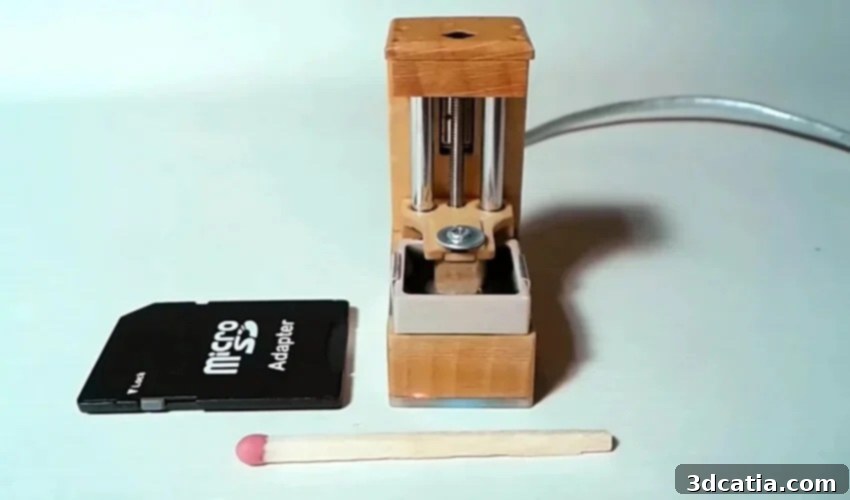
Unveiling the World’s Smallest 3D Printer: My N Mi’s Revolutionary Micro-Printing Innovation
The landscape of 3D printing is in a constant state of flux, experiencing rapid evolution with innovations emerging almost daily. This relentless pace of development spans across various facets of additive manufacturing, from increasing printing speeds and introducing novel materials to exploring new frontiers in machine size. Manufacturers are continuously pushing boundaries, whether striving for greater build volumes in industrial-scale machines or, conversely, pursuing extreme miniaturization. A recent project from the creative YouTuber known as “My N Mi” perfectly encapsulates this drive towards the incredibly small, showcasing a truly groundbreaking achievement in personal fabrication. He has successfully designed and built what he claims to be the smallest 3D printer in the world – a marvel of engineering that redefines the limits of desktop additive manufacturing.
This diminutive solution is astonishingly compact, boasting dimensions that are even smaller than a standard matchbox. Measuring a mere 1.8 x 3 x 4 centimeters and weighing an incredibly light 17 grams, this device challenges conventional notions of what a 3D printer can be. Its minuscule footprint makes it a pioneering example of how advanced manufacturing capabilities can be condensed into an unbelievably portable form factor. Such miniaturization is not just a novelty; it opens up new avenues for on-demand fabrication in environments where space is at a premium or where highly specialized, tiny components are required.
In a compelling YouTube video, the ingenious designer provides a comprehensive demonstration of his creation in action, illustrating its capabilities by successfully printing a remarkably small mannequin. Despite the device’s minuscule size, it can produce parts with an impressive maximum volume of 11 x 11 x 17 millimeters. The results are truly awe-inspiring, not only in terms of the intricate details and quality of the finished objects but also considering the sheer ingenuity behind the machine’s construction and operational implementation. The printer achieves this precision through the principle of photopolymerization, a process commonly associated with stereolithography (SLA) or digital light processing (DLP) technologies. It employs a small motor to precisely control the movement of the printing plate and an LCD screen that selectively cures liquid resin layer by layer, solidifying it into the desired three-dimensional object. This method allows the mini 3D printer to craft small, highly detailed objects with remarkable fidelity.
The use of photopolymerization in such a compact design is a testament to clever engineering, highlighting the versatility of resin-based 3D printing. Given the incredibly small scale, the resin tank itself is similarly tiny, necessitating that the photopolymer resin be added with extreme care, typically drop by drop using a syringe. This meticulous process underscores the precision required at every stage of operating this micro-printer. According to its inventor, this groundbreaking device is specifically engineered for 3D micro-printing applications, making it an ideal tool for creating incredibly tiny components that are essential for electronic devices, intricate sensors, microfluidic systems, and a myriad of other specialized applications where conventional manufacturing methods fall short or are prohibitively expensive.
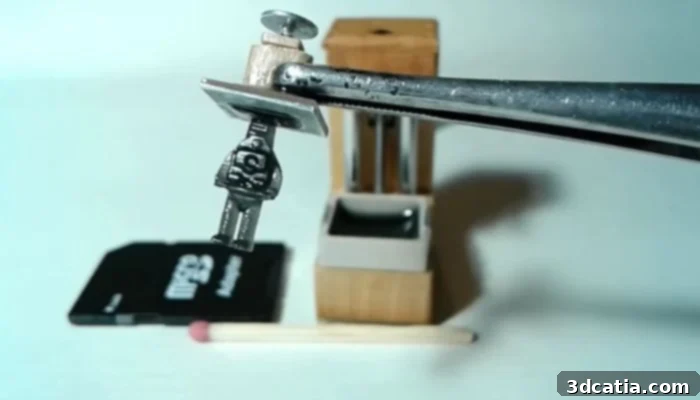
The part created on the mini 3D printer (photo credits: My N Mi)
While the creator, My N Mi, has yet to release any open-source plans, schematics, or detailed build instructions for this revolutionary printer, the demonstration video has undeniably generated significant excitement and substantial interest within the global 3D printing community. The sheer audacity and successful execution of such a miniature device have sparked numerous discussions, with many enthusiasts and professionals alike speculating on its potential applications and broader implications. Indeed, several experts have suggested that this tiny 3D printer could evolve into an invaluable tool for researchers, engineers, and developers engaged in highly specialized projects that demand the fabrication of extremely small and intricate parts. Its ability to produce custom micro-components on demand could significantly accelerate prototyping cycles and foster innovation in fields ranging from medical device development to advanced robotics and micro-electromechanical systems (MEMS).
It is important to acknowledge that this mini 3D printer is not designed for the mass production of medium or large series components; its niche lies firmly in precision micro-fabrication and rapid prototyping of individual, small-scale items. However, its exceptional originality, especially considering its unprecedented size and advanced features, firmly sets it apart from conventional 3D printers. Delving into its technical specifications, the device offers an impressive accuracy of 0.135 mm on the XY axis, ensuring fine detail rendition in the horizontal plane. Furthermore, it provides a layer resolution that can be adjusted between 0.005 and 0.3 mm, allowing users to balance print speed with desired surface finish and vertical detail. These specifications are remarkably precise for any 3D printer, let alone one of such minuscule proportions, underscoring the advanced engineering principles My N Mi has integrated into his design.
The ability to achieve such high resolution and accuracy in a device so small is particularly significant for scientific research and specialized industrial applications. For instance, in materials science, researchers could print micro-lattices or custom micro-structures to study mechanical properties at the nanoscale. In the field of bioengineering, it could facilitate the creation of custom micro-scaffolds for tissue engineering or intricate drug delivery systems. The potential for on-site, rapid prototyping of complex geometries at the micro-scale presents a transformative advantage, circumventing the lengthy lead times and high costs often associated with traditional micro-manufacturing techniques. This innovation democratizes access to sophisticated micro-fabrication capabilities, potentially enabling smaller research labs and individual innovators to experiment with designs previously only feasible in highly specialized facilities.
The construction of this miniature 3D printer is a smart amalgamation of readily available commercial components and custom-designed, 3D-printed parts, showcasing a blend of off-the-shelf efficiency and bespoke innovation. While the device is not yet commercially available, the possibility remains that its ingenious inventor might decide to release it for sale in the future or, perhaps even more impactful for the community, publish the detailed plans for designing and building it right at home. Such a move would undoubtedly catalyze further experimentation and development in the realm of micro-3D printing, empowering a wider audience of hobbyists, educators, and small-scale innovators. Although it might initially be perceived by some as an elaborate gadget, its underlying technological advancements and the implications for accessible micro-fabrication are undeniable. This project, regardless of its immediate commercial viability, deserved widespread recognition and thorough coverage, as it represents a significant leap forward in the ongoing quest to miniaturize and democratize advanced manufacturing technologies.
The future trajectory of this smallest 3D printer is intriguing. While it may indeed begin its journey as a curiosity or a specialized tool for a niche market, its very existence pushes the boundaries of what is technically achievable. The innovation it embodies could inspire a new generation of micro-manufacturing tools, making intricate fabrication accessible to a broader user base. Imagine classrooms where students can print micro-robots, or small businesses developing custom electronic prototypes without needing industrial-scale equipment. This project highlights the critical role of independent inventors and the online community in driving technological progress, often bypassing traditional research and development cycles. It stands as a testament to human ingenuity and the boundless potential of additive manufacturing when combined with creative problem-solving.
What are your thoughts on this incredible smallest 3D printer and its potential to revolutionize micro-manufacturing? We’d love to hear your insights and predictions for the future of such tiny technology. Please let us know in a comment below or join the conversation on our LinkedIn, Facebook, and Twitter pages! Don’t forget to sign up for our free weekly Newsletter here to receive the latest 3D printing news, insights, and innovations straight to your inbox! You can also find all our compelling videos and demonstrations on our dedicated YouTube channel, offering a visual journey through the exciting world of additive manufacturing.
*Cover Photo Credits: My N Mi