
Unlocking Innovation: The Powerful Synergy of Reverse Engineering and 3D Printing
Reverse engineering stands as a sophisticated methodology for deconstructing and analyzing a finished product to comprehensively understand its intricate design, manufacturing processes, and underlying functional principles. By meticulously deciphering the structural composition, material properties, and operational mechanisms of an object, this technique empowers engineers and designers to achieve multiple objectives: reproducing the item with exacting precision, enhancing its performance or features, or drawing invaluable inspiration for the creation of entirely new, innovative designs. While its applications span across diverse technical domains, including software development, electronics, and chemical processes, our focus here will be on its profound and transformative impact within the realm of mechanical engineering and product design.
When seamlessly integrated with the capabilities of 3D printing, reverse engineering transcends its traditional boundaries, evolving into an exceptionally potent and versatile tool that is rapidly reshaping numerous industries. This dynamic combination offers an unprecedented ease and precision in the ability to recreate, optimize, and innovate around existing physical parts. As advanced 3D scanning technologies continue their rapid evolution, coupled with the relentless advancements in additive manufacturing, this powerful alliance is paving the way for the development of solutions that are not only more efficient and functional but also inherently more sustainable. This article will delve into the intricate workings of this technological synergy, exploring its diverse applications, and illuminating the multifaceted benefits it brings to modern manufacturing and innovation.
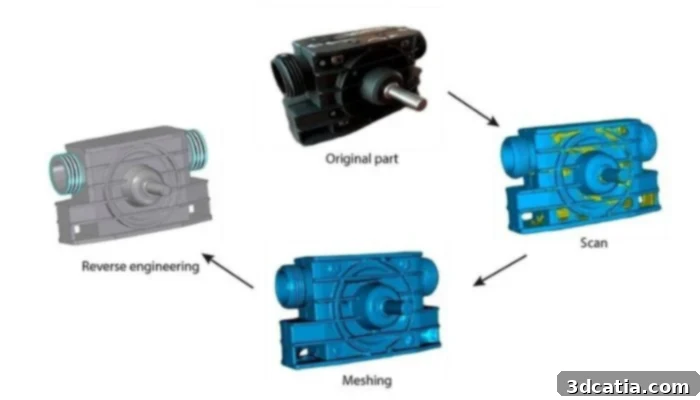
The reverse engineering process (photo credits: 3dcaptura.cz)
The Multi-Stage Method of Reverse Engineering: From Physical to Digital
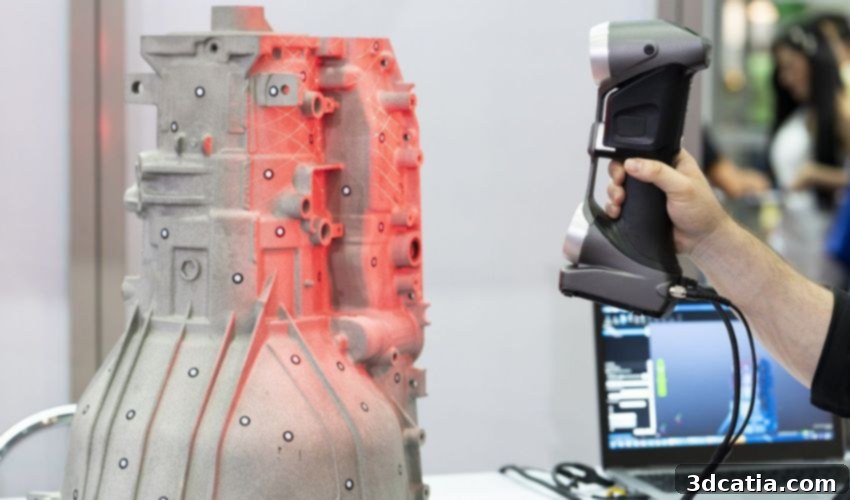
The journey of reverse engineering commences with the critical first step: the precise digitization of a physical object. This initial phase involves capturing the exact geometry and dimensions of the component using sophisticated data acquisition technologies. Advanced methods such as high-resolution laser scanning, detailed structured light scanning, internal computed tomography (CT scanning), or photographic photogrammetry are employed to capture the object’s intricate details. Each technology offers unique advantages; laser scanners are excellent for large, complex surfaces, structured light scanners provide high accuracy for smaller objects, and CT scanning can reveal internal structures without damaging the part. The output of this stage is typically a vast collection of data points, known as a point cloud, which digitally represents the object’s surface geometry.
Following data acquisition, this raw point cloud data undergoes intensive processing within specialized 3D modeling software. Here, the point cloud is converted into a polygonal mesh, and subsequently, into a high-fidelity CAD (Computer-Aided Design) model. This CAD model is a parametric, editable representation of the original physical object, allowing for precise measurements, geometric analysis, and design modifications. This digital model then serves as the foundation for further analysis, modification, and optimization. It can be meticulously refined to improve its original specifications, adapt it for new applications, or prepare it for manufacturing. For seamless integration with 3D printing, the finalized CAD file is then translated into a format suitable for additive manufacturing (typically an STL or 3MF file), which is subsequently sent to a 3D printer. The printer then materializes the object layer by layer, reproducing the design with remarkable accuracy and impressive detail.
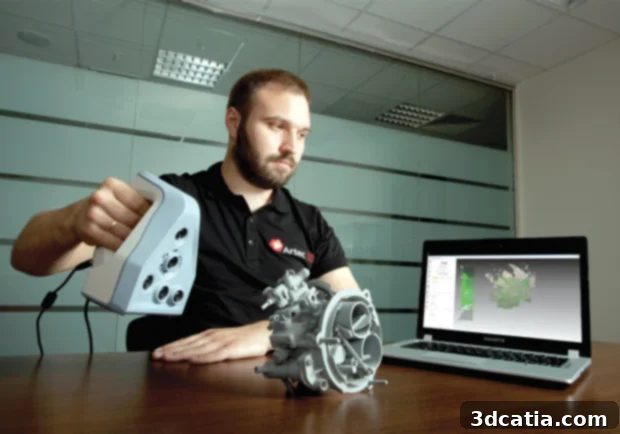
3D scanning simplifies reverse engineering (photo credits: Artec3D)
Software expertise is absolutely paramount throughout this entire process. Specialized tools are not only essential for processing the raw scan data but also enable engineers to reconstruct missing or damaged sections of a part, automatically model complex, freeform designs, and conduct in-depth analysis of object dimensions, surface integrity, and geometric tolerances. These software solutions facilitate crucial tasks such as feature extraction, surface reconstruction, and deviation analysis, ensuring the digital model accurately reflects the physical object. Among the most widely adopted and highly regarded software packages that empower this workflow are industry leaders such as Geomagic Design X (renowned for its direct CAD modeling from scan data), Catia and Creo (powerful comprehensive CAD/CAM/CAE suites), Mesh2Surface (for intuitive surface modeling), Artec Studio (integrated with Artec 3D scanners), and Fusion 360 (a versatile platform for design, engineering, and manufacturing).
Strategic Advantages: Why Opt for Reverse Engineering?
The strategic benefits derived from embracing reverse engineering are extensive and profoundly impactful, particularly for manufacturers operating in highly competitive global markets. This methodology offers a robust framework for overcoming various design, production, and maintenance challenges, driving efficiency and fostering innovation:
- Accelerated Product Development and Enhancement: Reverse engineering dramatically streamlines the product development lifecycle. By analyzing existing products, whether they are legacy components or competitor offerings, companies can quickly identify successful design elements, understand functional advantages, and pinpoint areas for improvement. This insight enables rapid customization, iterative design improvements, and the creation of superior, higher-performance products that meet evolving market demands or specific customer needs. It’s an invaluable tool for competitive benchmarking, allowing businesses to analyze competitor products and quickly adapt or surpass their features.
- Manufacturing Optimization and Cost Reduction: Through detailed analysis of a product’s digital model, engineers can identify inefficiencies in its original design or manufacturing process. Parts can be strategically lightened without compromising structural integrity, strengthened in critical areas to extend lifespan, or redesigned for more economical production methods. This optimization leads to significant reductions in material usage, assembly time, and overall production costs, ultimately enhancing profitability and sustainability. It also allows for the consolidation of multiple components into a single, complex part, further simplifying assembly and supply chains.
- Reproduction of Obsolete or Unobtainable Parts: In sectors such as automotive, aerospace, and industrial machinery, critical parts can become obsolete, with original manufacturers no longer supporting them, or technical drawings may be lost. In such scenarios, reverse engineering becomes an indispensable solution. It is often the *only* viable method to recreate these vital components, ensuring the continued operation, maintenance, and longevity of valuable equipment, historic vehicles, or legacy systems, thus preventing costly downtime or complete system replacement.
- Catalyst for Innovation and New Creations: The process of reverse engineering naturally fosters innovation. By meticulously dissecting an existing product, designers gain deep insights into its functional principles, material choices, and aesthetic considerations. This profound understanding often sparks inspiration for entirely new solutions, novel design approaches, or the development of groundbreaking products that address previously unmet needs, pushing the boundaries of what is possible within a given industry.
- Creation of Accurate Digital Twins: Reverse engineering is the foundational technology for generating highly precise digital twins. These virtual replicas of physical assets are instrumental for advanced applications such as predictive maintenance, where simulations can anticipate equipment failures, and for rigorous performance simulations. Digital twins enable companies to monitor, analyze, and optimize the performance of their physical counterparts in real-time, extending asset lifespans, improving operational efficiency, and informing strategic decision-making throughout a product’s entire lifecycle.
- Quality Control and Assurance: Beyond design and reproduction, reverse engineering is an excellent tool for quality control. It allows manufacturers to scan and compare produced parts against their original CAD models or design specifications, identifying deviations, manufacturing defects, or variations that could affect performance or fit. This ensures that products consistently meet stringent quality standards and design tolerances.
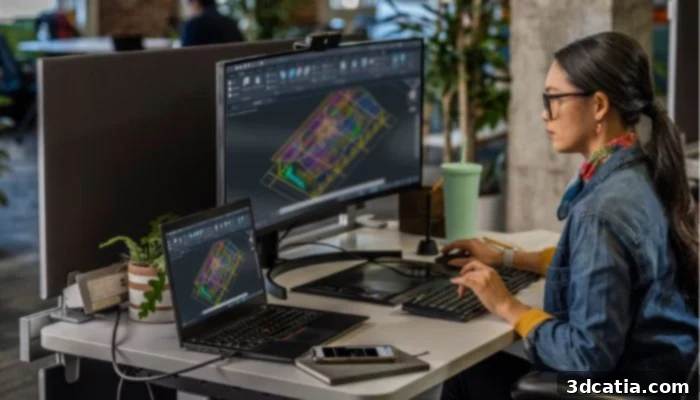
CAD software is used to draw reverse-engineered parts (photo credits: Autodesk)
The Transformative Role of 3D Printing in Reverse Engineering Workflows
The integration of 3D printing into the reverse engineering workflow expands the scope of possibilities exponentially. Additive manufacturing, by its very nature, offers unparalleled design freedom. This allows for the precise recreation of extremely complex shapes, internal geometries, or unusual forms that would be either impossible or prohibitively expensive to produce using conventional subtractive or formative manufacturing methods. This capability is critical for optimizing parts, as it allows for the implementation of lightweighting structures (like lattices), internal channels for fluid dynamics, or consolidated multi-part assemblies into a single print.
3D printing proves to be an indispensable ally, especially when the goal is to reproduce spare parts that are no longer available for purchase. The traditional alternatives, such as manufacturing these components using conventional techniques (which often require expensive tooling and long lead times) or replacing an entire damaged or malfunctioning product, would incur significantly higher costs. This economic advantage becomes particularly pronounced when dealing with small, intricate components or parts featuring fine details. For example, producing such parts with injection molding would demand the creation of costly molds, a process that is often financially unsustainable for low-volume or single-part reproduction, making 3D printing the most efficient and cost-effective solution in terms of both time and financial investment.
Furthermore, when considering the inherent need for manufacturers to iterate and test numerous design variations before finalizing a product, the capabilities offered by additive manufacturing become profoundly advantageous. The rapid prototyping function of 3D printing allows for quick, low-cost production of functional prototypes directly from CAD models generated through reverse engineering. This accelerates the design-test-refine cycle, enabling engineers to quickly validate concepts, test fit and function, and make necessary adjustments, dramatically reducing development times and bringing products to market faster. This iterative approach is a huge advantage over traditional manufacturing, which often involves lengthy and expensive tooling modifications for each design change.
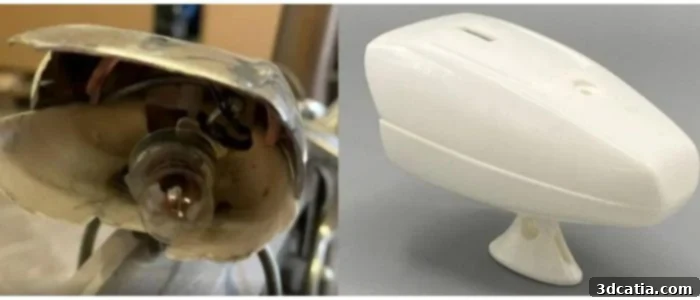
3D printing combined with reverse engineering is often used to reproduce damaged parts that are no longer on the market (photo credits: Formlabs)
While there isn’t a single “best” 3D printing technology for combining with reverse engineering, the choice heavily depends on the specific material requirements, desired precision, and functional attributes of the final part. However, it’s worth noting that certain technologies are frequently favored for their ability to deliver exceptional detail and accuracy. Stereolithography (SLA) is often chosen for polymer components due to its superior surface finish and fine feature resolution, making it ideal for prototypes, master patterns, and highly detailed functional parts. For metal components, Laser Powder Bed Fusion (LPBF) technologies, such as Selective Laser Melting (SLM) or Direct Metal Laser Sintering (DMLS), are commonly utilized. These processes excel at producing strong, complex metal parts with high precision and density. That said, other technologies like Fused Deposition Modeling (FDM) might be used for quick, cost-effective prototypes, and Selective Laser Sintering (SLS) for durable, functional polymer parts, depending entirely on the specific demands of the final application, including mechanical properties, environmental resistance, and cost considerations.
Diverse Applications Across Industries
The synergistic application of reverse engineering and 3D printing has manifested in a wide array of concrete and impactful applications across various industries. Beyond the general production of optimized parts for the manufacturing sector, several key areas have particularly benefited from this powerful combination:
- The Automotive Industry: Restoration, Optimization, and Customization: This sector regularly leverages reverse engineering and 3D printing. A prime example is the meticulous restoration of historic vehicles. The ability to precisely reconstruct vintage car parts, for which original blueprints are often non-existent or components are no longer manufactured, ensures that these irreplaceable vehicles can be kept operational and preserved without compromising their original integrity. This extends to engine components, interior trim, and bodywork. Furthermore, modern automotive applications include optimizing the performance, composition, and weight of new parts, developing aftermarket accessories, and creating custom prototypes for new vehicle designs.
- Aerospace and Defense: Lightweighting and Critical Component Repair: The aerospace sector, in particular, reaps immense benefits from this combination. The focus here is often on lightweighting components to improve fuel efficiency, enhancing aerodynamic performance, and repairing highly complex or critical parts. Reverse engineering allows for the creation of improved designs that incorporate advanced geometries (such as lattice structures) which are only possible with 3D printing. Examples include the production of customized aircraft brackets, complex turbine components for repair or enhancement, and the rapid creation of new equipment or prototypes for military applications, often using high-performance metal alloys.
- Medical and Healthcare: Personalized Solutions and Training Aids: This is a rapidly expanding field for reverse engineering and 3D printing. Custom prosthetics and orthotics can be designed to perfectly fit an individual’s anatomy by scanning a limb and then 3D printing a personalized device. Surgical guides, based on patient-specific CT or MRI scans, allow surgeons to plan and execute complex procedures with greater precision. Anatomical models, reverse-engineered from medical scans, provide invaluable training aids for medical students and can be used for pre-surgical planning, enhancing patient care and outcomes.
- Architecture, Art, and Cultural Heritage Preservation: These fields have benefited significantly from the ability to accurately reproduce and restore. Cultural heritage preservation projects frequently utilize reverse engineering and 3D printing to reconstruct damaged sections of historic buildings and monuments, or to create precise replicas for display at other sites. This approach ensures the preservation of architectural and historical integrity while also allowing important artifacts and artworks to be reproduced and made accessible to a wider global audience, especially when direct transportation of originals is impractical or impossible.
- Consumer Goods and Electronics: Product Analysis and Customization: Reverse engineering helps companies understand competitor products, identify potential improvements, and design more effective versions of their own. For consumer goods, it enables the creation of custom-fit accessories, ergonomic designs, and rapid prototyping of new product iterations, accelerating time-to-market.
The convergence of reverse engineering and 3D printing represents a paradigm shift in how products are designed, developed, and maintained. This powerful synergy continues to unlock unprecedented opportunities for innovation, efficiency, and sustainability across virtually every industry, promising a future where design limitations are continually pushed, and bespoke solutions become increasingly accessible.
What transformative opportunities do you envision in the synergy between reverse engineering and 3D printing for your industry? We invite you to share your thoughts and insights in a comment below or engage with us on our Linkedin, Facebook, and Twitter pages! Don’t forget to sign up for our free weekly Newsletter here, to receive the latest 3D printing news and developments directly in your inbox! You can also find all our comprehensive videos and tutorials on our dedicated YouTube channel.