
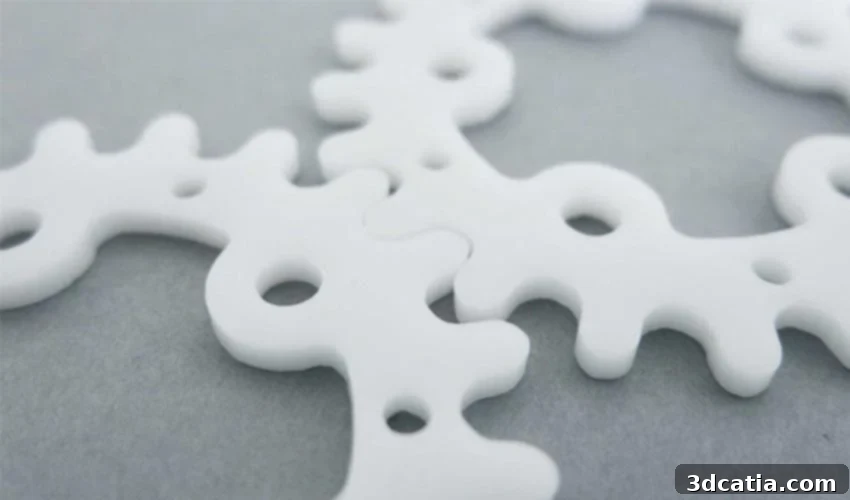
Polyoxymethylene (POM) for 3D Printing: Properties, Applications, and Expert Printing Tips
Polyoxymethylene, widely recognized by its acronym POM, is a high-performance thermoplastic polymer celebrated for its outstanding mechanical and chemical properties. Often classified as an “engineer-grade” plastic, POM was first discovered in 1920 but gained significant industrial traction much later. Today, it stands as one of the most frequently utilized materials in injection molding, following only polypropylene (PP) and polyamide (PA). Its robust characteristics have also led to its increasing popularity in the additive manufacturing sector, particularly in Fused Deposition Modeling (FDM) and Fused Filament Fabrication (FFF) 3D printing. As a semi-crystalline polymer, POM possesses a unique internal structure comprising both amorphous and crystalline zones, contributing to its distinctive blend of flexibility and strength. In its raw form, POM typically appears as a brilliant white material, making it highly versatile for color customization.
The versatility of POM is further enhanced by its existence in two primary forms: the homopolymer (POM-H) and the copolymer (POM-C). POM-H was pioneered and commercialized by DuPont in the 1950s under the brand name Delrin, quickly becoming a benchmark for high-performance plastics. A decade later, Celanese introduced the copolymer variant, POM-C. The fundamental distinction between these two lies in their molecular composition. POM-H is constructed from a single type of monomer, specifically formaldehyde, leading to a highly regular and crystalline structure. In contrast, POM-C is a copolymer, meaning it is composed of several different types of monomers, which introduces slight irregularities into its polymer chain. These structural differences directly translate into varying property profiles. While POM-H generally exhibits superior mechanical properties, including higher tensile strength and hardness, it tends to be less resistant to UV radiation and strong acids. Conversely, POM-C boasts enhanced thermal stability, improved chemical resistance, and greater ductility, making it more resilient to temperature fluctuations and chemical exposure. For these reasons, coupled with its easier extrudability, POM-C is predominantly favored in 3D printing applications, especially when available in filament form, which will be our primary focus throughout this guide.
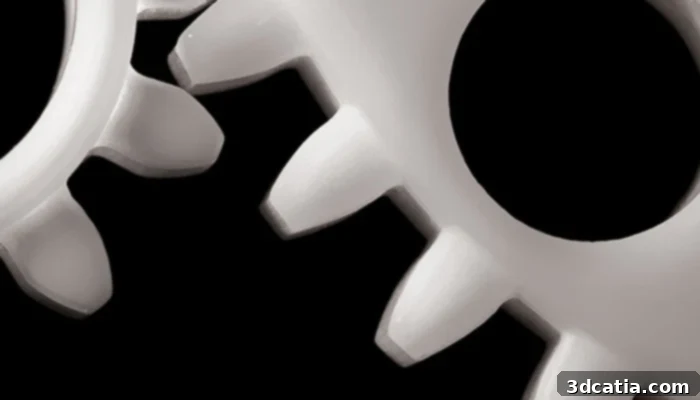
POM is available in white and easily colorable, offering design flexibility.
Understanding POM: Production Processes and Key Characteristics
The production methods for POM-H and POM-C differ significantly, influencing their final properties and suitability for various applications. POM-H, the homopolymer, is primarily synthesized through the direct polymerization of formaldehyde. This process typically involves anionic or cationic chain-growth polymerization, leading to a highly linear and ordered polymer structure. Alternatively, POM-H can also be produced via the transition metal-centered cationic polymerization of trioxane, a cyclic trimer of formaldehyde ((-CH2-O-)3). To enhance the material’s long-term stability and resistance to thermal degradation and chemical attack, particularly from acids, the unstable hemiacetal end groups of POM-H are meticulously “capped” or “closed” through etherification and esterification reactions. This stabilization process is crucial for preventing depolymerization at elevated temperatures.
In contrast, POM-C, the copolymer, is manufactured through the copolymerization of trioxane with a small percentage of a cyclic ether comonomer, most commonly dioxolane or butanediol formal. The incorporation of these comonomers introduces randomly distributed carbon-carbon bonds into the polymer chain, which acts as a “block” to prevent chain unzipping (depolymerization) from the ends. This structural modification makes POM-C inherently more stable against thermal degradation and hydrolysis. To further ensure its stability, any remaining unstable end groups in POM-C are typically removed or degraded to formaldehyde by hydrolysis, leaving only the more stable C-C bonds in the backbone. These distinct manufacturing processes underscore the engineering precision involved in tailoring POM for specific industrial and consumer demands.
Outstanding Properties of Polyoxymethylene (POM)
The appeal of POM as an engineering thermoplastic stems from its remarkable array of properties. It is widely recognized for its excellent chemical resistance, making it suitable for environments where exposure to various solvents, fuels, oils, and weak alkalis is common. This chemical inertness ensures that parts printed with POM maintain their integrity and performance even under challenging conditions. Furthermore, POM exhibits exceptional thermal stability and performs reliably across a broad temperature range, typically from -40°C to +140°C. This allows POM parts to retain their dimensional stability and mechanical strength without significant deformation or degradation, even when subjected to considerable temperature fluctuations. Its low moisture absorption is another critical advantage, contributing to its excellent dimensional stability in humid environments, unlike many other engineering plastics that can swell or warp when exposed to moisture.
Beyond its chemical and thermal attributes, POM also boasts impressive mechanical characteristics. It offers a unique combination of high stiffness, hardness, and toughness, coupled with excellent impact and abrasion resistance. The high impact resistance of POM parts, especially in 3D printed objects, is often attributed to the very good adhesion between layers, which prevents delamination under stress. Moreover, POM is renowned for its low coefficient of friction and excellent wear resistance. This self-lubricating nature makes it an ideal material for applications involving moving parts, such as gears, bearings, and bushings, where smooth operation and extended service life are critical. Its good electrical insulation properties further expand its utility in electronic components and housings. The overall balance of these properties makes POM a versatile material for demanding engineering applications, offering a reliable alternative to metals in many scenarios.
Mastering POM 3D Printing: Tips and Challenges
While the benefits of POM are substantial, printing with this engineering material in 3D applications requires specific considerations and careful parameter management. One of the primary challenges encountered when 3D printing with POM is achieving adequate bed adhesion. Due to its inherent slippery nature and semi-crystalline structure, POM has a tendency to warp and detach from the print bed, particularly with larger parts. Therefore, equipping your 3D printer with a heated build plate is not just recommended but essential, with temperatures typically ranging from 90°C to 120°C. Using adhesion aids such as a thin layer of ABS slurry (ABS dissolved in acetone) or specific POM-compatible adhesive sheets can significantly improve print success rates. Utilizing a brim or a raft in your slicer settings can also help anchor the part more securely to the build plate, mitigating the risk of warping.
Another critical aspect of successfully printing with POM is temperature control. POM typically requires high extrusion temperatures, often between 220°C and 230°C, to ensure proper flow and layer fusion. However, maintaining consistent temperatures throughout the printing process – both at the nozzle and the build chamber – is paramount to achieving high-quality results and preventing thermal stress. For optimal results, an enclosed print chamber is highly recommended to stabilize the ambient temperature around the print, further reducing warping and improving layer adhesion. Beginners, in particular, may find that printing POM presents a steeper learning curve compared to more forgiving materials like PLA. It is often advisable to conduct several test prints with smaller, simpler models to fine-tune the necessary parameters, including extrusion temperature, bed temperature, print speed, cooling fan settings, and retraction settings, to find the optimal combination for your specific printer and filament brand. Patience and meticulous calibration are key to unlocking POM’s full potential in 3D printing.
Beyond print settings, a crucial safety consideration when 3D printing with POM is the emission of formaldehyde gas during the extrusion process, especially if the material is overheated or degraded. Formaldehyde is a toxic gas, and prolonged exposure can be harmful. For this reason, it is imperative to ensure that your printing environment is exceptionally well-ventilated. Printing in an open, well-aired room or utilizing a dedicated fume extraction system with appropriate filtration is highly recommended. Personal protective equipment, such as a respirator, might also be necessary, particularly for those who print with POM frequently or in less-than-ideal ventilation conditions. Prioritizing safety precautions is non-negotiable to protect your health while working with this powerful engineering material.
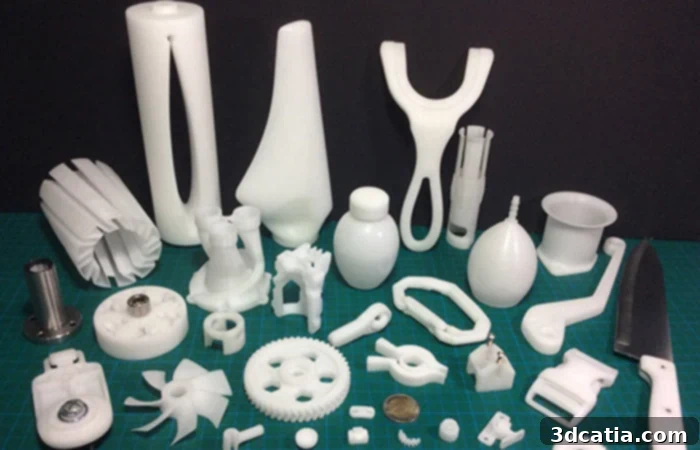
POM offers extensive application possibilities, but printing necessitates strict safety protocols (photo credits: Jean-Charles Vingiano).
Diverse Applications of Polyoxymethylene (POM)
Thanks to POM’s exceptional blend of mechanical properties, chemical resistance, and its naturally white, easily colorable nature, the material finds a vast array of possible applications across numerous industries. In the automotive sector, POM is extensively used for fuel system components, interior trim, gears, bearings, clips, and various small moving parts that require high stiffness, low friction, and resistance to fuels and oils. Its reliability in extreme temperatures makes it suitable for under-the-hood applications. The medical sector also benefits greatly from POM’s attributes; its chemical resistance allows for easy disinfection, making it ideal for surgical instruments, drug delivery components, and prosthetics. Certain medical grades of POM even exhibit biocompatibility, allowing for the manufacturing of implants and other body-contacting devices.
Furthermore, POM’s outstanding impact resistance and its characteristically low coefficient of friction, combined with excellent sliding properties, make it a top choice for manufacturing precision components such as small gears, bushings, bearings, and conveyor belt parts. It is commonly found in consumer goods like zippers, backpack buckles, showerheads, coffee maker components, and high-quality toys where durability and smooth operation are paramount. Its ability to withstand heat also makes POM suitable for parts exposed to elevated temperatures, such as components within heating ovens or hot water systems. The natural white color of POM also opens doors for aesthetic applications, allowing it to be easily pigmented to match various design requirements, from car interior fittings to decorative elements, offering designers considerable flexibility while ensuring functional integrity. The combination of its strength, excellent wear characteristics, and chemical inertness ensures POM’s continued relevance and growth in high-precision engineering technologies and beyond.
- Photo Credits: Jean-Charles Vingiano
Leading Manufacturers & Market Pricing for POM Filaments
While the demand for engineering-grade thermoplastics like POM is steadily increasing in the 3D printing community, the number of manufacturers offering POM as a filament remains comparatively lower than for more common materials such as ABS or PLA. This reflects POM’s specialized nature and the specific printing challenges it presents. Nonetheless, several reputable companies provide high-quality POM filaments for discerning users. One such manufacturer is Capifil, which offers POM spools in popular colors like white, natural (unpigmented), and black. These are typically available in the standard 1.75 mm and 2.85 mm filament diameters, priced competitively at approximately €39.99 for a 1 kg spool, making it an accessible option for many users.
Another prominent player in the chemical industry, the Polish group Grupa Azoty S.A., also supplies natural-colored POM filaments. Their offering typically comes in a 500g spool for a 1.75 mm filament, priced around €44.90. This smaller spool size can be ideal for users who wish to test the material or for applications requiring less volume. On the higher end of the market spectrum, Ensinger offers its TECAFIL POM-C filament, also in the natural POM color and 1.75 mm size. However, Ensinger’s product is positioned in a significantly higher price segment, with a 500g coil retailing for approximately €140. The considerable price variation among manufacturers can often be attributed to factors such as the specific grade of POM-C used, additional additives for enhanced printability or mechanical properties, brand reputation, and quality control standards. For critical engineering applications, investing in a higher-grade, more expensive filament might be justified by superior consistency and performance.
Polyoxymethylene (POM) stands out as an indispensable engineering plastic for 3D printing, offering a unique combination of strength, stiffness, low friction, and chemical resistance. While its printing process demands attention to detail, particularly regarding bed adhesion and fume management, the resulting durable and high-performance parts are well worth the effort. Its versatility across automotive, medical, and industrial sectors underscores its value. Do you incorporate POM into your 3D printing projects? We’d love to hear your experiences and insights on this remarkable material! Share your thoughts in a comment below or connect with us on our LinkedIn, Facebook, and Twitter pages. Don’t forget to sign up for our free weekly Newsletter here to receive the latest 3D printing news directly in your inbox! You can also explore all our informative videos on our YouTube channel for more content.
*Cover Photo Credits: Sculpteo