

Mastering 3D Printing Materials: The Indispensable Role of Rheology
Rheology, a specialized branch of physics, is dedicated to understanding how materials deform and flow under applied forces or stress. While its principles are fundamental across diverse scientific and technological disciplines, rheology takes on a particularly critical role within the realm of 3D printing. In additive manufacturing, precise control over material behavior during the successive layering process is paramount. Rheological insights allow us to predict, manage, and optimize the performance of various materials, from conventional plastics to complex hydrogels, ensuring the quality and integrity of printed objects.
The formal establishment of rheology as an independent field of study dates back to approximately 1930, championed by figures like Eugene Bingham. Etymologically, the term itself is derived from the Greek words rheo, meaning “to flow,” and logos, meaning “science” or “study.” Essentially, rheology provides the scientific framework for describing how materials respond to deformation and flow dynamics under varying stress conditions. This understanding enables the classification of materials based on their mechanical responses: elastic solids, for instance, return to their original shape after deformation; viscous fluids, such as water or oils, deform and flow continuously when a force is applied. A third crucial category, especially relevant to additive manufacturing, is viscoelastic fluids. These materials exhibit properties of both elastic solids and viscous liquids, demonstrating a time-dependent response to stress and strain. Many polymers and resins commonly used in 3D printing fall into this viscoelastic class, making rheological characterization an essential step in their application.
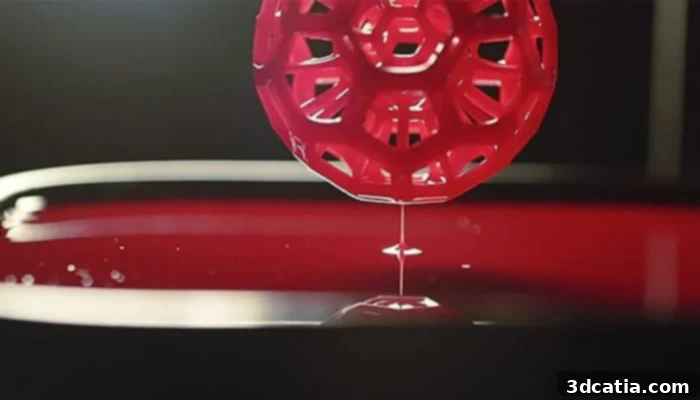
A good understanding of rheology helps ensure the quality of 3D-printed parts.
The Indispensable Role of Rheology in 3D Printing
The significance of rheology in 3D printing cannot be overstated, as it dictates the behavior of materials during critical manufacturing stages, from deposition to solidification. Whether materials are extruded as filaments or selectively polymerized from liquid resins, their rheological properties fundamentally influence the success and quality of the final print. A deep understanding of how these polymeric materials behave under process conditions allows manufacturers and researchers to accurately predict their performance, which is vital for achieving desired part accuracy, structural integrity, and surface finish. The rheological behavior of materials during printing directly impacts numerous aspects of the additive manufacturing process. Below are the primary reasons why rheology is foundational to successful 3D printing:
Precision Control of Viscosity and Flow Behavior
Controlling Viscosity. In both extrusion-based 3D printing (like Fused Deposition Modeling, FDM) and resin-based processes (such as Stereolithography, SLA, or Digital Light Processing, DLP), the material’s viscosity is a paramount property that must be meticulously balanced with its elasticity. The viscosity directly impacts the material’s flow characteristics and, consequently, the quality and consistency of the printed part. If the viscosity is excessively high, the material becomes challenging to extrude or deposit, often leading to common issues like nozzle clogging, inconsistent flow rates, or significant defects within the printed layers. Such issues compromise layer integrity and overall part accuracy. Conversely, if the viscosity is too low, the material may flow too freely, resulting in uncontrolled spreading, unwanted material accumulation, poor definition of fine features, or even complete structural collapse during printing. Through detailed rheological analysis, combined with precise adjustments of process parameters—such as extrusion temperature, pressure, and speed for FDM, or resin temperature for SLA—manufacturers can achieve optimal material flow and ensure highly accurate and defect-free prints. This often involves understanding non-Newtonian behaviors like shear-thinning, where viscosity decreases under shear stress, allowing for easier extrusion but rapid solidification upon deposition.
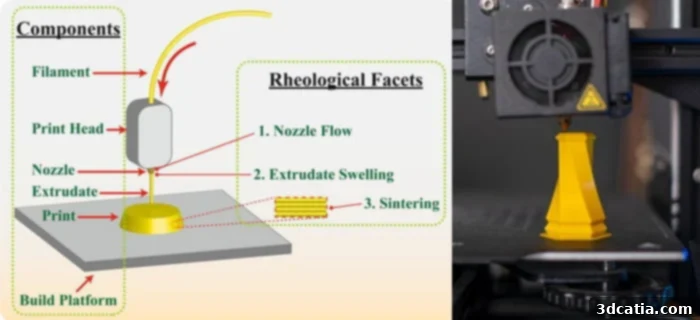
Study of Rheology Applied to Extrusion-Based 3D Printing.
Enhancing Precision in Material Deposition: Reducing Drips and Overflows
Reducing Drips and Overflows. In material jetting technologies, where precise droplets of resin are selectively deposited onto the build platform, rheological properties are absolutely critical for preventing undesirable drips, spills, or uncontrolled spreading. If the resin lacks the appropriate rheological profile—for example, if its viscosity is too low at the moment of deposition or its surface tension is poorly controlled—the material can easily form satellite droplets, wick into unintended areas, or simply flow beyond the intended boundaries. For optimal material jetting, the resin must possess a sufficiently low viscosity to ensure smooth ejection and accurate droplet formation, yet simultaneously exhibit a high enough viscosity and surface tension immediately after deposition to maintain its shape, prevent dripping, and solidify precisely where intended. Rheological fine-tuning ensures that each voxel is placed with micro-level precision, crucial for high-resolution models and intricate designs.
Ensuring Strong and Consistent Layer Adhesion
Layer Adhesion. A persistent and significant challenge in many 3D printing technologies, particularly FDM and other layer-by-layer processes, is ensuring robust and consistent adhesion between successive printed layers. This critical aspect largely hinges on the rheological properties of the material, especially its viscoelastic behavior. Materials must possess adequate viscosity to allow a newly deposited layer to retain its structural integrity and shape without excessive flow or deformation. Simultaneously, the material’s viscoelastic characteristics must enable sufficient molecular interpenetration and fusion with the underlying layer before solidification. This involves the polymer chains of the new layer diffusing into the previous one, forming strong intermolecular bonds. Insufficient layer adhesion can lead to delamination, anisotropy in mechanical properties, and ultimately, part failure. This is especially vital for producing high-resolution prints, structurally sound parts, and components with complex geometries that demand uniform strength across all axes. Optimizing processing parameters such as nozzle temperature, bed temperature, and cooling rates, all of which influence material rheology, is key to achieving superior layer bonding.
Achieving Dimensional Stability and Mitigating Post-Processing Issues
Dimensional Stability and Post-Processing. The journey of a 3D-printed part doesn’t end with fabrication; many materials are prone to deformation during cooling and solidification, as well as subsequent post-processing steps. Phenomena such as warping, shrinkage, and residual stresses can significantly compromise the dimensional accuracy, functional performance, and aesthetic quality of the final parts. Rheological knowledge provides invaluable insights into how materials will react to thermal gradients and phase changes during and after printing. By understanding the material’s glass transition temperature, melting point, and viscoelastic relaxation times, printing conditions can be meticulously adjusted to minimize these detrimental deformations. For instance, controlled cooling rates can reduce thermal stresses, and strategic support structures can counteract warping tendencies. Furthermore, post-processing techniques like annealing or curing are often designed around the material’s rheological response to temperature and chemical exposure, ensuring that parts achieve their intended final properties without undesirable changes in shape or dimension.
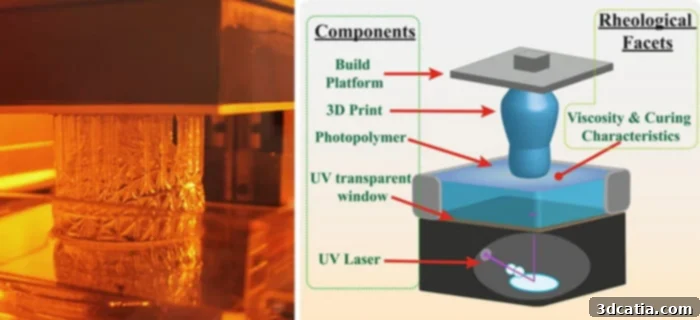
Analysis of Rheology Applied to Resin-Based 3D Printing
Driving Innovation in New Material Development
Development of New Materials. Rheology stands as a cornerstone in the ongoing research and development of novel materials tailored for 3D printing. This includes engineering materials with highly specialized properties, such as enhanced thermal resistance, superior flexibility, improved biocompatibility, or minimized deformation during the cooling and solidification phases. Through comprehensive rheological characterization, researchers can accurately predict how these innovative compounds will behave throughout the complex printing process, ensuring their compatibility with specific additive manufacturing technologies and their suitability for diverse industrial and scientific applications. For example, in bioprinting, the rheology of bio-inks is meticulously controlled to enable cell viability and structural integrity of printed tissues. In functional materials, rheological properties can be optimized to embed electrical conductivity or magnetic responses while maintaining printability. This predictive capability accelerates material discovery, reducing trial-and-error and paving the way for groundbreaking advancements in 3D printable formulations.
Conclusion: The Future of Additive Manufacturing Driven by Rheology
As evident, rheology is not merely an academic concept but a profoundly practical and essential discipline for advancing polymer-based additive manufacturing. From precisely governing material flow and deposition to significantly improving layer adhesion and effectively minimizing post-print deformation, a thorough understanding of a material’s rheological behavior enables the comprehensive optimization of every single phase within the 3D printing process. This sophisticated knowledge is critical not only for consistently ensuring the high quality, accuracy, and performance of printed parts but also for continually fueling the development of innovative new materials with tailored properties that dramatically expand the existing possibilities and applications of 3D printing across a multitude of industrial sectors. As 3D printing continues to evolve, the role of rheology will only grow in importance, driving further innovation and pushing the boundaries of what is manufacturable.
What are your thoughts on rheology and its intricate study in 3D printing? We’d love to hear your insights! Share your comments below or engage with us on our LinkedIn or Facebook pages! Additionally, don’t forget to subscribe to our free weekly Newsletter to receive the latest 3D printing news directly in your inbox. You can also explore all our videos and expert content on our YouTube channel.
*All Photo Credits: Repsol