
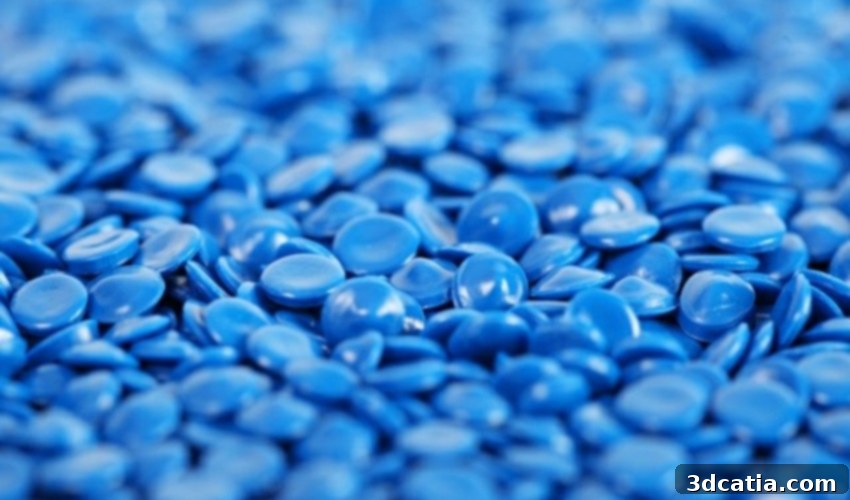
Polyethersulfone (PESU): A High-Performance Polymer Revolutionizing Additive Manufacturing
Polyethersulfone, commonly abbreviated as PESU, is a remarkable member of the sulfone polymer family. Esteemed as a high-performance material, PESU boasts a unique thermal profile that sets it apart in the diverse landscape of thermoplastics. This amorphous polymer is exceptionally heat-resistant and exhibits a compelling array of properties, making it invaluable across numerous industries. Despite its significant potential, PESU remains somewhat underexplored within the burgeoning field of additive manufacturing (AM).
PESU is available in various forms to suit different manufacturing processes, including filaments for extrusion-based 3D printing, powders for selective laser sintering (SLS), and injection-grade granules. The latter, injection-grade granules, are particularly noteworthy due to their often superior material purity. This enhanced purity enables the production of highly functional parts through additive manufacturing, replicating the rigorous standards and certifications typically associated with injection-molded components. This capability is pivotal for manufacturers seeking to leverage the benefits of high-performance materials in their AM workflows without compromising on quality or performance.
A key innovator in this domain is the French company Pollen AM, which has pioneered the use of PESU pellets for additive manufacturing. Their extensive research and development efforts have yielded profound insights into the material’s intricate characteristics, pushing the boundaries of what’s possible with PESU in advanced manufacturing. But what exactly are these distinguishing characteristics, and why is Polyethersulfone becoming such an attractive and increasingly vital material for the additive manufacturing industry?
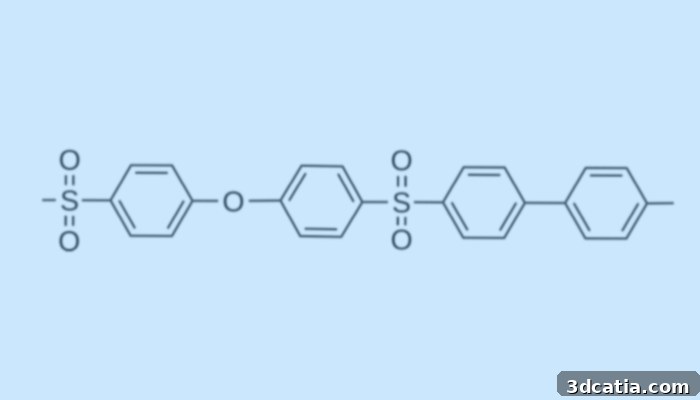
Chemical structure of polyethersulfone (PESU).
Understanding Polyethersulfone: Production, Properties, and Advantages
Production and Core Characteristics of PESU
Polyethersulfone is primarily celebrated for its extraordinary thermal properties. It can endure extremely high temperatures, maintaining its structural integrity and performance up to 220°C (429°F). Furthermore, it performs exceptionally well in harsh liquid and vapor environments, resisting degradation at temperatures up to 170°C (338°F). This inherent resilience makes it a prime candidate for applications demanding robust performance under thermal stress. Beyond heat resistance, PESU also exhibits excellent fire and smoke resistant characteristics, positioning it as a material of choice for safety-critical industries such as aerospace, rail, and automotive. To illustrate its thermal endurance, the material typically begins to degrade only above 400°C (752°F), with combustion initiating between 475°C and 575°C (887°F and 1067°F). This impressive thermal stability, coupled with its resistance to flame and smoke, ensures enhanced safety and reliability in demanding operational conditions.
In addition to its unique thermal profile, PESU offers a suite of other compelling attributes. It is food-safe, making it suitable for applications in the food and beverage industry where contact with consumables is required. The material can withstand very high mechanical loads, contributing to its use in structural components where strength is paramount. Its good electrical insulation properties and excellent dielectric characteristics further extend its utility into the electronics sector, where reliable performance in electrical applications is crucial.
The production of PESU typically involves a step-growth polymerization process. In this method, specific monomers containing ether and sulfone functional groups react sequentially to form long, complex polymer chains. The primary monomers employed in PESU synthesis are 4,4′-dihydroxybiphenyl sulfone (BPS) and 4,4′-difluorodiphenyl sulfone (DFDPS). These are reacted under controlled conditions, often in the presence of a catalyst and a suitable solvent, to achieve the desired polymer structure. This polymerization yields a high molecular weight polymer characterized by a linear molecular structure, which directly contributes to its outstanding mechanical and thermal performance.
Polyethersulfone’s array of characteristics goes beyond its thermal prowess. Its exceptional thermal stability, as highlighted, makes it indispensable for high-temperature applications. Moreover, PESU boasts excellent chemical resistance, allowing it to remain stable and functional when exposed to various acids, bases, and aggressive organic solvents, even under severe chemical exposure scenarios. Its high mechanical strength and stiffness are critical for applications demanding structural integrity and significant load-bearing capabilities. Furthermore, PESU maintains remarkable dimensional stability, ensuring that parts retain their precise shape and size even when subjected to extreme temperatures and fluctuating environmental conditions, a property vital for precision engineering.
The material’s inherent flame resistance means it naturally complies with stringent fire safety standards, often without the need for additional flame-retardant additives, simplifying product design and manufacturing processes. Its excellent optical clarity allows for applications where transparency or optical performance is required, such as in sight glasses or certain medical components. To a certain extent, PESU is also biocompatible, leading to its successful deployment in specific medical and healthcare applications where it can safely interface with biological systems. Collectively, PESU’s exceptional and diverse properties underscore its value and versatility across a broad spectrum of industries, from heavy industrial to sensitive medical sectors.
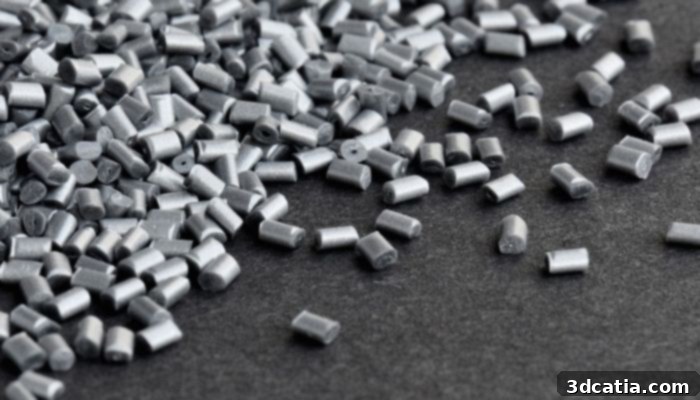
PESU’s high mechanical strength and stiffness make it suitable for applications requiring structural integrity and load-bearing capabilities (Photo credits: Gerdau Graphene)
3D Printing with PESU: Advantages and Overcoming Challenges
PESU is classified as an amorphous material, meaning it possesses a disordered molecular structure, lacking the crystalline regions found in semi-crystalline polymers. This amorphous nature offers a significant advantage in additive manufacturing. Unlike semi-crystalline materials, PESU experiences less pronounced contraction and expansion effects during temperature changes, making it comparably easier to shape and process in 3D printing. This characteristic significantly reduces the risk of warping and internal stresses, which are common challenges when printing high-temperature polymers. With a melting point typically ranging between 340°C and 390°C (644°F and 734°F), these two inherent characteristics – its amorphous structure and a manageable melting range – position PESU as an inherently ideal material for various additive manufacturing technologies.
The ability to 3D print complex geometries with PESU empowers manufacturers to innovate designs that would be difficult or impossible to achieve with traditional methods. Its inherent resistance to heat, fire, and smoke is an especially critical benefit, opening up new possibilities for functional prototyping and end-use parts in safety-conscious industries. When compared to other high-performance polymers like PEI (Polyetherimide), notably known by its brand name ULTEM, which is also widely available in filament form, PESU not only often boasts superior characteristics across several metrics but can also be a more cost-effective alternative. Furthermore, polyethersulfone exhibits significantly lower moisture uptake than many comparable polymers. This property is crucial in 3D printing, as absorbed moisture can lead to print defects, material degradation during processing, and compromised part quality. Its low moisture absorption therefore makes PESU a seriously compelling alternative worth considering for advanced additive manufacturing applications.
Despite its numerous advantages, adapting PESU for certain 3D printing processes, particularly Fused Deposition Modeling (FDM) or Fused Filament Fabrication (FFF), presents specific challenges. The high processing temperatures required for PESU necessitate advanced 3D printers equipped with high-temperature extruders and heated build chambers to maintain thermal stability during printing and prevent warping. While PESU filaments are increasingly becoming available from various material manufacturers, it’s important to note that the process of extruding raw PESU into a filament can sometimes lead to a slight degradation or alteration of its pristine characteristics. This can potentially diminish some of the appeal that the raw granular form of PESU initially offers. However, the industry is actively engaged in overcoming these obstacles, with several companies investing heavily in R&D to develop specialized filament formulations and optimized printing parameters that preserve PESU’s exceptional properties even in FDM-printed parts. Innovations in material science and printer technology are continuously expanding the viability of PESU for broader AM applications.

Household appliance manufacturer De’Longhi uses polyethersulfone (PESU) by BASF for upper piston of brewing unit in coffee machine (Photo Credit: BASF)
Diverse Applications of Polyethersulfone in Modern Industry
Thanks to its exceptional thermal, mechanical, and chemical characteristics, 3D printed PESU is finding an ever-expanding range of applications across a multitude of industries. Its unparalleled performance makes it particularly popular within the transport sector, extending beyond aerospace and rail to include critical automotive components. It is also highly valued in electronics, the medical field, and for high-performance consumer goods. Common uses include the production of lightweight and heat-resistant aircraft interior components, durable automotive parts that can withstand harsh engine environments, precision electrical connectors requiring excellent insulation, advanced filtration membranes for industrial and medical uses, and intricate medical devices where biocompatibility and sterilizability are paramount.
PESU’s versatility, combined with its high strength and superior resistance to elevated temperatures and aggressive chemicals, solidifies its status as an invaluable material in the most demanding engineering applications. For instance, its robust resistance to fluids, greases, and petrol makes it perfectly suited for manufacturing components such as probes for checking oil levels in automotive or industrial machinery, where material integrity under chemical exposure is crucial. Furthermore, PESU is increasingly being utilized in the design and production of personal protective equipment (PPE), providing enhanced durability and safety features.
Historically, PESU has often been employed as a high-performance substitute for the family of polyamides, and more specifically, polycarbonate. It offers comparable good transparency, while crucially adding advantages such as intrinsic food safety and sterilizability, features that are often essential in medical and food-contact applications where polycarbonates might fall short. It’s important to note, however, that PESU is not a flexible material; its stiffness is a key characteristic for its intended applications. Although not yet as ubiquitous as some other engineering plastics in 3D printing, a growing number of companies are now offering PESU in various forms for additive manufacturing.
Given its impressive array of qualities and the increasing demand for high-performance, lightweight, and durable components, it is highly probable that PESU will see a significant surge in adoption in the near future. This growth is especially anticipated as industries like aerospace and automotive continue their strong shift towards integrating 3D printing into the production of high-performance, end-use parts. The ability of PESU to meet stringent regulatory requirements and withstand extreme conditions makes it an ideal candidate for this manufacturing evolution.
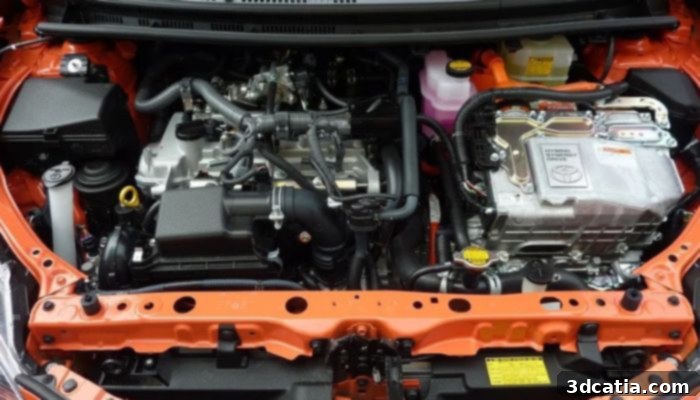
Reinforced PESU resin is becoming a popular choice for automotive components, gradually replacing traditional metal and thermoset materials. (Photo credits: SpecialChem 2023)
Key Manufacturers and Pricing for PESU
The market for Polyethersulfone is supported by several prominent manufacturers who offer a range of grades and specialized formulations tailored to diverse industrial applications. Well-established names in the production of high-quality PESU include companies like Solvay, BASF, Victrex, Ensinger, and SABIC. Additionally, innovative players such as Pollen AM are making significant strides in offering PESU for additive manufacturing, providing specific solutions for advanced 3D printing needs. These manufacturers are renowned for their expertise in engineering thermoplastics and reliably feature PESU within their extensive product portfolios, catering to various industry requirements and performance specifications.
Regarding the pricing of PESU, it is generally considered a higher-priced engineering thermoplastic. This premium cost reflects its exceptional properties, superior performance characteristics, and the complex manufacturing processes involved in its synthesis. The price of PESU can vary significantly based on several factors, including the specific grade (e.g., standard, medical, reinforced), the quantity purchased (bulk orders often receive discounts), and the individual supplier. Typically, prices can range from approximately $40 to $100 or even more per kilogram, especially for highly specialized grades or smaller quantities. For example, a medical-grade PESU with specific certifications will naturally command a higher price than a general industrial grade.
It is crucial for potential buyers to acknowledge that material pricing is dynamic and can fluctuate over time due to various market forces. These include shifts in raw material costs, changes in global supply chain dynamics, market demand trends, and geopolitical factors. For the most accurate and up-to-date pricing information, as well as details on specific grades and available forms (granules, filaments, powders), it is highly recommended to contact individual manufacturers or their authorized distributors directly. Furthermore, prudent procurement involves comparing prices and terms from multiple sources to ensure the best value and suitability for the intended application, thereby optimizing cost-effectiveness without compromising on the required performance.
Are you currently utilizing PESU in your additive manufacturing projects or exploring its potential? Share your experiences and insights in a comment below or connect with us on our Facebook and Twitter pages! Don’t forget to sign up for our free weekly Newsletter to receive all the latest news and advancements in 3D printing directly in your inbox!
*Cover photo credits: Medical Plastics News