
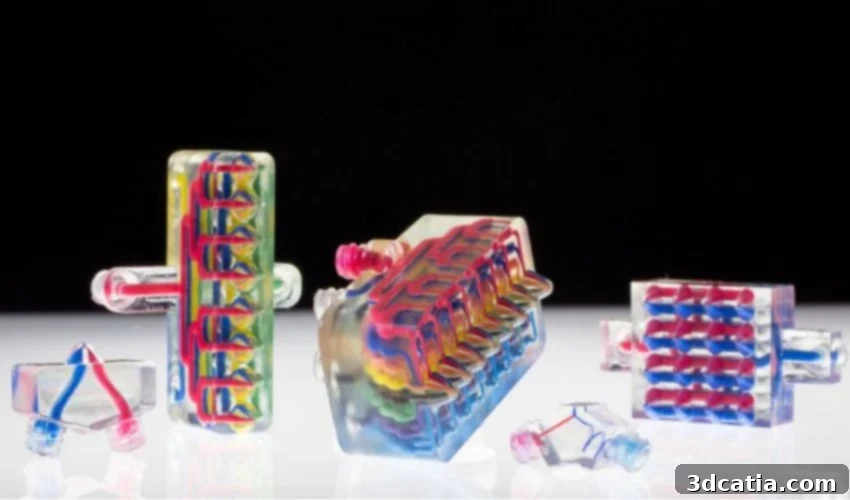
Unlocking Innovation: A Comprehensive Guide to Multi-Material 3D Printing
Multi-material 3D printing stands as a groundbreaking advancement in additive manufacturing, allowing for the simultaneous use of diverse materials within a single, continuous printing process. It’s crucial to distinguish this from multi-color printing, where a single material is processed in various hues. While multi-material prints often exhibit multiple colors, their fundamental purpose extends far beyond aesthetics; it’s about synergistically combining distinct material properties to achieve enhanced functionality. Different materials possess unique characteristics – they might be electrically conductive, exceptionally hard, remarkably soft, transparent, chemically resistant, or possess other specialized attributes. These properties make them ideal for particular applications. However, many cutting-edge designs and functional prototypes demand a fusion of these characteristics within one object to fully realize their potential. This inherent need is precisely what multi-material 3D printing addresses, opening up a realm of possibilities previously unattainable.
Indeed, the utility of multi-material 3D printing shines brightest when designers aim to integrate two or more complementary material properties into a single component. Imagine a part that needs to be partially rigid for structural integrity and partially flexible for shock absorption or articulation – multi-material printing makes this seamless integration possible. Beyond creating sophisticated end-use parts, this technology also revolutionizes the creation of support structures. It allows for printing these temporary supports in a different, often soluble or easily removable, material. This significantly streamlines the post-processing phase, saving valuable time and effort. Common examples of such specialized support materials include PVA (Polyvinyl Alcohol) and HIPS (High Impact Polystyrene), known for their dissolvability or ease of break-away. Furthermore, by enabling the production of complex, multi-component parts in a single print operation, multi-material 3D printing virtually eliminates the need for subsequent assembly of individually printed components. This not only reduces labor and potential assembly errors but also dramatically cuts down overall production time and post-processing requirements, making it a highly efficient manufacturing solution.
The efficacy of multi-material 3D printing is profoundly influenced by the specific additive manufacturing technology and hardware employed. While the field is a hotbed of continuous experimentation and rapid progress, not all 3D printing processes are inherently designed or easily adapted for simultaneous multi-material deposition. Currently, several technologies demonstrate robust multi-material capabilities. Stereolithography (SLA), for instance, can achieve this by utilizing multiple resin vats, each containing a different material. However, material jetting technology is arguably the most naturally suited for multi-material applications due to its intrinsic design. In material jetting systems, printheads are typically outfitted with an array of nozzles, each capable of precisely jetting distinct materials using an inkjet-like mechanism. This allows for fine-grain control over material placement and the creation of highly detailed multi-material components. The ability to deposit various materials in a single pass makes material jetting particularly versatile for blending properties at a microscopic level.
Among the various additive manufacturing techniques, Fused Deposition Modeling (FDM), also known as Fused Filament Fabrication (FFF), currently stands out as one of the most productive and accessible solutions for multi-material 3D printing, especially for those new to additive manufacturing. Its widespread adoption is due to several key advantages: FDM printers are generally more cost-effective, simpler to operate, and highly versatile in processing a vast array of thermoplastic polymers and composite materials. Depending on its specific configuration, an FDM printer can already be equipped to handle multiple materials. However, achieving successful multi-material prints with FDM requires careful consideration of the hardware setup. This guide will therefore delve into the various approaches and considerations for multi-material 3D printing specifically within extrusion-based processes, offering insights into optimizing your setup for diverse applications.
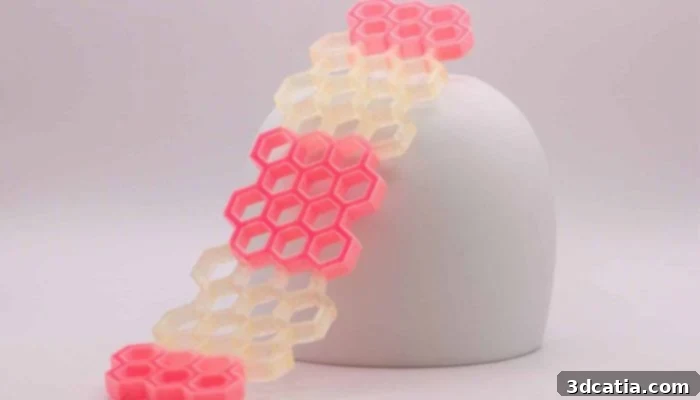
Although multi-material printing is possible with various technologies, it is most advanced with FDM processes (photo credits: Printing with Novojet technology from Quantica / Quantica)
The Multi-Material 3D Printing Process: From Design to Reality
Like any successful 3D printing endeavor, multi-material printing begins with meticulous design. Modern CAD (Computer-Aided Design) software has evolved to support this complexity, allowing users to accurately label different sections of a part with specific materials or assign distinct geometries to various material types. This foundational step is critical for defining the material distribution within the final object. Following the design phase, the next crucial stage is setting the correct slicer parameters. The slicer software acts as the intermediary, translating the 3D model into detailed instructions (G-code) that the printer can understand. For multi-material prints, the slicer must be precisely configured to inform the printer exactly when and where each material needs to be extruded. In some advanced scenarios, specific material change instructions might even need to be manually integrated into the G-code for optimal control. The exact settings and workflows, however, vary significantly depending on the printer’s hardware configuration – whether it uses a single nozzle, multiple nozzles, or a specialized add-on system, each approach presents its own set of considerations. Let’s explore these different possibilities in detail!
Single Printhead Solutions for Multi-Material Printing
Surprisingly, multi-material 3D printing is achievable even with a standard FDM printer equipped with a single printhead. However, if the printer features only one extruder with a single hotend and nozzle, the process necessitates manual material changes. This involves pausing the print job each time a new material is required. These pauses can be pre-programmed into the G-code, either automatically by the slicer or manually inserted by the user. While some slicers simplify this step, others might require a more intricate setup. Generally, printing with multiple materials on a single-nozzle standard printer can be very time-consuming and labor-intensive, particularly for parts requiring frequent material swaps. The complexity escalates dramatically if multiple materials are needed within the same layer, rather than alternating materials layer by layer, as this demands more precise and frequent manual intervention.
Beyond purely manual filament swapping, there are more automated single-printhead solutions designed to facilitate multi-material (and multi-color) printing. One such example is a mixing hotend system. While primarily utilized for blending colors of a single material, it can also be adapted for multiple materials. The main caveat here is that the printing temperatures of the different materials must be very close, ideally identical, to prevent printing errors like clogging, poor adhesion, or material degradation. Achieving optimal results often requires a narrow thermal window for all combined filaments. Another approach, particularly common with Bowden extruder systems, involves using a classic Y-splitter. This simple mechanical device allows two different materials to feed into a single hotend alternately. The Bowden system keeps both filaments “ready” to be pushed through the Y-splitter and into the nozzle. This method, frequently used for two-color printing, can be extended with dual Y-splitters or more complex feeding systems to accommodate multiple extruders and materials.
For those looking to upgrade their existing FDM printer, several innovative add-ons have emerged to enable multi-material capabilities without needing a new machine. Prusa Research, a leader in desktop FDM, has pioneered such solutions with its Multi-Material Upgrade (MMU) kits, including the MMU1, MMU2, and the latest MM3 iterations. These add-ons attach to a single-material Prusa printer, utilizing a splitter-based Bowden extrusion system to feed up to five different filaments into a single hotend. The MMU system automates the filament loading and unloading process, dramatically reducing the manual effort required and enhancing the variety of materials that can be used in a single print. This system is celebrated for its ability to produce complex, multi-material parts with relative ease and reliability.

Prusa3D offers the possibility to print multiple materials with its Multi Material Upgrades (MMU) (photo credits: PrusaDd)
Another remarkable add-on is the Mosaic Palette, a device compatible with a wide range of FDM printers. The Mosaic Palette operates by precisely cutting and splicing different filament strands together, creating a single, continuous, multi-material or multi-color filament. This “fusion” allows the printer to operate without pauses or material changes, as it believes it’s printing with a single, composite filament. This innovative approach effectively bypasses the limitations of single hotends for multi-material printing, enabling complex designs with minimal print disruption. Furthermore, some printer manufacturers now integrate advanced multi-material systems directly into their machines. For example, Bambu Lab’s AMS (Automated Material System) exemplifies this trend. The AMS is a sophisticated unit that manages multiple spools of filament, automatically swapping them as needed. This system frees users from the constraints of single-filament printing, facilitating the creation of highly versatile, aesthetically pleasing, and functionally advanced prints with multiple colors and materials. While these systems offer significant advantages, it’s worth noting that increasing the number of hotends within a single print head does add weight, which can potentially affect printing speed and introduce issues like ringing or ghosting at higher velocities.
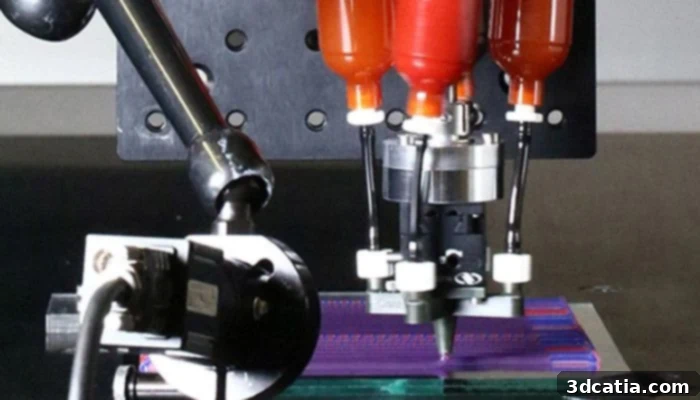
This print head has four filament feeders (photo credits: Harvard John A. Paulson School of Engineering and Applied Sciences)
Multiple Printhead Systems for Enhanced Versatility
Extending the multi-nozzle concept to encompass multiple, independent printheads significantly elevates the potential for material diversity and print quality. This configuration often yields superior results because different materials do not share a single heating block or hotend, thus minimizing issues like material mixing, cross-contamination, and clogging that can occur in single-hotend multi-material setups. A prime example of this advanced approach is IDEX printers (Independent Dual Extruder). These machines feature two distinct printheads, each with its own hotend, capable of moving independently along the X-axis. The separate movement paths of the respective filaments ensure that materials do not interact until they are deposited on the print bed. This separation virtually eliminates common multi-material 3D printing errors such as nozzle clogging or material ooze from an idle nozzle. While highly effective, an IDEX printer typically processes only two materials simultaneously. These are most commonly a primary build material and a dedicated support material, making IDEX ideal for complex geometries requiring extensive, easily removable supports.
Pushing the boundaries of multi-extrusion further are tool changer systems. These sophisticated machines are equipped with a mechanism that can automatically swap printheads during operation. The versatility of tool changers extends beyond just different printheads for various materials; they can also integrate other tools such as cutters, mills, or drills, enabling hybrid manufacturing processes where additive and subtractive techniques are combined. In the context of 3D printing, tool changers allow for an even greater variety of materials to be used in a single print than IDEX systems. By having a carousel of printheads, each configured for a specific material, the printer can select the appropriate tool as needed, similar to how a robotic arm might pick up different tools. This significantly expands the range of material combinations and part complexity achievable, making tool changers ideal for highly demanding industrial and research applications where maximum material flexibility and precision are paramount.
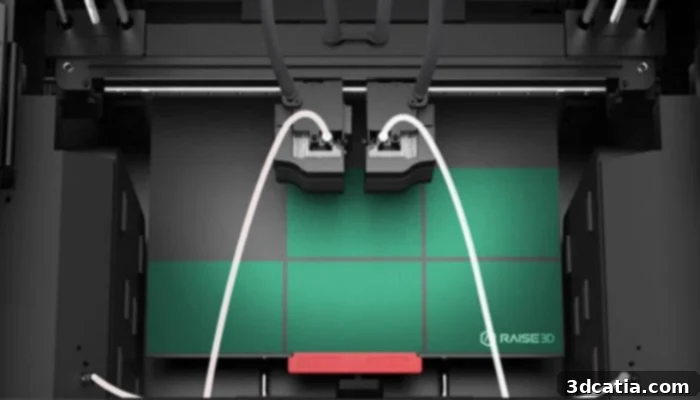
IDEX printers are equipped with two independent extruders and can therefore process two filament types in one print (photo credits: Raise3D)
Applications, Benefits, and Key Limitations of Multi-Material 3D Printing
The primary goal of multi-material 3D printing is to imbue a single end-part with a diverse range of properties. These properties can span aesthetic qualities, such as combining glossy and matte finishes or embedding unique filling materials, to critical functional attributes. For instance, a multi-material print can be engineered to simultaneously exhibit exceptional hardness, high heat resistance, and specific zones of flexibility by strategically integrating materials with these individual characteristics. The ability to tailor surface textures and material transitions directly impacts both the tactile feel and the post-processing requirements. By producing multi-component objects in one continuous process, the tedious and time-consuming step of assembling individual, separately printed parts is often completely eliminated, marking a significant benefit in production efficiency and part integrity.
The diverse and combined material properties unlocked by this technology open up an expansive array of application possibilities across numerous sectors. In the medical field, multi-material 3D printing is increasingly employed for creating customized prosthetics, often combining soft, biocompatible materials like TPU with rigid, high-strength composites such as carbon fiber. This allows for prostheses that are both comfortable for the wearer and durable enough for daily use. In robotics, particularly in the emerging field of soft robotics, multi-material printing is invaluable for manufacturing grippers and actuators that require flexible, compliant sections alongside hard, structural components. Similarly, it’s vital for microfluidic chips, where different materials are needed for channels, membranes, and structural integrity within a minuscule footprint. However, achieving success in multi-material 3D printing is not without its challenges; careful planning and execution are essential to guarantee the desired outcomes.
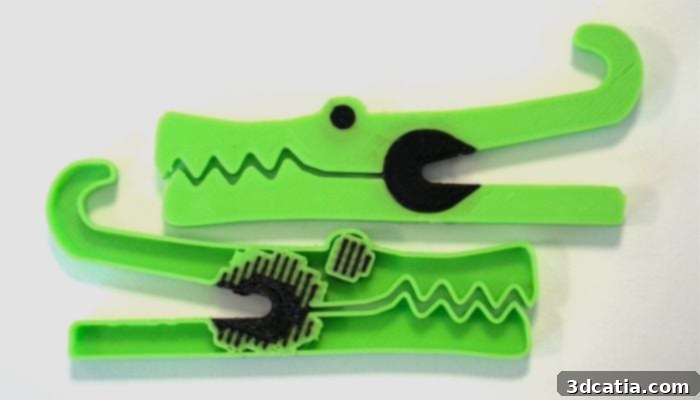
Multi-material prints are used in many areas when different properties are required in a workpiece, for example hard and soft (photo credits: UltiMaker)
When designing for multi-material prints, a critical consideration is how the different materials will interface. Should they seamlessly overlap, create a distinct boundary, or interlock in a “zipper” fashion? It’s paramount to establish both a form-fit (geometrical compatibility) and, more importantly, a “fabric-fit” (material compatibility) between the chosen filaments. Not all materials bond well together due to their inherent chemical and physical differences. A significant challenge arises if the processing temperatures of the chosen materials are too disparate, making simultaneous extrusion problematic. Even when materials are chemically similar, the principle of “like adheres better to like” often applies. To artificially enhance adhesion between less compatible materials, engineers sometimes employ interface layers – thin layers of an intermediate material designed to bond effectively with both adjacent materials, creating a stronger overall structure.
Beyond compatibility, the unique properties of each material also dictate specific printing parameters. Combining two or more materials requires careful calibration of numerous settings, including nozzle temperature, print bed temperature, print speed, and retraction settings, for each individual filament. This complexity is often the source of the highest error rates in multi-material printing. For example, if operating a single extruder with a single hotend from which all materials are extruded, meticulous attention is required to prevent residual material from contaminating the next, or worse, causing a backlog and potential nozzle clog. This issue is exacerbated when working with unusual or abrasive materials like wood or metal composites. Conversely, in systems with multiple extruders or nozzles, a different problem can arise: oozing. This phenomenon occurs when an idle nozzle, heated but not actively extruding, slowly drips molten material onto the print, leading to imperfections and material waste. Overcoming these challenges necessitates a deep understanding of material science and extensive experimentation with printer settings to achieve reliable and high-quality multi-material prints.
Leading Manufacturers in Multi-Material 3D Printing
The market for multi-material 3D printers has expanded significantly, offering a wide array of solutions ranging from affordable desktop models to robust industrial systems, alongside various add-ons and upgrade kits discussed previously. One of the earliest pioneers in multi-material printing was the Fab@Home, first introduced in 2006, demonstrating the nascent potential of the technology. Today, at the prosumer and hobbyist level, companies like Prusa Research, Bambu Lab, and Flashforge are leading the charge with innovative solutions that make multi-material printing more accessible. Notable models include the Flashforge Creator 4, known for its robust performance, the Prusa XL, which boasts the capability to print with up to five different materials simultaneously, and the E2 from Raise3D, a popular IDEX system. These machines provide users with flexibility and reliability for diverse applications.
In the realm of industrial multi-material solutions, manufacturers like Modix offer large-format printers such as the Modix Big-120Z, designed for substantial multi-material parts. OMNI3D provides industrial-grade systems like the Factory 2.0 and Factory 2.0 NET, known for their reliability and large build volumes. WASP also contributes to the industrial segment with machines like the Delta WASP 2040 Industrial X, which leverages delta kinematics for speed and precision. AIM3D takes an innovative approach to industrial multi-material 3D printing by combining both pellets and filaments in its printing systems, offering greater material flexibility and cost efficiency for production environments. Regardless of the specific solution chosen – be it a desktop printer with an upgrade, a dedicated IDEX system, or an industrial powerhouse – a thorough understanding and careful consideration of material properties and precise printer settings remain absolutely critical for achieving successful and high-quality multi-material 3D prints.
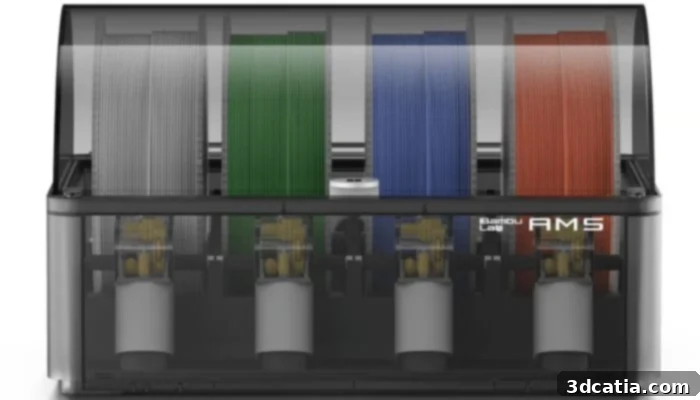
Bambu Lab’s AMS allows different filaments to be processed for multi-color or multi-material printing (photo credits: Bambu Lab)
Do you currently utilize multi-material 3D printing in your projects? We’d love to hear about your experiences! Share your thoughts and insights in a comment below or connect with us on our LinkedIn, Facebook, and Twitter pages! For the latest updates and breaking news in the world of additive manufacturing, don’t forget to sign up for our free weekly newsletter here. You can also explore our extensive library of videos and tutorials on our YouTube channel for more in-depth content.
*Cover Photo Credits: Harvard University