
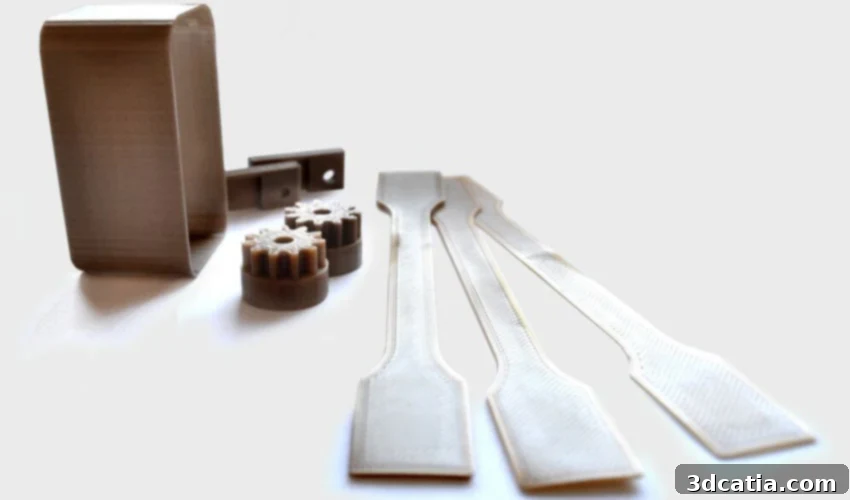
PEEK 3D Printing: Exploring the High-Performance Polymer for Advanced Additive Manufacturing
Polyether ether ketone, universally recognized as PEEK, stands out as a semi-crystalline thermoplastic revered throughout the manufacturing industry for its exceptional mechanical properties. In recent years, PEEK has rapidly gained prominence within the additive manufacturing sector, transitioning from a niche material to a sought-after solution for demanding applications. Its availability has expanded significantly, now offered in filament form compatible with most FDM/FFF 3D printers, and increasingly as a powder for advanced SLS processes. This high-performance polymer finds critical applications in industries such as aerospace, medical, and automotive, primarily due to its remarkable resistance to heat and wear. Its impressive strength-to-weight ratio often positions it as a viable substitute for certain metals, pushing the boundaries of what’s possible with polymers. However, embracing PEEK for 3D printing comes with its own set of challenges; it is a technically demanding material, requiring precise control over numerous printing parameters to achieve successful, high-quality results. This comprehensive guide delves into everything you need to know about harnessing the power of PEEK for your 3D printing endeavors, exploring its unique characteristics, printing intricacies, and transformative applications.
The Genesis and Intrinsic Characteristics of PEEK
PEEK is a distinguished member of the PAEK (polyaryletherketone) family, a class of polymers renowned for their superior thermomechanical properties. Within the vast hierarchy of industrial polymers, PEEK occupies a coveted position at the apex, categorized among the elite group of high-performance polymers. Its distinctive molecular structure is characterized by the precise arrangement of a ketone group and two ether groups, which are organic compounds belonging to the carbonyl family, featuring a double bond between a carbon and an oxygen atom. This unique chemical architecture imparts PEEK with its extraordinary resilience and stability. First introduced to the market in the late 1970s, PEEK was swiftly embraced by high-stakes sectors such as aeronautics and electronics, where its unparalleled performance capabilities provided significant advantages. Fundamentally, PEEK is a semi-crystalline polymer. This means that upon melting, its molecular chains align themselves in an orderly fashion under the influence of heat, maintaining this structured arrangement as the material solidifies. This inherent semi-crystalline nature is pivotal to its ability to retain robust mechanical characteristics even under elevated temperatures, distinguishing it from amorphous polymers. While this structure is the source of many of its desirable attributes, it also presents complexities in additive manufacturing. Successful 3D printing with PEEK necessitates a highly technical approach, demanding both experienced operators and specialized equipment to manage its challenging processing requirements effectively.
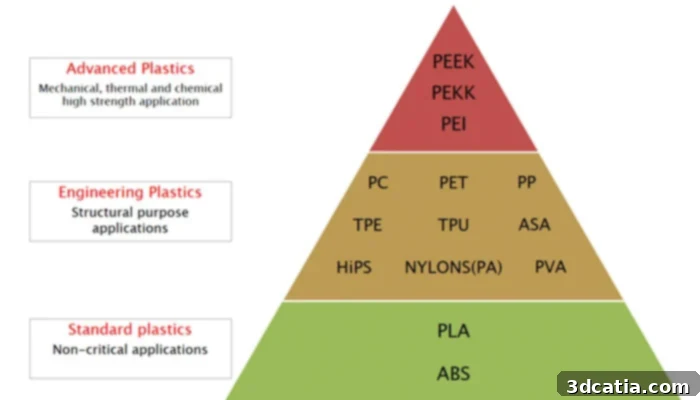
Mastering 3D Printing with PEEK: Process and Properties
The successful 3D printing of PEEK hinges critically on the precise control of its crystallization process. During printing, a portion of the material will undergo crystallization, leading to changes in its density and internal stress. Consequently, consistent and elevated temperatures across the entire printing environment – including the extrusion nozzle, the build plate, and the print chamber – are absolutely essential, with any significant temperature fluctuations needing to be meticulously avoided. To effectively 3D print PEEK, you will require a specialized 3D printer equipped with an extruder capable of reaching temperatures up to 400°C. The build chamber must be able to maintain a consistent temperature of around 120°C, and the build plate should be heated to approximately 230°C. These specific temperature ranges are crucial not only for achieving optimal layer adhesion and mitigating internal stresses but also for ensuring proper part release upon completion and preventing common issues like warping, which is a significant challenge with semi-crystalline polymers. As the material cools after extrusion, it undergoes a chemical reaction that results in a change in density and subsequent contraction, a phenomenon that must be carefully managed to maintain dimensional accuracy and structural integrity.
Despite its demanding nature, the material properties PEEK offers are exceptionally compelling across a diverse array of industries. It exhibits outstanding resistance to high temperatures and mechanical wear, coupled with excellent chemical resistance, making it suitable for harsh environments. PEEK is also inherently sterilizable, a critical attribute for medical applications, and possesses valuable dielectric properties for electronic components. Its superior strength-to-weight ratio frequently allows it to replace heavier, traditional metal components, leading to significant weight savings without compromising performance. Furthermore, PEEK is inherently flame resistant, a feature that makes it an ideal material for sectors like aerospace, where stringent fire, smoke, and toxicity (FST) regulations are paramount. When benchmarked against other high-performance thermoplastics, such as ULTEM (PEI), PEEK consistently demonstrates superior mechanical strength, solidifying its position as a top-tier engineering polymer for advanced additive manufacturing applications. Its ability to perform reliably in extreme conditions – from high-stress mechanical loads to aggressive chemical exposures and wide temperature fluctuations – underscores its value in developing cutting-edge solutions through 3D printing.
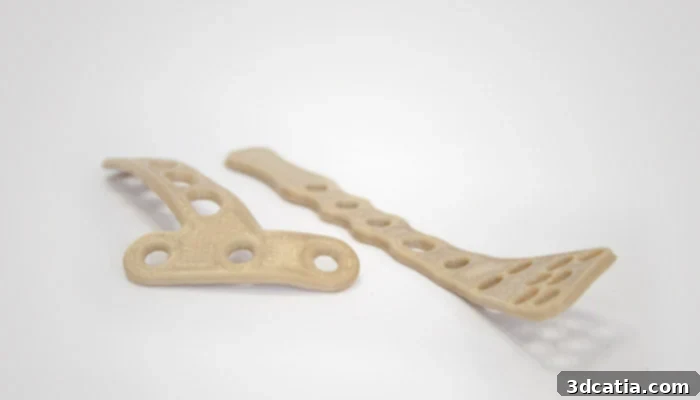
Photo Credits: Apium
Transformative Applications of PEEK in Modern Industries
The unique attributes of PEEK make it particularly advantageous for the medical sector. Its sterilizability, coupled with its proven biocompatibility, enables its use in a broad spectrum of critical medical applications, including the custom manufacturing of patient-specific implants. PEEK exhibits mechanical properties remarkably similar to human bone, which is a significant advantage. This similarity means that a 3D printed PEEK implant can potentially promote the reconstruction of surrounding tissues, thereby accelerating osseointegration and reducing issues such as stress shielding that can occur with stiffer metallic implants. Consequently, numerous pioneering companies, such as FossiLabs, have successfully leveraged 3D printing with PEEK to design and produce highly customized medical devices, ranging from spinal cages and cranial plates to dental prosthetics and specialized surgical instruments. The ability to create complex geometries tailored to individual patient anatomy, combined with PEEK’s inherent biological compatibility, is revolutionizing personalized healthcare.
Beyond medicine, the aerospace and automotive industries also stand as major beneficiaries of PEEK 3D printing. Additive manufacturing inherently allows for the creation of high-performance, lightweight, and custom parts on demand, and when coupled with a material as capable as PEEK, its appeal becomes even greater. In these sectors, PEEK offers superior wear resistance, exceptional temperature stability, and impressive chemical inertness, all while significantly optimizing part weight – a critical factor for enhancing fuel efficiency in aerospace and extending range for electric vehicles in automotive. PEEK’s capabilities are so profound that components manufactured from this polymer have already been deployed in space missions, serving as irrefutable evidence of its capacity to meet the stringent demands of the most extreme operating environments. From intricate brackets and ducts to high-temperature connectors and structural elements, PEEK is enabling new designs and functionalities that were previously unattainable with traditional manufacturing methods.
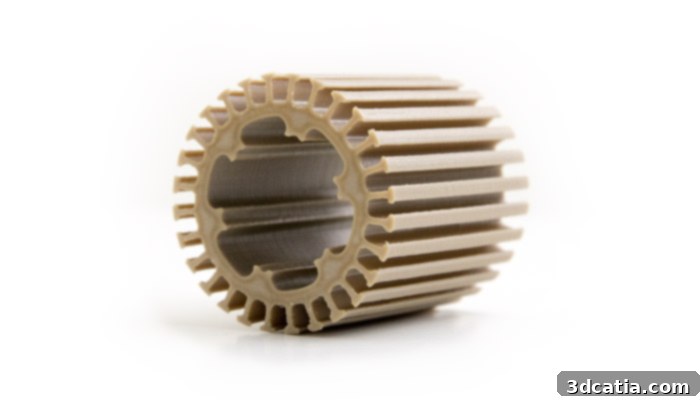
Photo Credits: Apium
Key Manufacturers, Market Availability, and Pricing Insights
Presently, the market for PEEK in 3D printing is predominantly dominated by filament form, making it widely accessible for FFF (Fused Filament Fabrication) 3D printers. For applications requiring enhanced stiffness and strength, carbon fiber-filled PEEK filaments are also readily available. Leading chemical companies such as Victrex, Solvay, and Evonik are the primary producers of the base PEEK polymer resin, which is then processed into various forms suitable for additive manufacturing. In the filament segment, many specialized 3D printer manufacturers, including Intamsys, Apium, and Roboze, produce their own high-quality PEEK filaments tailored for their systems. Additionally, independent material suppliers like the Spanish company Innovatefil, a subsidiary of Smart Materials 3D, also offer a range of PEEK filaments. When considering the investment, PEEK is undeniably a premium and consequently very expensive material, reflecting its advanced properties and complex manufacturing. Prices typically range between €350 and €700 for a single kilogram of PEEK filament. For context, PEKK (polyetherketoneketone), another high-performance thermoplastic with similar characteristics but often easier processability due to a lower crystallization rate, usually costs between €400 and €500 per kilogram. This price difference highlights PEEK’s position at the very high end of the polymer spectrum.
While FFF remains the most common route, the demand for PEEK in powder form for Selective Laser Sintering (SLS) is steadily growing due to its ability to create complex geometries with superior isotropic properties. Historically, EOS was among the first – and for a time, the sole – manufacturer to offer PEEK HP3, a dedicated material for powder bed fusion systems. However, the landscape is evolving, with companies like the Belgian firm Aerosint actively developing innovative SLS machines capable of multi-material printing. PEEK is anticipated to be a crucial material in such advanced systems, further expanding its application potential in additive manufacturing. The continued development in both material science and 3D printing hardware suggests that while PEEK remains an expensive and technically challenging material, its indispensable role in producing high-performance components will only grow, driving further innovation and potentially broader accessibility in the future.
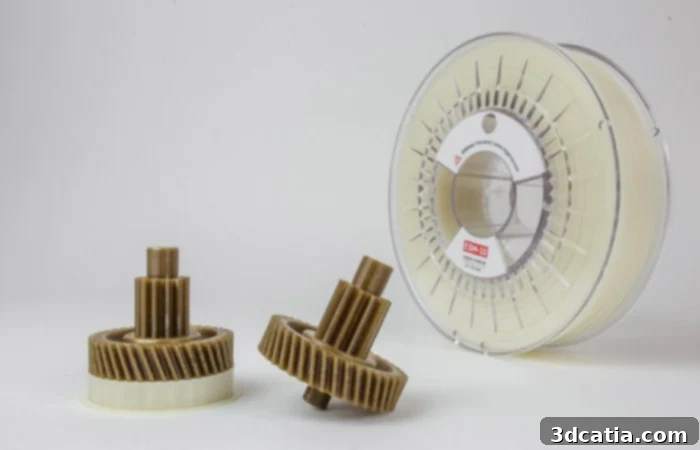
It is most widely available in filament form (photo credits: 3DGence)
*Cover Image Credits: Indmatec
PEEK’s journey in additive manufacturing signifies a paradigm shift towards highly functional, performance-driven parts. Its unique blend of strength, thermal stability, chemical resistance, and biocompatibility positions it as an unparalleled material for pushing the boundaries of engineering across critical industries. While the challenges of processing PEEK via 3D printing are notable, the rewards in terms of component performance and design freedom are immense. As technology advances and material development continues, PEEK is set to play an even more pivotal role in the future of advanced manufacturing, enabling innovations that were once considered impossible. Do you have any further questions about PEEK or its applications in 3D printing? Let us know in a comment below or connect with us on our Facebook and Twitter pages! Don’t forget to sign up for our free weekly Newsletter, to receive all the latest news and insights in the world of 3D printing directly to your inbox!