
Mastering 3D Print Quality: The Essential Guide to Filament Drying and Storage
3D printing, a cornerstone of modern manufacturing and innovation, offers an unparalleled array of opportunities for companies and hobbyists alike to revolutionize production routines and enhance efficiency. From rapid prototyping to customized end-use parts, the versatility of additive manufacturing is truly transformative. However, unlocking its full potential often hinges on meticulously managing the nuances of the printing process. Despite its diverse benefits, the technology is not without its share of challenges. Many ambitious 3D printing projects encounter setbacks due to common printing errors like warping, where parts lift from the build plate, or ghosting, visible echoes of print features. These phenomena significantly affect the quality, dimensional accuracy, and sometimes even the mechanical properties of the 3D printed part. While several factors can contribute to these issues, one frequently overlooked culprit is often the simplest: 3D printing filament not being properly dry.
Filament, the lifeblood of FDM/FFF 3D printers, is inherently susceptible to environmental conditions, particularly moisture. During storage, even for a short period, many types of filament can readily absorb moisture from the surrounding atmosphere. If this absorbed moisture remains trapped within the material when it’s fed into the printer, it will inevitably lead to a cascade of printing problems. This issue is particularly pronounced with highly hygroscopic materials such as PA (Nylon), TPU (Thermoplastic Polyurethane), PVA (Polyvinyl Alcohol), PMMU (Polymethyl Methacrylate Urethane), or BVOH (Butenediol Vinyl Alcohol Copolymer) – materials commonly used for support structures due to their water solubility. However, even more common filaments like PLA, PETG, and ABS are vulnerable to moisture absorption, albeit at different rates. Understanding how to detect, prevent, and rectify moisture-related issues is paramount for any 3D printing enthusiast or professional. In this comprehensive guide, we will delve into the science behind filament hygroscopy, explain how to identify tell-tale signs of wet filament, and provide detailed, actionable strategies to effectively dry your filament and implement robust storage practices to mitigate these common printing errors, ensuring consistent, high-quality results.

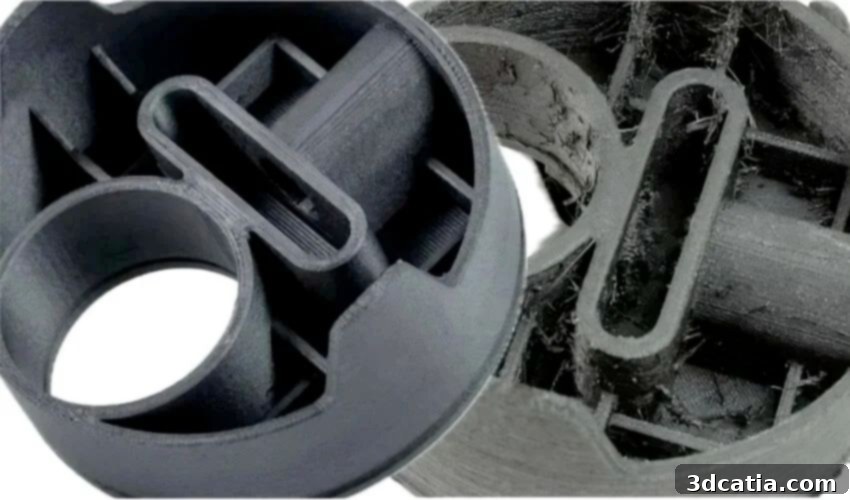
Moisture trapped in the filament (image credits: BCN3D)
Why Is Drying 3D Printing Filament So Crucial for Print Quality?
The presence of moisture in 3D printing filament is not merely an inconvenience; it’s a fundamental threat to the integrity and aesthetics of your prints. When wet filament enters the heated nozzle of a 3D printer, the absorbed water rapidly turns into steam. This sudden expansion creates bubbles within the molten plastic, leading to a host of observable and structural defects. In most instances, you can detect moisture in your 3D printing filament by certain characteristics, though often these only become apparent during the printing process itself. While rare, the most obvious sign is the formation of actual water beads on the surface of your filament, usually indicating extreme saturation. More commonly, however, a wet spool might look and feel just like an intact, dry filament, making detection challenging before printing commences.
During printing, the signs become unmistakable. If your nozzle starts hissing, crackling, or popping, or if white smoke (which is actually steam) emanates from the extrusion point, these are definitive indicators that your filament is saturated. Furthermore, if you observe a rough, inconsistent surface finish on your printed parts, or if bubbles appear under the heat of extrusion, it’s a clear signal that drying is necessary. These microscopic steam explosions within the nozzle lead to various macroscopic print defects, including severe under-extrusion (where insufficient material is laid down), stringing (fine threads of plastic appearing between features), blobbing, inconsistent line widths, and significant surface defects that compromise the visual appeal of your object. Beyond aesthetics, moisture degrades the material itself, leading to poor adhesion between layers, which results in delamination and, overall, weaker, more brittle, and fragile objects that lack the desired mechanical properties. In extreme cases, repeated steam build-up can even lead to extruder clogging, causing print failures and potential damage to your printer. This hydrolysis, or chemical breakdown due to water, irreversibly damages the polymer chains, weakening the final product even after drying. Therefore, proactive filament drying is not just about avoiding errors; it’s about preserving material quality and ensuring successful, durable prints.
Effective Measures to Take: How to Dry Your 3D Printing Filament
Once you have identified moisture trapped in your filament as the root cause of your printing errors, it’s time to take action. Thankfully, there are several effective methods for drying filament, ranging from household appliances to specialized equipment. The key across all methods is consistent, low-heat exposure to allow the moisture to evaporate without melting or degrading the plastic.
1. Using Your Domestic Oven
One of the most accessible options for drying filament is your standard domestic oven. This method involves placing the filament spool in your oven, preheated at a very low and stable temperature for several hours. For general guidance, we recommend a temperature range of 40-45 degrees Celsius (105-115°F) for PLA, and higher temperatures around 80-90 degrees Celsius (175-195°F) for more resilient materials like ABS and nylon. PETG typically falls somewhere in between, around 60-70 degrees Celsius (140-160°F). However, extreme caution must be exercised. Ovens can have significant temperature fluctuations, and using a temperature that is too high, even for a short period, will damage your material by causing it to soften, warp, or even fuse together, rendering the entire spool unusable. It’s advisable to use an external oven thermometer to verify the actual temperature inside and to leave the oven door slightly ajar to allow moisture to escape and prevent temperature spikes. This method is cost-effective but requires vigilance.
2. Employing a Food Dehydrator
A superior alternative to a domestic oven for filament drying is a food dehydrator. These devices are specifically designed to preserve food by drying it with a constant, low flow of heated air, making them ideal for filament. The primary advantage of a food dehydrator over a conventional oven is its ability to maintain a much more stable and consistent temperature. Many models offer precise temperature controls, allowing you to set the exact temperature required for different filament types without the risk of overheating. The continuous airflow also helps to more efficiently carry away the evaporated moisture. When selecting a food dehydrator, ensure it’s large enough to comfortably accommodate your filament spools without them touching the heating element or the sides. Always verify the maximum temperature your filament’s spool can withstand to prevent deformation of the plastic spool itself during the drying process. This method offers a balance of affordability and effectiveness.
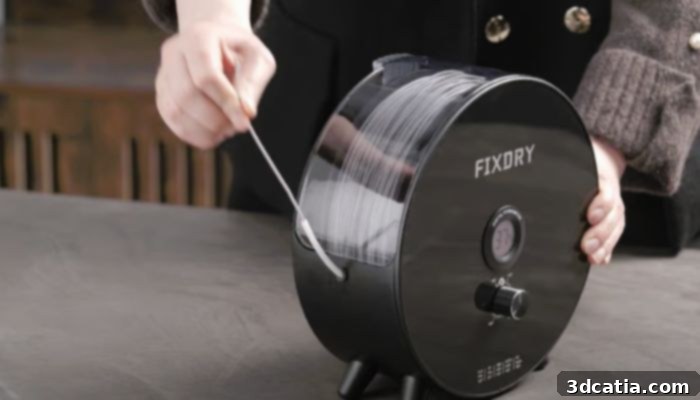
A dedicated filament-drying machine (image credits: Fix Dry)
3. Investing in a Dedicated Filament Dryer
For professional users or serious hobbyists seeking the most efficient and reliable solution, a dedicated filament dryer is the ultimate choice. These specialized units are engineered to break the intermolecular bonds between water and polymer at precisely controlled drying temperatures, optimizing moisture removal. Many advanced models are equipped with active sorption units or desiccant chambers that absorb the filament’s moisture, allowing for particularly quick and efficient drying. The device circulates heated air, bringing the moisture outside of the filament into the ambient air, or captures it internally. Various models are available on the market, such as those from BCN3D, PrintDry, or Fix Dry, offering features like active heating elements, integrated fans, humidity sensors, and even built-in storage. All you have to do is select the desired parameters for your specific filament type, and the unit automatically begins the drying process, which typically lasts a few hours, depending on the material and saturation level. While these units represent a higher initial investment, their precision, effectiveness, and convenience often justify the cost, especially when dealing with moisture-sensitive or expensive engineering-grade filaments. It’s important to note that for some highly hygroscopic filaments like nylon, particularly if they’ve been severely saturated for extended periods, moisture might no longer be completely removable due to irreversible hydrolysis. As a result, the filament might become very brittle even after drying, indicating that the material’s polymer chains have been compromised.
Understanding Filament Hygroscopy and the Impact of Moisture
To truly master filament care, it’s essential to understand the science behind why moisture is such a problem. Hygroscopy is the property of a substance to attract and hold water molecules from the surrounding environment. Most plastics used in 3D printing, especially thermoplastics like PLA, PETG, ABS, Nylon, and TPU, are inherently hygroscopic to varying degrees. Materials like Nylon (PA) and PVA are extremely hygroscopic, absorbing moisture rapidly, sometimes within hours of exposure to humid air. PETG and TPU are also quite susceptible, while PLA and ABS absorb moisture at a slower rate but are still vulnerable. When these plastics absorb water, the water molecules integrate into the polymer matrix. During extrusion, the high temperature in the hotend vaporizes this trapped water into steam. This steam causes localized pressure build-up and forms bubbles that burst as the plastic exits the nozzle. This phenomenon leads to the audible popping and hissing sounds and visibly affects the quality of the extruded plastic. More critically, the interaction of water at high temperatures with certain polymers can lead to hydrolysis, a chemical reaction that breaks down the long polymer chains into shorter ones. This irreversible degradation significantly reduces the material’s mechanical properties, leading to weaker, more brittle prints with reduced impact strength and layer adhesion, even if the material is subsequently dried. Therefore, proactive drying and proper storage are not just about aesthetics but about maintaining the structural integrity and performance of your 3D printed objects.
How to Keep Your Filament Dry: Proactive Storage Solutions
While drying wet filament is a necessary corrective measure, the best approach is always prevention. Implementing proper storage techniques will help you avoid the hassle of drying altogether and consistently guarantee better printing results. The fundamental principle is to store filament in an environment that is both dry and protected from other environmental factors.
1. Airtight Containers with Desiccants
The most common and effective method for preventing moisture absorption is to store your filament in suitable airtight storage boxes or containers. These containers create a sealed environment that prevents humid air from reaching the filament. To enhance their effectiveness, always include a desiccant inside the container. Desiccants are materials that absorb moisture from the air, effectively creating a dry microclimate within the sealed container. Silica gel packets, often found in new product packaging, are a popular choice. For better performance, consider indicator silica gel that changes color when saturated, or molecular sieves, which are even more effective at absorbing moisture. Remember to “recharge” or dry your desiccants periodically (usually by baking them in a low oven) to restore their absorption capacity.
2. Vacuum Sealing Bags
For long-term storage or when space is at a premium, vacuum sealing bags are an excellent option. These bags remove the air, and thus the moisture, from around the filament spool, creating a truly dry environment. When combined with a desiccant packet inside the bag, they offer superior protection against humidity. This method is particularly useful for storing highly hygroscopic filaments like Nylon or PVA that are not in active use.
3. Integrated Storage Solutions and Dry Boxes
Some advanced 3D printers or printing setups are equipped with integrated filament storage units or dedicated dry boxes that feed the machine directly. These often feature active heating elements, desiccant chambers, or humidity sensors to maintain an optimal low-humidity environment for the filament even while printing. Such systems are incredibly handy as they eliminate the need to handle spools in and out of storage, reducing exposure to ambient air. For those without integrated solutions, DIY dry boxes can be constructed using airtight containers, desiccants, and even simple hygrometers to monitor humidity levels. Keeping the filament within a controlled environment, such as an enclosure that also controls temperature and humidity, further enhances print quality and reliability.
Beyond moisture, filament should generally be stored away from direct sunlight and UV rays, as prolonged exposure can degrade the plastic over time, making it brittle or altering its color. Whichever solution you choose, prioritizing proper storage is a non-negotiable step for any 3D printing enthusiast. It will prevent the need for frequent filament drying, guarantee more consistent and higher-quality results, and ultimately save you time and material by minimizing failed prints and material degradation. By understanding the challenges posed by moisture and adopting these proactive measures, you’ll ensure your filament remains in optimal condition, ready to produce exceptional 3D prints every time.
Best Practices and Pro Tips for Filament Management
To further enhance your filament care routine and ensure peak performance, consider these additional best practices:
- Monitor Ambient Humidity: Invest in a simple hygrometer for your printing area. Understanding your local humidity levels will help you assess how quickly your filament might absorb moisture and adjust your storage strategies accordingly.
- Pre-Dry New Spools: Even brand-new filament spools can sometimes arrive with a certain level of moisture, especially if they’ve been stored in less-than-ideal conditions by the manufacturer or during shipping. For critical prints or highly sensitive materials, a pre-drying session for a few hours is a wise precaution.
- Drying Duration: The time required for drying depends on the filament type, its level of saturation, and the drying method. While a few hours might suffice for lightly damp PLA, heavily saturated Nylon could require 6-12 hours or even more in a dedicated dryer. Patience is key.
- Controlled Printing Environment: If you frequently print with highly hygroscopic materials, consider investing in a 3D printer enclosure. These enclosures can help maintain a stable temperature and, when combined with desiccants or active humidity control, provide a much more stable printing environment, reducing the chances of re-absorbing moisture during long prints.
- Consistency is Key: Make filament drying and proper storage a consistent part of your 3D printing workflow. It’s a small investment of time and effort that yields significant returns in print quality, material longevity, and overall printing success.
Have you encountered frustrating problems with damp filaments? Share your experiences, tips, and tricks in a comment below or connect with us on our LinkedIn, Facebook, and Twitter pages! Don’t forget to sign up for our free weekly Newsletter here to receive the latest 3D printing news, industry insights, and expert advice straight to your inbox!
*Cover Image Credits: BFI 3D