
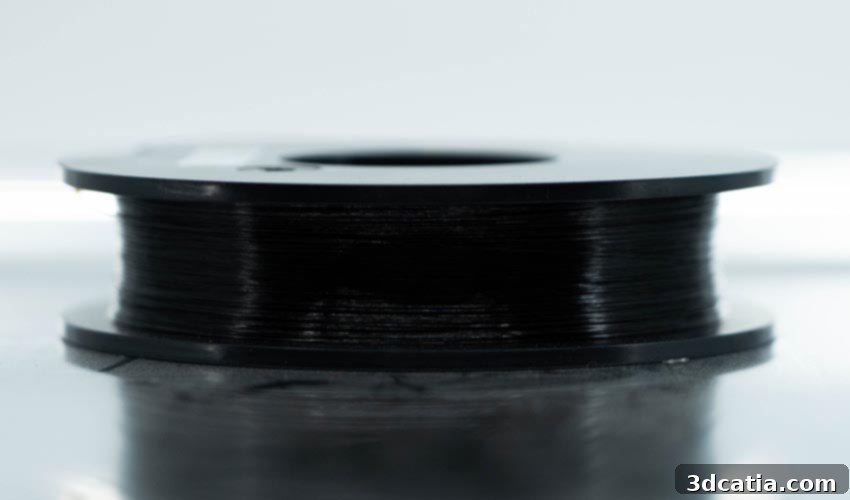
Unlocking Advanced Manufacturing: The Definitive Guide to 3D Printed Carbon Fiber Composites
The landscape of design and manufacturing has been profoundly reshaped by the advent of 3D printing, ushering in an era of unprecedented innovation. Among the most exciting developments is the emergence of 3D printed carbon fiber composites, which are now opening up an entirely new realm of engineering possibilities. Carbon fiber, a material originally conceptualized by Joseph Swan in 1860, is characterized by its fundamental composition: long, interconnected chains of carbon atoms. These microscopic fibers typically boast a diameter ranging from five to ten micrometers, with their length varying significantly based on the specific application for which they are designed. This comprehensive guide delves deep into the contemporary utilization of carbon fiber in additive manufacturing, offering invaluable insights into its diverse applications, the leading manufacturers pioneering this material in various forms (including advanced filament), and the compelling reasons behind its rapidly expanding adoption across numerous high-stakes industries.
Understanding Carbon Fiber Properties: Strength, Stiffness, and Lightweight Design
It is crucial to understand that raw carbon fibers are almost never used in isolation. Instead, they are meticulously engineered into composites by being combined with other materials. In the context of 3D printing and advanced manufacturing, these are specifically known as carbon fiber-reinforced materials. At their core, these composites consist of a matrix material—most commonly a polymer, though non-polymeric substances such as ceramics can also be employed—to which the carbon fibers are strategically added. This fusion leverages the best attributes of both components, creating a material far superior to its individual constituents.
The paramount advantage of these composites lies in their ability to facilitate the manufacturing of components that are not only significantly stronger but also remarkably lighter, all while exhibiting heightened rigidity. When compared to virtually all other 3D printed plastics, the mechanical properties of 3D printed carbon fiber composites stand out, particularly in terms of their exceptional toughness and superior temperature resistance. This combination of attributes makes them indispensable for applications demanding high performance under strenuous conditions.
Types of Carbon Fiber Reinforcement in Filaments
One of the most common ways carbon fiber is integrated into 3D printing is through the use of **short carbon fibers**. These segments, typically less than a millimeter in length, are expertly blended with a thermoplastic base material to create reinforced filaments. A wide array of popular filaments are available with these carbon fiber fillers, including PLA, PETG, nylon, ABS, and polycarbonate. The addition of these fibers imparts exceptional strength and stiffness to the filament, while simultaneously contributing to a reduction in the overall weight of the printed part. This makes them ideal for semi-structural components where improved mechanical properties are desired without the complexity of continuous fiber printing.
Over time, carbon fiber has cemented its popularity across diverse industries, largely owing to its extraordinary intrinsic properties. These include high stiffness, remarkable tensile strength, extremely low weight, excellent chemical resistance, an impressive capacity to withstand high temperatures, and very low thermal expansion. To put its strength into perspective, pure carbon fiber is an astounding five times stronger and twice as stiff as steel, despite being significantly lighter. Such a compelling combination of characteristics makes carbon fibers exceptionally well-suited for a myriad of applications where material properties are critical for optimizing performance. This is particularly true in demanding sectors like aerospace, automotive, military and defense, marine, and civil engineering, among many others, where efficiency, durability, and weight reduction are paramount.
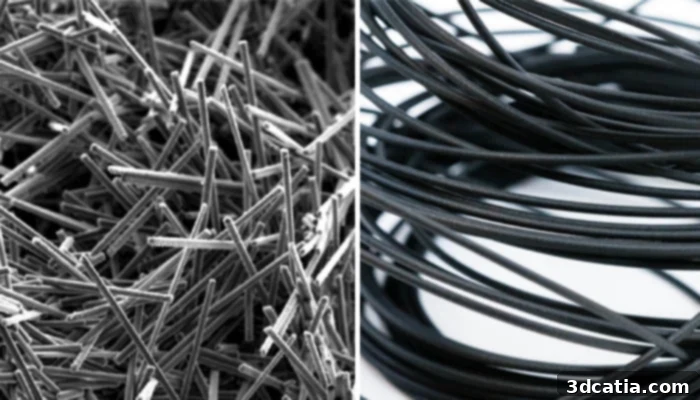
Carbon fiber segments are incorporated into the filament for reinforcement (photo credits: Markforged)
Carbon Fiber 3D Printing: Techniques and Considerations
When it comes to 3D printing with carbon fiber filaments, the foundational requirements for the 3D printer generally align with those of the base thermoplastic material they are combined with. However, a critical distinction arises due to the abrasive nature of carbon fibers. These fibers can cause rapid wear and potential blockages in standard brass nozzles, prompting experts and manufacturers to strongly recommend the use of a hardened steel nozzle or other abrasion-resistant nozzle materials. Furthermore, it’s worth noting that if the carbon fiber content within the filament surpasses a certain threshold, it can sometimes compromise the surface finish of the 3D printed object, leading to a slightly rougher texture. Proper filament drying is also essential to prevent moisture absorption, which can further degrade print quality and part strength.
In the expansive realm of additive manufacturing, carbon fiber can be effectively utilized in two principal ways: through carbon fiber reinforced filaments (chopped fibers) or via continuous carbon fiber reinforcement. While carbon fiber filament, reinforced with chopped fibers, already offers significantly greater strength compared to unreinforced thermoplastics, an even higher level of mechanical performance can be achieved through the alternative technique of continuous carbon fiber reinforcement. This distinction is vital for engineers and designers seeking to optimize part performance for specific demanding applications.
Chopped vs. Continuous Carbon Fiber: A Deeper Dive
Chopped carbon fiber filaments are produced by blending short, cut segments of carbon fiber (typically 0.1-1 mm long) directly into the polymer matrix. These filaments are relatively easy to print on standard FDM (Fused Deposition Modeling) machines with the appropriate nozzle, making carbon fiber reinforcement accessible to a broader range of users. They offer improved stiffness, strength, and dimensional stability compared to unreinforced plastics, making them excellent for functional prototypes, jigs, fixtures, and semi-structural components. However, the short fiber length means that load transfer efficiency between fibers is limited, resulting in mechanical properties that are enhanced but not reaching the full potential of carbon fiber.
Conversely, the continuous carbon fiber reinforcement method represents the pinnacle of composite 3D printing strength. This advanced technique typically involves the use of specialized 3D printers equipped with two distinct nozzles: one dedicated to extruding the thermoplastic filament that forms the part’s bulk structure, and the other extruding a continuous strand of carbon fiber. Since the continuous carbon fiber is not cut into smaller segments but rather laid down intact along stress lines, it retains a far higher level of inherent strength and stiffness. This uninterrupted fiber path allows for highly efficient load transfer, mirroring the performance of traditionally manufactured composites.
The advantages of continuous carbon fiber 3D printing are truly remarkable. Parts produced with this method are robust enough to effectively substitute aluminum components, often weighing only half as much. This significant weight reduction, coupled with comparable or even superior strength, is a game-changer for many industries. In fact, many 3D printer manufacturers assert that this technology can even replace traditional metal 3D printing in certain applications, primarily due to its compelling cost-effectiveness and faster production times. Furthermore, the strategic placement of continuous carbon fiber—guided by sophisticated additive manufacturing design techniques and simulations—allows engineers to further enhance the strength and performance of a part precisely where it’s needed most, all while minimizing overall material consumption and reducing part weight. This targeted reinforcement capability unlocks unprecedented design freedom and material efficiency.
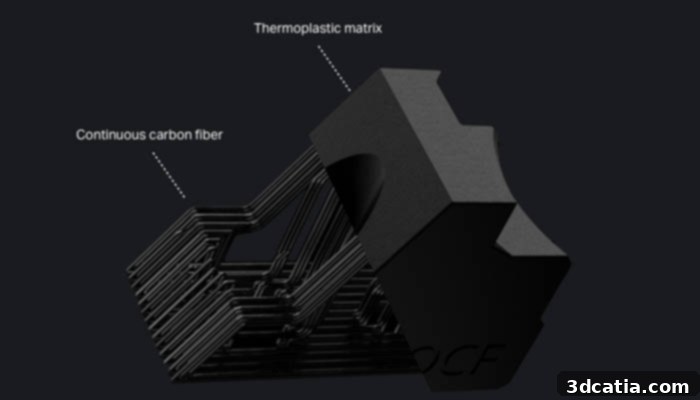
This part shows how continuous fiber 3D printing can add strength to a plastic part (photo credits: Markforged)
Diverse Applications of 3D Printed Carbon Fiber Composites
Historically, carbon fiber composites have been the material of choice for structural design in applications where every gram matters, and where added weight directly translates to higher life-cycle costs or compromised performance. Traditionally, these composites have been utilized to manufacture an impressive array of high-performance products, including lightweight bicycle frames, robust aircraft wings, efficient propellers, and critical automotive components. Given the myriad benefits of carbon fiber, it is no longer just traditional manufacturing systems that leverage its exceptional properties; additive manufacturing is rapidly catching up and expanding its reach.
Transforming Industries with Additive Manufacturing
In recent years, a growing number of 3D printing companies have been at the forefront of offering sophisticated carbon fiber reinforced materials and cutting-edge printing technologies. These innovators have meticulously developed the capabilities to work with these advanced composites, enabling a new generation of high-performance applications. 3D printed carbon fiber parts are uniquely positioned to withstand extreme temperatures, exhibit high chemical resistance, and facilitate the rapid creation of customized, geometrically complex shapes with unparalleled efficiency. Furthermore, by bypassing conventional machining or molding processes, additive manufacturing significantly simplifies and accelerates the production of custom parts, on-demand spare parts, and highly functional prototypes, leading to substantial cost and time savings.
- Aerospace and Defense: The demand for lighter, stronger components that can withstand extreme conditions is paramount. Carbon fiber 3D printing enables the production of custom brackets, drone components, interior parts, and even tooling with significant weight savings and performance improvements.
- Automotive Industry: From high-performance racing components to lightweighting initiatives in electric vehicles, 3D printed carbon fiber offers solutions for custom intake manifolds, body panels, structural reinforcements, and tooling that improve fuel efficiency and overall vehicle dynamics.
- Sports and Recreation: Custom sporting equipment, such as bicycle frames, golf clubs, and athletic gear, benefits immensely from the strength-to-weight ratio and design flexibility offered by carbon fiber 3D printing, enabling performance optimization for individual athletes.
- Industrial Tooling and Fixtures: Manufacturing aids like jigs, fixtures, and end-of-arm tooling for robots can be rapidly produced with carbon fiber composites, offering high strength, reduced weight for easier handling, and excellent dimensional stability compared to traditional plastic tooling.
- Medical and Prosthetics: Customized prosthetic limbs, orthotics, and medical devices can be tailored precisely to a patient’s needs, leveraging the lightweight and durable properties of carbon fiber for enhanced comfort and functionality.
The potential growth of this market is substantial. In their influential report, “3D Printing Composites 2020-2030,” IDTechEx projects that the global 3D printing composites market is poised to reach an impressive value of $1.7 billion by 2030. While this figure encompasses a broader range of composites, including materials reinforced with fiberglass or other plastics, the overarching trend unequivocally indicates that the additive manufacturing industry is increasingly integrating all types of advanced composites, especially carbon fiber, into its production activities. This growth underscores the material’s criticality in the ongoing evolution of advanced manufacturing.
In summation, 3D printed carbon fiber parts are exceptionally versatile, proving invaluable across an expansive spectrum of applications. They are inherently tough, remarkably lightweight, and demonstrate superior resistance to impacts, heat, and corrosive chemicals. For example, highly engineered 3D printed parts crafted from plastic and carbon fiber composites are fully capable of enduring the intense heat generated by automobile and aircraft engines, offering a high-performance alternative to traditional materials. Moreover, these advanced composites can effectively replace traditionally machined aluminum parts and complex manufacturing fixtures, often at a lower cost and with greater design flexibility. Their ability to deliver high performance in challenging environments makes them a cornerstone of modern engineering.
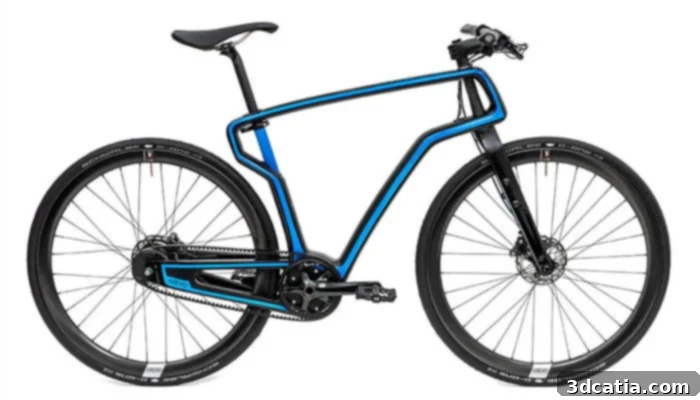
The body of this bicycle frame is made of carbon fiber | Credits: Arevo
Leading Manufacturers and Pricing in the Carbon Fiber 3D Printing Market
The rapid advancements in carbon fiber 3D printing have given rise to several key players in the market, each offering proprietary technologies that enable the continuous printing of this advanced material. Companies like Markforged lead the way with their patented “Continuous Filament Fabrication” (CFF) technology, which precisely lays down continuous carbon fibers within a thermoplastic matrix. Similarly, Anisoprint has developed its unique “Composite Fiber Coextrusion” (CFC) process, allowing for optimized fiber placement and superior part strength. Additionally, 9TLabs has innovated an additional system, known as Additive Fusion Technology (AFT), which integrates seamlessly with conventional 3D printers to enhance their capabilities for composite production, offering a unique hybrid approach to high-volume composite additive manufacturing.
Advanced Carbon Fiber Filaments for Specialized Applications
Beyond continuous fiber systems, several specialized companies have focused on developing high-performance carbon fiber filaments specifically engineered for the most demanding technical applications. These filaments often utilize high-performance polymers such as PEEK (Polyether Ether Ketone) or PEKK (Polyether Ketone Ketone) as their base materials. As a result, they deliver not only exceptional benefits like enhanced durability, superior mechanical, and chemical performance, but also a significantly improved strength-to-weight ratio. Printing with these advanced polymers requires specialized equipment; parameters need to be carefully adjusted, as these materials typically demand extruders capable of reaching temperatures around 400°C, along with 3D printing systems equipped with actively heated build chambers and heated print plates to ensure optimal layer adhesion and prevent warping. Prominent manufacturers of such high-performance carbon fiber filaments include industry leaders like Roboze, 3DXTech, ColorFabb, Markforged (also offering chopped fiber filaments), Kimya, Intamsys, Zortrax, and numerous others who are continually pushing the boundaries of material science in additive manufacturing.
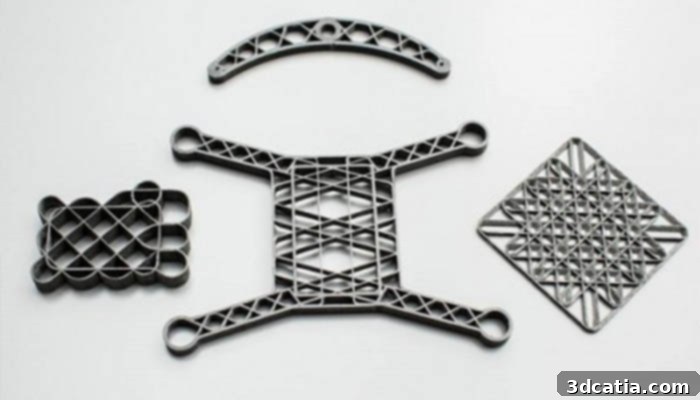
Using design techniques, it is possible to reinforce a part | Credits: Anisoprint
Emerging and Alternative Carbon Fiber 3D Printing Technologies
Stepping away from the more familiar extrusion processes, one particularly intriguing technology is AREVO’s patented approach, which is based on a specialized form of Direct Energy Deposition (DED) technology. This innovative method involves using a precisely controlled laser to simultaneously heat both the thermoplastic filament and the continuous carbon fiber, while a roller then compresses the two together, ensuring optimal consolidation and bonding. This allows for highly localized reinforcement and excellent material properties. Other notable players like Impossible Objects and EnvisionTEC (now ETEC) have also integrated systems for continuous fiber 3D printing into their impressive lineup of machines, though their technology differs somewhat. They typically employ a unique lamination process, weaving sheets of carbon fiber into the print layer by layer, then infusing them with a polymer matrix. Lastly, Continuous Composites pioneers a fascinating hybrid technology where the fiber yarn is saturated with resin and then instantly cured with UV light, bearing conceptual similarities to stereolithography (SLA) 3D printing. This diverse range of technologies underscores the rapid innovation and significant investment in the carbon fiber additive manufacturing space, driving down costs and expanding capabilities.
The pricing of carbon fiber materials and 3D printers varies significantly based on the type of carbon fiber (chopped vs. continuous), the base polymer used (standard vs. high-performance), and the sophistication of the printer itself. While chopped carbon fiber filaments are relatively affordable and accessible, continuous carbon fiber systems and high-performance PEEK/PEKK filaments represent a more substantial investment, justified by their unparalleled mechanical properties and suitability for critical applications. However, as the technology matures and adoption increases, we anticipate a gradual reduction in costs, making these advanced materials more accessible to a wider industrial base.
What are your thoughts on the transformative potential of 3D printed carbon fiber? Have you embarked on any projects leveraging this incredible material, perhaps for lightweight drones, custom automotive parts, or even sustainable initiatives like coral restoration in your area? We’d love to hear your experiences! Let us know in a comment below or connect with us on our Linkedin and Facebook pages. Don’t forget to sign up for our free weekly Newsletter here to get the latest 3D printing news delivered straight to your inbox! You can also find all our insightful videos on our YouTube channel.